
2026 Yamaha R7 Vs Honda CBR650R: Performance Specs Comparison
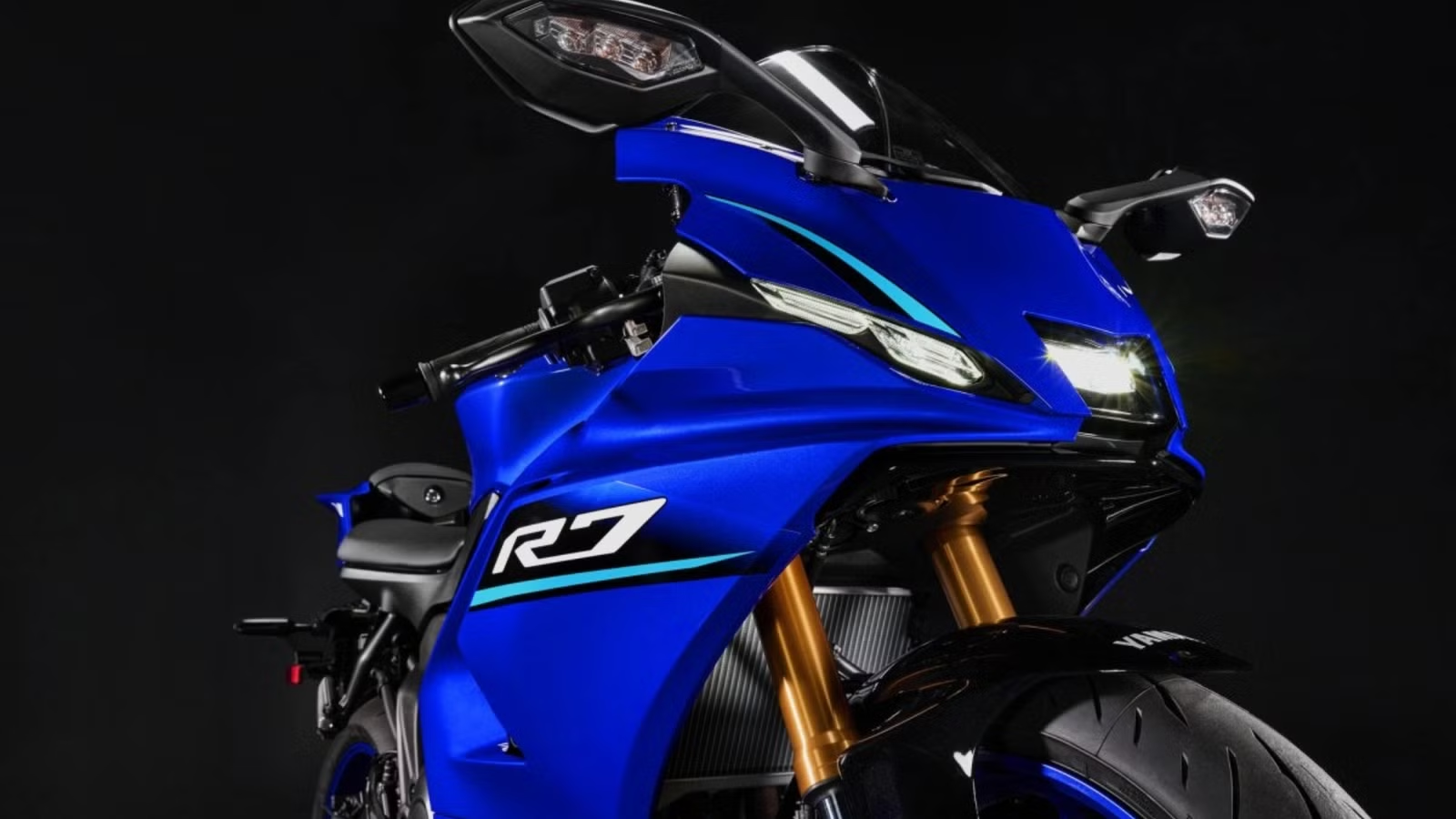
Put a 2026 Yamaha R7 and Honda CBR650R next to each other and the decision looks deceptively simple. The Honda has four cylinders and considerably more peak power, while the Yamaha counters with less weight, a torquey CP2 twin and a chassis aimed squarely at riders who live for the next corner. They’re also separated by just $200 before destination charges.

But horsepower doesn’t tell the entire story here. The R7 has received some serious upgrades for 2026, while the CBR650R remains one of the increasingly rare ways to put a high-revving naturally aspirated inline-four between your legs for less than $10,000. Choosing between them ultimately comes down to where you ride and what you want your sport bike to do.
That said, let’s break down the 2026 Yamaha R7 and the Honda CBR650R across the five performance specs that would actually define how these bikes ride, and not just how they look on paper. When you’re done reading, get up and go test ride both to feel the love yourself.

The R7 And CBR650R Take Completely Different Roads To Performance
|
Feature |
2026 Yamaha YZF-R7 |
2026 Honda CBR650R |
|---|---|---|
|
Engine |
689cc Liquid-cooled parallel twin (CP2) |
649cc Liquid-cooled inline four-cylinder |
|
Power Output |
72 hp @ 8,750 rpm |
95 hp @ 12,000 rpm |
|
Torque |
51.2 lb-ft @ 6,500 rpm |
47.2 lb-ft @ 9,500 rpm |
|
Transmission |
6-speed; Assist & Slipper clutch |
6-speed; Honda E-Clutch |
|
Wet Weight |
417 lbs |
466 lbs |
|
Seat Height |
32.7 in |
31.9 in |
|
Fuel Capacity |
3.7 gal |
4.1 gal |
|
Suspension |
Front: 41mm USD fork (Fully Adj.) Rear: Monocross shock (Adj. preload/rebound) |
Front: 41mm Showa SFF-BP USD fork Rear: Showa Monoshock (Adj. preload) |
|
Brakes |
Front: Dual 298mm discs (Radial) Rear: 245mm disc; Cornering ABS |
Front: Dual 310mm discs (Radial) Rear: 240mm disc; 2-channel ABS |
|
MSRP |
$9,399 |
$9,199 |
Most of the time, when either of these two bikes is searched for online, the search is about their engine architecture. Now, let’s try to quench the argument you’ve been having with every other biker at the gas station. The Yamaha R7 uses a 689cc CP2 parallel-twin engine while the Honda CBR650R is fitted with a 649cc inline-four engine. These engines represent fundamentally different philosophies. This is the heart of the story.

The 689cc parallel-twin of the Yamaha R7 is torquier, has a more accessible power curve, and is great for mid-range punch. On the other hand, the 2026 Honda CBR650R’s 649cc inline-four engine is revvier, produces higher peak power with its 95 horsepower output exceeding the 2026 Yamaha R7’s 73 horsepower, and is smoother at high RPM. With Yamaha’s higher cc, one would have expected it to have a higher peak power than the Honda, but the CBR makes more power thanks to the smaller displacement from its four cylinders.
In the real world, each engine produces a much different character trait. The R7 is more muscular of the two, while the CBR650R is a screamer. Long story short, is the CBR650R more powerful than the R7? Yes, by approximately 23 horsepower at peak. It’s like the story of the sprinter vs. the long-distance runner; both bikes are crazy fast, but with different styles.
Nearly 50 Pounds Separate These Two Sport Bikes

Horsepower might favor the Honda, but Yamaha takes a massive swing back once you put the motorcycles on a scale. The 2026 R7 weighs 417 pounds wet. Honda lists the CBR650R E-Clutch at 466 pounds curb, leaving a substantial 49-pound difference between them. Less mass makes the R7 easier to transition from side to side, easier to manage during aggressive riding and generally more eager to change direction. Yamaha went even further for 2026, revising the R7’s high-tensile steel frame and asymmetrical swingarm while adding lighter SpinForged aluminum wheels. The new wheels reduce unsprung weight and rotational inertia, precisely the places where shedding pounds can make a motorcycle feel more responsive.

Honda’s additional weight isn’t automatically a disadvantage, though. The CBR650R isn’t pretending to be a stripped-down race replica. It’s balancing sporting ability against everyday usability, and that distinction becomes increasingly important the farther you ride from your favorite canyon road. The difference also changes how we’d approach these bikes as newer riders. The Honda has the lower seat at 31.9 inches versus 32.7 inches for the Yamaha, but seat height alone doesn’t determine whether a motorcycle will feel manageable. Rider inseam, seat width, suspension sag and, critically, the motorcycle’s overall weight all contribute to how confidently someone can handle it at a stop. Sit on both before buying. That tells you considerably more than an inseam chart ever will.
Braking And Suspension — Which Bike Stops (and Corners) Like It Means Business

For any sports vehicle, whether it’s a bike or a car, stopping power and chassis dynamics directly shape the rider’s confidence as well as lap times. It’s a core performance metric for sport bike buyers. The 2026 Yamaha R7 is fitted with a Brembo radial master cylinder braking system: dual 298mm front discs with radial-mount calipers for the front and a single 245mm hydraulic disc for the rear. It also uses KYB fully-adjustable inverted forks.
In comparison, the 2026 Honda CBR650R is fitted with a Nissin braking system: dual 310mm floating front discs and radial-mounted four-piston calipers in the front, which are larger than the R7’s 298mm rotors, and a single 240mm hydraulic disc and a single-piston hydraulic caliper in the rear. The Showa SFF-BP forks typically offer zero adjustability compared to the KYB system on the Yamaha, though the Honda’s larger rotors provide slightly more bite.
For suspension, the Yamaha R7 is fitted with a linked-type monocross shock, which is designed for a more aggressive, track-ready response, compared to the Pro-Link rear suspension system used on the Honda CBR650R, which is meant to offer riders a “plush” and comfortable ride suitable for long-distance sports touring. That makes the Honda the more plausible option for long-distance riding. ABS is standard on both bikes.
Power Delivery And Rideability — Which Bike Rewards the Rider More

Raw horsepower numbers aside, it is also important to discuss how the power is delivered on the road; this very importantly shapes the entire riding experience. Imagine a rider on a canyon road trying to navigate a corner, or a rider on the street trying to overtake a slow-going truck. This is where usable power matters more than just peak power. The Yamaha R7 has a torque advantage at lower RPMs. It produces 50.2–51.2 lb-ft of torque at 6,500 rpm, which is easier to use on the street, compared to the CBR650R’s peak torque of 46.4–47.2 lb-ft at a higher RPM of 9,500 rpm, only rewarding riders who work the rev range.

On the R7, the Lean-Sensitive Traction Control (TCS) system knows how far the bike has leaned and will adjust power more precisely to prevent slides. The CBR uses the Honda Selectable Torque Control (HSTC) system, which isn’t lean-angle sensitive, but effectively reduces rear-wheel slip on various surfaces. It also uses Honda’s E-Clutch system, which eliminates the need to touch the clutch lever, allowing you to start, stop, and change gears using only the foot pedal. The R7 uses the 3rd Gen Quickshifter (QSS) system to provide something similar.
The R7 has better fuel efficiency, producing 10 MPG more than the CBR’s best-case scenario of 49 MPG. Its 3.7-gallon fuel tank gives it 30 more miles of driving per fill-up compared to the 190 miles you’d get on the CBR’s 4.1-gallon tank. That said, maintenance is a different ball game. The Yamaha requires oil changes in 4,000 miles or every six months, while the Honda gives you 8,000 miles of riding between oil changes. However, Honda’s inline-four engine is more expensive to repair, though the less frequent service intervals help offset the cost.
Hondas are typically better known in the bike world as comfort machines. The 2026 Honda CBR650R feels like the better everyday option due to its comfort on the road and reliability, but the 2026 Yamaha R7 is the enthusiast’s choice for spirited canyon carving. So, is the Yamaha R7 good for beginners compared to the CBR650R? That depends on whether your poison is the track or the street.
Price Vs. Performance — Which Bike Gives You More Bike for the Money

When all metrics have been considered, the next thing to check is the price. Value-for-money always rounds out the performance conversation. The 2026 Yamaha R7 has an MSRP of $9,399. The 70th Anniversary Edition has an MSRP of $9,699. Destination charge adds $675 to the MSRP. On the other hand, the 2026 Honda CBR650R has an MSRP of $9,199, with destination charges adding $600 to the MSRP. While the R7 delivers more torque, lighter weight, and Yamaha’s motorsport pedigree, it costs just over $10,000 with destination charges at its cheapest point. Meanwhile, the Honda CBR650R delivers more peak power, a more refined inline-four engine, and Honda reliability for $9,799.
Sources: Honda, Yamaha

Related posts
Latest Post


No Comments