
The First Production Chevrolet To Wear The SS Badge
One of the last known Chevrolet muscle cars to have been adorned with the SS badge was the outgoing Chevrolet Camaro. It’s rumored that there is a new Chevrolet Camaro on the horizon. There’s also speculation about how many doors it has, whether it will be a coupe or a four-door sedan. All of that to say, the Super Sport badge has been Chevrolet’s longest-running performance icon and has been worn by everything from a Chevelle to a Nova and even an Impala.

Wouldn’t you believe it, it actually didn’t first appear on a mass-produced muscle car? It actually came about through a vehicle that you couldn’t purchase. Of course, that only leads to one thing: a concept car. This concept car was shown in 1956 and was put to the test in March 1957. Then, there was one 1961 model that finally wore it in a mass-produced style.
How A One-Off Race Car At Sebring Started It All
Even more surprising, the first SS technically wasn’t even a muscle car. Louis Chevrolet was a race car driver and a mechanic. He had been into racing long before the SS badge even existed. There was also a kit that you could purchase for your car to wear and give the feeling that it was more than just a normal everyday car.
The Badge Was Designed To Make Any Chevy Feel Like A Racer


The name “Super Sport” was meant as an epithet to help bolster the appearance and performance of the vehicle. Everything was turned up with bolder styling, more advanced racing-style tech, and interior features that helped drive the point home. The first car to wear it, however, was one of a kind.
Chevrolet Built One Corvette SS, Raced It At Sebring, And Never Made Another

While the Corvette had already debuted in 1953 as a two-door coupe roadster, there were a few concept cars that were made from the Corvette itself. The first concept car that Chevrolet ever made was based on their already-in-production Corvette and was called the 1954 Chevrolet Corvette Corvair Concept.
Then, they made an even more exclusive one-off version of an already special vehicle, the 1957 Chevrolet Corvette SS. This was a low-slung roadster that actually raced for 12 hours at Sebring in March 1957.
How A $53 Option Kit Made Automotive History

While technically the Corvette was already in production, and a one-off version did carry that name badge, there was really only one car that started it all.
Why Only 453 Of 491,000 1961 Impalas Earned The SS Badge

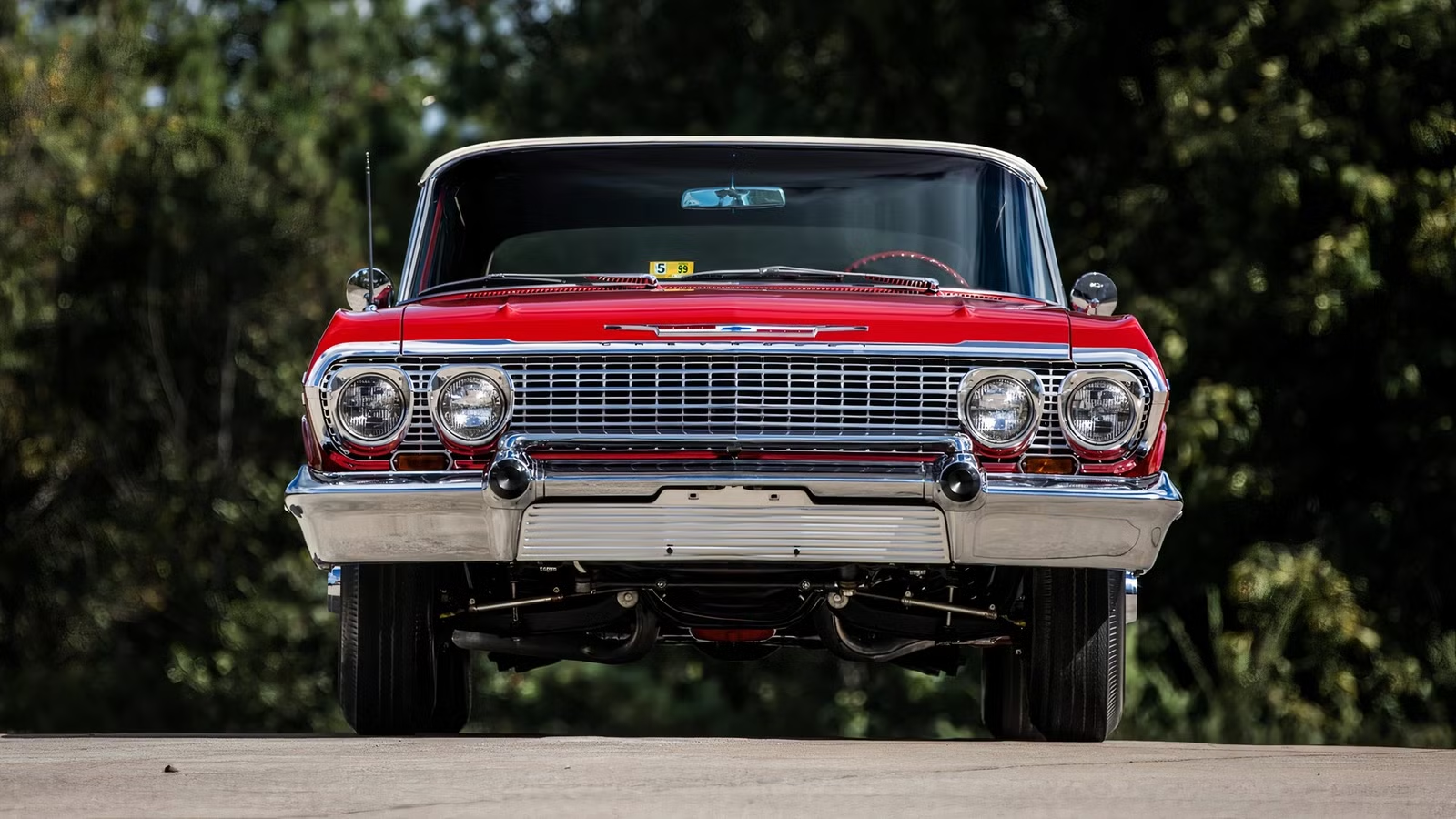
is the first to ever wear it publicly. Chevrolet also didn’t make very many of them, as there were only 453 units built with these modifications. There was a column-style tachometer, unique body styling, upgraded power brakes, and a better suspension.
When the Chevrolet Impala first came out, Chevrolet had been in business for almost 50 years at this point. Chevrolet came around in 1911, and by 1958 came the one-year-only 1958 Chevrolet Bel Air Impala Sport Coupe. It was considered the top of the line Bel Air and was already “sporty” out the gate.
The second generation was when it really came into its own. By the third generation, in 1961, Chevrolet finally decided to offer it with the SS kit. The kit was referred to as RPO 240 and was made to market the new 409 engines. Out of 491,000 Impalas made in 1961, only 453 had this option.
Power Brakes, A Safety Bar, And A Tachometer — All for Under $55

If you can believe it, the kit only cost $53.80 in 1961. Adjusted for inflation, however, this amounts to about $600 in today’s money. That’s still really not a lot for what you would get in this kit. It came with power steering, power brakes, metallic linings, wheel covers, a floor console, and a passenger safety bar, and more.
If you wanted this package, you had to have at least the 348 V8 or higher. Any old Impala couldn’t have this. The Impala of this generation also had so many different engines to choose from, from a smaller in-line six to a monstrous 6.7-liter V8. But knowing what came in the box is one thing — understanding what those engines actually did on the street and against Ford’s best is another.
Specs And The Scrimmage

The 1961 Chevrolet Impala SS was not only an extremely long vehicle with an overall length of 209 inches, but it was also extremely powerful with a few engines to choose from. Before getting into the engines, however, it is interesting to note that these were actually fairly lightweight vehicles, even though they were humongous. Depending on the body style and the engine, it could weigh anywhere from 3600 pounds to 3,750 pounds. The suspension was a three-link coil spring system on the rear axle, with upgraded heavy-duty shock absorbers and springs included in the $53 SS package.
348 And 409

As stated previously, if you want to opt for the SS package, you have to choose one of the more powerful engines out of the number to choose from. The primary engine option was a 348-cubic-inch, or 5.7-liter, V8. These could make anywhere between 305 horsepower to 350 horsepower depending on what kind of thrust it had.
Torque ranged from 350 pound-feet up to 364 pound-feet. A three-speed manual transmission was standard, but a four-speed manual that was mounted to the floor was more preferred by customers. There was also a two-speed automatic transmission, which seems remarkably limited by modern standards. Depending on what engine you had, you could achieve zero to 60 miles an hour between 6.7 and 7.8 seconds.
Competition With Rivals

At this point in the automotive industry, the horsepower wars had already been in full swing and lasted until the ’70s, when the fuel crisis caused most high-powered cars to shed horsepower. Technically, the 409 big-block engine made by Chevrolet was a direct response to the Ford 390 engine. Although it didn’t have nearly as much power as the 390 (375 horsepower), its 6.7-liter displacement was enough for buyers to want and respect it. Later, the engine did end up outdoing Ford’s engine in power output, with 425 horsepower on offer.
The Longstanding Legacy

The SS badge has spanned decades as well as continents. There have been SS-badged Chevrolets in countries like Australia, Argentina, South Africa, Brazil, and even parts of the Middle East. Finding a genuine 1961 409 Impala SS is incredibly difficult, but not terribly expensive. The SS badge showcases the fact that you could take an average everyday kind of car and turn it into an aggressive street eating machine. Probably the three most prominent applications of the SS badge have been on the Chevrolet Camaro, the Chevrolet Chevelle, and the Chevrolet El Camino, along with the Impala.
Values Of A ’61 Impala SS

If you look at Classic.com, you can see that the range of value varies wildly depending on the year, the condition and the mileage. They’ve gone for as low as $25,000, as well as over $200,000. According to the Newport Car Museum, there are really only between five and 10 iterations of this variant that actually remain. According to classic.com, there were only two original 409 sales between 2021 and 2026, selling for $137,500 and $66,000 respectively.
Modern Variants

From a modern standpoint, there have been a number of legacy vehicles that have received the SS badge still to this day, like the Impala and Monte Carlo, which were introduced in the early 2000s and beyond. There were also some questionable choices, like the Cobalt SS and the HHR SS. Most notable of all, however, is the fact that they made two dedicated models that wore the badge as the moniker in some form or fashion. First, there was the Chevrolet SSR, which was a half pickup truck, half hot rod El Camino callback. It ended up with a less powerful engine than buyers wanted.
Then, for the 2014 model year, there came the dedicated Chevrolet SS. This was based on the Australian-market Holden Commodore SS and was essentially the pinnacle of badge engineering. Since the 2010s, there haven’t been many vehicles to wear the SS badge, except recently with the Chevrolet Blazer EV SS trim. This features a red interior with red accent stitching and a more aggressive power output, allowing it to achieve zero to 60 mph in 3.4 seconds.
Sources: Chevrolet, Hagerty, Hemmings

Related posts


Latest Post


No Comments