
The Retro Kawasaki Cruiser That Nailed Heritage Styling A Decade Too Early
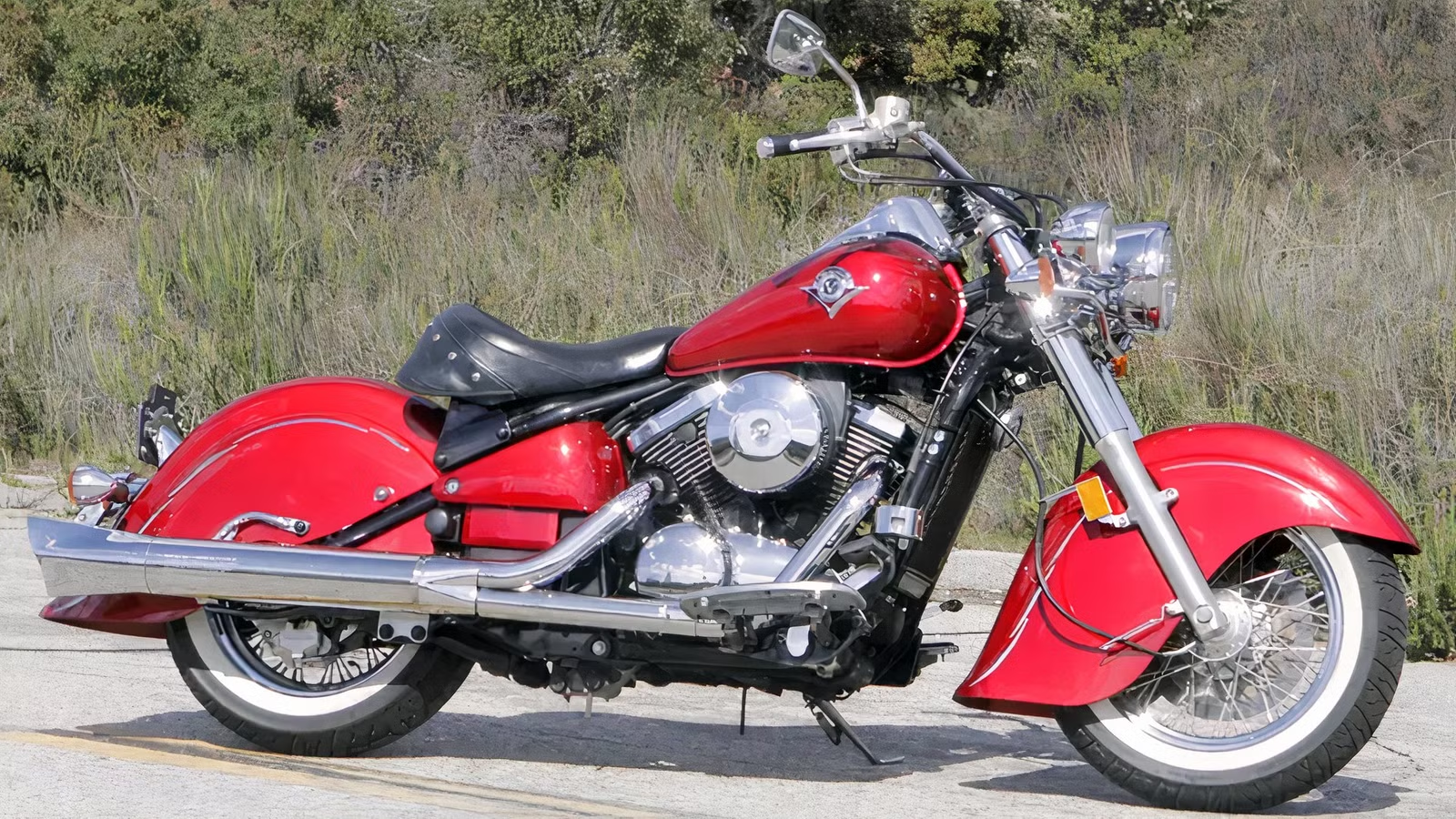
Kawasaki is part of a business conglomerate, like quite a number of other Japanese and Korean brands. As such, it has never been content to simply follow trends. Look back through its history, and you’ll realize that it had the world’s first turbocharged motorcycle on its side. Its bikes have always competed for top-speed honors in production motorcycles when that was a thing, and it also developed the largest-displacement V-twin engine ever put into a production motorcycle, until an extremely limited-run Harley-Davidson took the title from it two decades later.
Kawasaki Isn’t About Engineering Only – It Also Has Distinctive Design

When Kawasaki puts its mind to it, it can develop some very distinctive motorcycles. The Z1-R started the trend of razor-sharp edges in 1978, when everyone else was releasing motorcycles with curved lines. The Vulcan 2000 was not just larger than life; it was the first motorcycle to put four projector units in a single circular chrome headlamp. And in the middle of the 2010s, the Z1000 got Sugomi styling, which again made it stand out from the competition. And of course, even a decade after its launch, the Ninja H2 is instantly recognizable.
The Cruiser Segment Can Be A Tough Nut To Crack, Styling-Wise

The cruiser segment can be a contradiction at times. Customers in this segment usually do not like change; sometimes they can’t get enough of it. Today, there’s a very strong preference for factory bobbers and neo-retro-looking cruisers that echo old styling cues. Twenty years ago, at the turn of the millennium, this wasn’t the case. Everyone wanted bigger engine capacities housed in ultra-modern-looking cruisers. This meant that those that chased traditional styling cues like they had since the 1970s were out of sync with the times.
Kawasaki Was One Of The Hardest Hit Because Of This

It can’t be an easy job being a manufacturer, because putting out a new product means going through design, research and development, and validation testing before putting it on sale. You quite literally have to predict the future when you develop a new product. Sometimes you get it very right; sometimes it goes very wrong. For Kawasaki, the early 2000s had it shutting down a product that went quite wrong, not because it was too late, but because it was way before its time! Here is the story of the retro Kawasaki cruiser that nailed heritage styling a decade too early.

The Kawasaki Vulcan 800 Series Is The Retro Kawasaki Cruiser That Nailed Heritage Styling A Decade Too Early

The Vulcan 900 is familiar to all of us. It is a product that is on sale even today, and it is available in three distinct variants: the cruiser, the factory-custom drag bike, and the light tourer that feels made for 500-mile days. This template was originally introduced with the Vulcan 800 series that was launched in 1995, and that the Vulcan 900 series replaced. This earlier Vulcan series also had three distinct variants. This entire lineup was officially discontinued in 2006 with the advent of the Vulcan 900, but it started disappearing off marketing material in 2004, which suggests that production had stopped long before the replacement came out.
The Engine That Could Out-Torque Harleys Without The Harley Reliability Tax

For a mid-size cruiser aimed squarely at Harley buyers, the VN800’s engine had to be convincing — and on paper, it was. The VN800, which was liquid-cooled, had a 55-degree V-twin with single overhead camshafts and four valves per cylinder. It displaced 805 cc, had a compression ratio of 9.5:1, and made 52 to 56 horsepower at 7,000 rpm and 47.2 pound-feet of torque at 3,300 rpm.
This was then fed through a five-speed gearbox, which had Kawasaki’s Positive Neutral Finder, but unlike the VN900, this had a chain driving the rear wheel. The chain and the carburetor would probably make it a little unrefined compared to the 900, which feels more refined than expected.
The VN800 Debuted The Hidden Rear Suspension That The Vulcan 900 Still Uses Today

The chassis was similar to the Vulcan 900, although the VN800 is the one that debuted the hidden rear suspension. This is a double-cradle frame with 41 mm telescopic forks at the front and a Uni-Trak monoshock linkage-type rear suspension hidden under the seat. The rear has a seven-step preload adjustment, and the suspension travel available is 5.9 inches at the front and 3.9 at the rear.
All variants used 16-inch rims except for the VN800A, which used a 21-inch rim. All of them were spoked. However, they all had a single 300 mm disc brake at the front with a two-piston floating caliper. The rear brake, though, is a 180 mm drum brake. It has a 63-inch wheelbase (Classic), a four-gallon fuel tank, and weighs 575 pounds with a full tank of fuel.
Three Variants, Three Different American Icons To Fight

The VN800A debuted at $6,699 in 1995. It was designed to compete with the Harley-Davidson Softail Custom. This is noticeable in the kicked-out front forks and the large 21-inch spoke wheel. It had the good looks of an American V-twin cruiser, with the teardrop fuel tank, acres of chrome, and the hardtail rear appearance. This was a very custom look for the time, just as the Vulcan 900 Custom is the most aggressive-looking Japanese V-twin cruiser today.
The Vulcan 800 Classic Was Born To Fight Harleys

A year after the VN800A, the Vulcan 800 Classic was launched. As the name suggests, it traded in the factory custom or bobber look for a more standard cruiser look. It did this by replacing the large front wheel of the VN800A with a 16-inch spoked rim and fat tires. It also had valanced fenders, and that new smaller front wheel lowered the seat to 27.5 inches, which made it accessible to pretty much everyone. This was the Kawasaki that truly took the fight to Harley, because it had the looks, a much more reliable engine, and Harley-level performance without the Harley price.
The Vulcan 800 Drifter Was Designed To Compete With Indian

The Drifter was the third and final variant of Kawasaki’s 800 cc Vulcan series, and it had heavily valanced fenders that went all the way to the axles. It was a single-seater, and with the hardtail look, it resembled a vintage Indian Chief, much as the Indian Chief Vintage looks today. It also had fishtail exhausts, seen most recently on the original BMW R18. Back then, in the 1990s, there was nothing like the Vulcan Drifter on the market.
Great Styling, Wrong Timing For The VN800 Series

The 2000s were defined by everyone wanting bigger and larger engines in their cruisers. To illustrate, in the five years from 2001 to 2006, the following models were launched: the Honda VTX1800, the Honda Gold Wing GL1800, and the Suzuki Boulevard M109R, all three of which displaced roughly 1,800 cc.
There was the Yamaha Road Star Warrior that displaced around 1,700 cc, the Yamaha Raider or Stratoliner that displaced 1,854 cc, the Kawasaki Vulcan 2000 that displaced around 2,000 cc, and then there was the king of them all, the Triumph Rocket III, that displaced 2.3 liters.

What this meant is that the market for a mid-size neo-retro cruiser was very small at that point, and sales of the VN800 dropped so much that Kawasaki ultimately had to pull the plug on it by 2006. The marketing materials don’t mention it from 2004 onward, which itself is a clue that it took Kawasaki two years to clear out existing stock of the VN800 series.
The Market Sentiment Shift And What It Means For Us And The VN800

When Indian Motorcycle was revived in the early 2010s, there was a sudden shift in buyer sentiment toward cruisers with styling cues from heritage brands. This sentiment has only grown stronger over the years since, thanks to the Indian Chief Vintage and Indian Chief Vintage. Unfortunately, the VN800 series was discontinued a decade before Indian launched the revival so successfully.
What it means is that the VN800 becomes a great target for those who want a mid-size cruiser with heritage or vintage styling cues on a budget. There is no real alternative if you want to buy one new today, because the Scout Sixty series and the Harley-Davidson Nightster favor modern styling and cost a minimum of $9,999. You can source any of the VN800 models for less than $4,000, which means you can get a Japanese cruiser that is comparable to a Harley but for thousands less.
What Does One Need To Look Out For?

It is fair to assume that any Japanese motorcycle is reliable, and the Vulcan 900 has proven that it is a cruiser with Japanese reliability and American-bike presence. Even so, a VN800 series motorcycle today will be anything from two to three decades old.
Fuel delivery was via a single Keihin CV carburetor, which means all the rules that apply to old carburetors are in force here: you may need to clean the carb, get new jets, install new lines, and inspect for rust throughout. It has a chain drive, so you may need a new chain and sprocket kit, and cleaning, lubricating, and adjusting the chain will be a periodic reality of ownership.

Then there are the brakes. The setup is dated compared to today’s ABS-equipped cruisers and will be woefully inadequate, so plan your stopping distances accordingly. Finally, if you buy a Drifter, remember that it didn’t sell in large numbers, and unlike the chassis and driveline components, its body panels aren’t shared among thousands of VN800 cruisers, making them difficult to source. Either find one in pristine condition or make sure you have the resources to source a replacement panel should you need it.
Why The VN800 Makes For Such A Good Choice Today

The kind of money you’d spend on an authentic middleweight Japanese V-twin cruiser with genuine Harley-Davidson or Indian styling is less than the cost of a beginner cruiser bought new today. Sure, you might be required to be a little hands-on with the maintenance, but that’s exactly what you’d want from your motorcycle. If you are on a budget, it should look far more expensive than it is, ride well, and be easy to maintain — all things that the Kawasaki VN800 offers in spades.
Source: Kawasaki USA, Kawasaki Global

Related posts

Latest Post


No Comments