
The 10 Most Reliable Toyotas Ever Made
When it comes to cars and SUVs, Toyota has become the benchmark in the mainstream market. Since it sold its first vehicle in the U.S. in 1958, the Japanese marque has become a byword for everything tough, durable, easy to own, and long-living. Many of us, whether we are looking for our first vehicle or just want something we know will work, opt for Toyota.

The brand’s typically sensible engineering, top-tier quality control, use of proven and tested parts, and Kaizen philosophy have resulted in some of the most reliable vehicles ever. These ten models are the cream of the crop and are some of the most reliable Toyota vehicles ever made.
Toyota Highlander (First-Gen)
Family-Friendly Longevity
Built between 2001 and 2007, the first-gen Toyota Highlander may look a little dated today, but it more than makes up for it with longevity and reliability. At the heart of why it is dependable is that it shares its unibody chassis with the Camry, a chassis that was long proven and tested before it made its way into the SUV. You also get a choice of three engines, all of which are reliable. Between 2001 and 2007, a 2.4-liter 2AZ-FE inline-four good for 155 horsepower and 163 pound-feet of torque was available. It is low powered, but understressed.

Between 2001 and 2003, a 220-horsepower/220-pound-foot 3.0-liter 1MZ-FE V6 was available, and it featured a lightweight aluminum block, a closed-deck design, forged internals, and lightweight pistons, which cut down on friction. For 2004 to 2007 MYs, a 230-horsepower/242-pound-foot 3.3-liter 3MZ-FE V6 with VVT-i on the intake side only, conservative tuning, lack of an EGR valve, and cast-iron cylinder liners also provides smooth, dependable driving. iSeeCars says the Highlander has an average lifespan of around 173,000 miles with proper maintenance, but this is an average and not a ceiling.
Toyota Prius (Second-Gen)
Balancing Efficiency And Reliability

The Toyota Prius has always been an interesting vehicle in terms of reliability, especially the early generations, because it should be, in theory, more complicated and less reliable than models with naturally aspirated engines. However, the 2004 to 2009 Toyota Prius is equipped with a low-stress 110-horsepower 1.5-liter DOHC 1NZ-FXE inline-four mated with Toyota’s Hybrid Synergy Drive, and though that sounds like it adds complexity, the hybrid system actually helps.
The hybrid system handles slow-speed driving, so the engine doesn’t have to deal with stop-start shudder; there is no clutch or torque converter to go wrong; and regenerative braking means less wear on the brakes. Owners who left a review on Kelley Blue Book, all 947 of them to date, rate the second-gen Prius 4.8 out of 5 for reliability, and 95 percent said they would recommend buying one. One owner in the UK, Bob Old, racked up 435,000 miles in his ’04 Prius as of 2015, with regular servicing and diligent maintenance to thank.
Toyota Corolla (E120/E130)
Simple But Effective

According to the 2026 U.S. Vehicle Dependability Survey, the growing number of problems in modern cars is being caused by issues with phone connectivity, electric assistance under the hood, and infotainment systems. Something like the 2003–2008 Toyota Corolla doesn’t have this issue. It is nearly as simple as you can get. The E120/E130 lineup is the ninth-generation Corolla, so not only do you get a relative lack of driver aids that complicate things, but you also get decades worth of tweaking and improvements; the first model year of the U.S.-market Corolla was 1968.
The main engine choice for the ninth-gen Corolla is a 1.8-liter 1ZZ-FE naturally aspirated inline-four. Horsepower is only 130, so you are not going to pick up much speed in one, but as we find with countless Toyota models, it is not needed. The aim here was to make something easy to maintain and something that will last. The 1ZZ-FE is chain-driven, so there is less maintenance needed compared to a belt-driven engine; there is no turbocharger adding extra heat, and the five-speed manual and four-speed automatic gearboxes are both simple compared to modern transmissions. On top of that, RepairPal says it will only cost you $362 a year to maintain a Corolla, or well below the market average of $652.
Toyota Camry (XV30)
America’s Dependable Sedan

The Toyota Camry is one of the most-sold sedans in the U.S., with some 13 million sold since it was first released here in ’83. There is a very good reason for it: they tend to work when you need them to without asking too much in return. The XV30, or 2002 to 2006 Camry, rides on the uncomplicated K-platform, like many of Toyota’s front-wheel-drive models of the time. It is engineered to be structurally sound and predictable rather than being set up for extreme driving, and there are not a host of large screens or driver-assist technology like we find in almost all modern cars.
There are two main engine options for the 2002–2006 Camry: a 2.4-liter 2AZ-FE inline-four and a 3.0-liter 1MZ-FE V6. Neither of them is turbocharged, and while they do get electronic fuel injection and VVT-i, they are relatively conventional. One of the most well-documented, highest-mileage Camry models ever was a 2004 Camry LE with around 745,000 verified miles on the clock. It still had the original engine, and it was finally donated as a technical teaching tool. That kind of mileage is relatively rare, but the Camry is a vehicle that routinely passes 300,000 miles with proper maintenance.
Toyota Tundra (First-Gen)
V8 Strength And Big Pulling

When it comes to Toyota trucks, nameplates like the Tundra carry a lot of weight. When the first-gen 2000 to 2006 Toyota Tundra was released, it hit the market with body-on-frame construction, double-wishbone front suspension with torsion-bar springs, a solid rear axle with leaf springs, and a reasonably sized naturally aspirated V8. It all sounds old-fashioned and not very comfortable, but this kind of simple setup pays dividends on the worksite and for those looking for a truck that can last the miles.
Under the hood is one of Toyota’s most reliable engines: the 4.7-liter 2UZ-FE V8. In the first-gen Tundra, it puts out between 245 and 282 horsepower at between 4,800 and 5,400 rpm, and between 313 and 325 pound-feet at 3,400 rpm. Output is not huge, so the engine never works at high levels; peak torque is delivered low in the rev range; the block is made of cast iron; and the conventional automatic transmission removes some of the complexity of modern ones. On top of that, the maximum tow rating is 7,200 pounds, so you know it was made for more than just light-duty use.
Toyota Avalon (Third-Gen)
Overlooked But Tough

As maybe one of the most overlooked Toyota sedans, the 2005 to 2012 Toyota Avalon deserves a lot of attention for what it got right. The third-gen Avalon is based on Toyota’s K-platform, which was used very extensively at the time, and it gets a MacPherson front strut and a multi-link rear suspension. This means you get a comfortable ride without the need for adaptive dampers, and therefore less to go wrong. The Avalon is more sophisticated than the likes of the Corolla sedan, and you get navigation, a premium audio system, electronic stability control, and far more power accessories in the cabin, but it is still highly rated as a dependable Toyota sedan.
J.D. Power rates the 2012 model 86 out of 100 for reliability ; owners (664 to date) on Kelley Blue Book rate it 4.8 out of 5 for reliability; and iSeeCars estimates the average Avalon lifespan is 168,265 miles, or 14.6 years. The main engine that also makes the third-gen Avalon so dependable is the 3.5-liter 2GR-FE V6 under the hood. It is used in many, many Toyota and Lexus models; it is naturally aspirated, low-stress, it gets a sturdy timing chain, and it is well-reported to reach over 400,000 miles with proper maintenance.
Toyota Tacoma (First-Gen)
Small Truck With Exceptional Durability

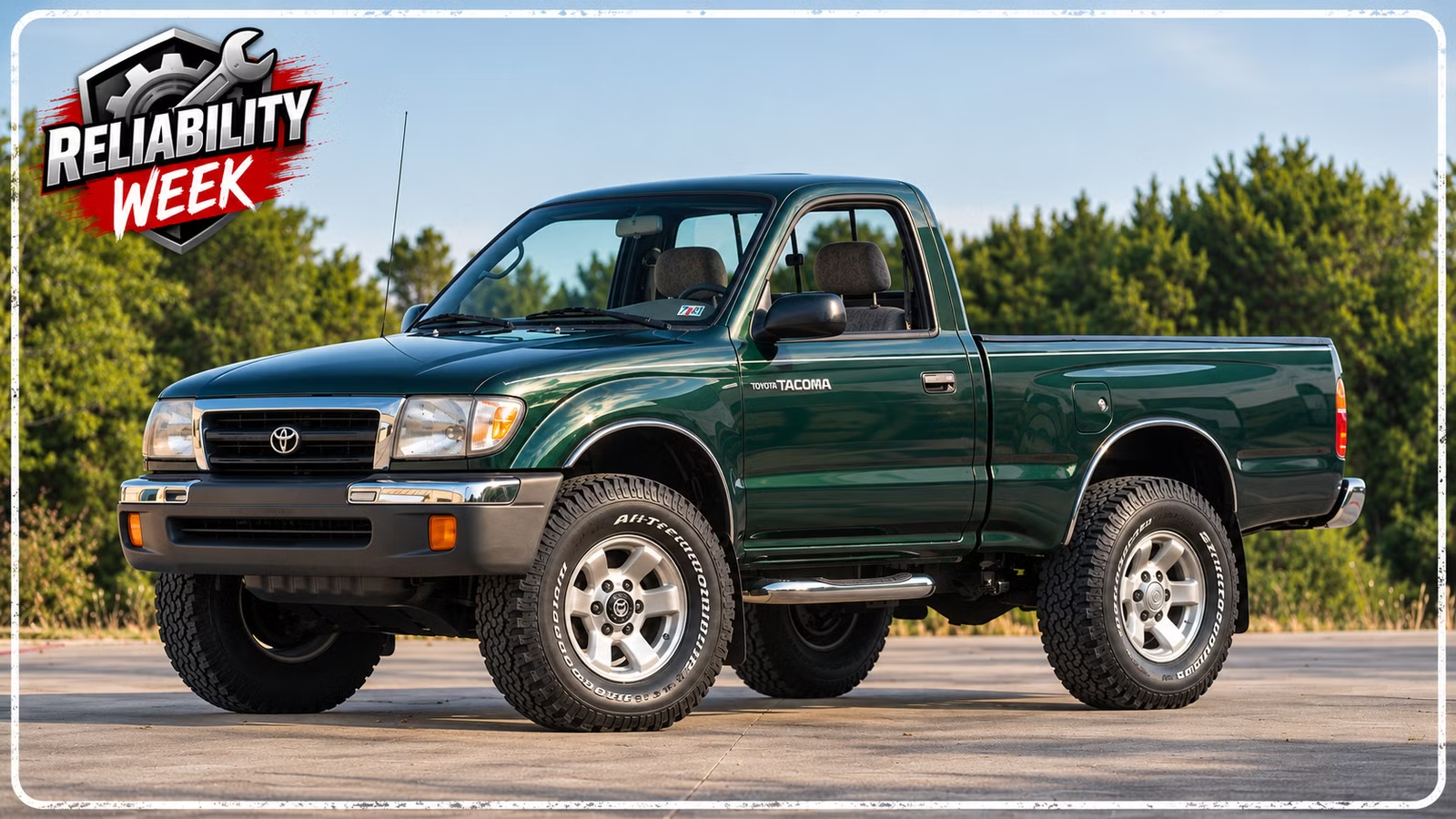
The first-gen Toyota Tacoma was built between 1995 and 2004, so it was around long before the evolution of turbo tech took over the market. The two main engine options are a 2.7-liter 3RZ-FE inline-four and a 3.4-liter 5VZ-FE V6. Both are naturally aspirated, overbuilt, and low-powered but relatively high-torqued (especially the V6: 220 pound-feet at 3,600 rpm). The inline-four option is chain driven, and while the V6 is belt-driven, the 5VZ-FE is a non-interference engine, so if the belt does snap, the pistons and valves won’t smash into each other and ruin the engine.
Like some of the toughest trucks on earth, the first-gen Tacoma rides on a ladder frame, which handles the strain of off-roading and towing far better than a unibody. There are also very few electronics in the cabin or controlling anything to go wrong compared to modern trucks. Many owners have reported that regular oil and fluid changes, along with diligent maintenance, will see first-gen Tacomas routinely run past 250,000 miles. iSeeCars also reports that Tacoma models have a 25.3 percent chance of reaching 250,000 miles, which makes them 5.3-times more likely to do so than the average modern vehicle.
Toyota 4Runner (Third-Gen)
A Cult Favorite For A Reason

For many years, the 4Runner has felt like an SUV that will last a lifetime , and the 2002 4Runner may well be the epitome of this. Its ladder frame was designed to take a beating off-road; the mechanical transfer case and low-range gearing are very well suited to the trails and serious towing; the A340-series automatic transmission is overbuilt and very strong; and everything is far more mechanical than modern SUVs. The standout engine choice from the third-gen 4Runner lineup is the 5VZ-FE V6 that is also found in the first-gen Tacoma.
Under the hood of the 4Runner, this sturdy V6 produces 183 horsepower at 4,800 rpm and 217 pound-feet at 3,600 rpm. As you can likely tell, Toyota did not build the 4Runner as a sport SUV, but as one that could calmly handle everyday life and tackle the mud. Many owners have reported putting well over 250,000 miles on the clock with simple maintenance. The final model year of the third-gen 4Runner is rated 4.9 out of 5 for reliability by 992 owners, with 98 percent recommending one. iSeeCars also says the 4Runner has one of the highest chances of any SUV of seeing at least 250,000 miles, with a 32.9 percent chance.
Toyota Sequoia (First-Gen)
Built For Big Mileage

As the SUV with the highest chance of reaching 250,000 miles, the Toyota Sequoia is a longevity hero. iSeeCars says there is a 39.1 percent chance of a Sequoia reaching these high miles, which makes it 9.1 times more likely than the average modern vehicle. They also estimate that the Sequoia has an average lifespan of 190,962 miles, or 12.6 years. The first-gen Sequoia was built between 2001 and 2007, and it is simple where it matters the most.
It shares the same body-on-frame construction as the Tundra, so it can genuinely take a hit, while the 4.7-liter 2UZ-FE V8 under the hood is made for all sorts of abuse. The 2UZ-FE is one of Toyota’s most reliable engines; it is overbuilt and comes equipped with a cast-iron block, a forged steel crankshaft, and oversized bearings, and it is conservatively tuned for low-stress driving. First-gen Sequoia horsepower output ranges from 240 to 282 at between 4,800 rpm and 5,400 rpm, while torque ranges from 314 to 325 pound-feet at 3,400 rpm, so you get peak torque delivered low in the rev range, and it is never working at high-stress levels.
Toyota Land Cruiser 100 Series
The Overbuilt Legend

As arguably the most reliable Toyota model ever created, the Toyota Land Cruiser 100 Series, built between 1998 and 2007, is the sweet spot of Land Cruiser ownership. It bridges the gap between the old-school 80 Series and the more complex, technology-laden 200 Series. This machine is overbuilt nearly everywhere and made for adventuring; you get a ladder-style chassis, the solid rear axle is well-suited to carrying heavy loads, the center differential provides traction on difficult ground, the low-range gearing helps you crawl and tow, and its simple engineering means there is not a huge amount to go wrong.
The 100 Series also gets the 2UZ-FE V8 under the hood, which Toyota originally said could produce 80 percent of its torque at just 1,100 rpm. Big displacement and a low-stress philosophy means it should just keep slugging along. There is a good reason why the Land Cruiser is such an overlanding icon, and we have seen some 100 Series models with half-a-million miles on their original engines, even after enduring the abuse of remote terrain and some of the harshest places on earth.
Sources: Toyota, iSeeCars, Kelley Blue Book, RepairPal, and J.D. Power.

Related posts




Latest Post


No Comments