
The Acura Luxury SUV Hiding A Rebadged Isuzu Trooper Underneath
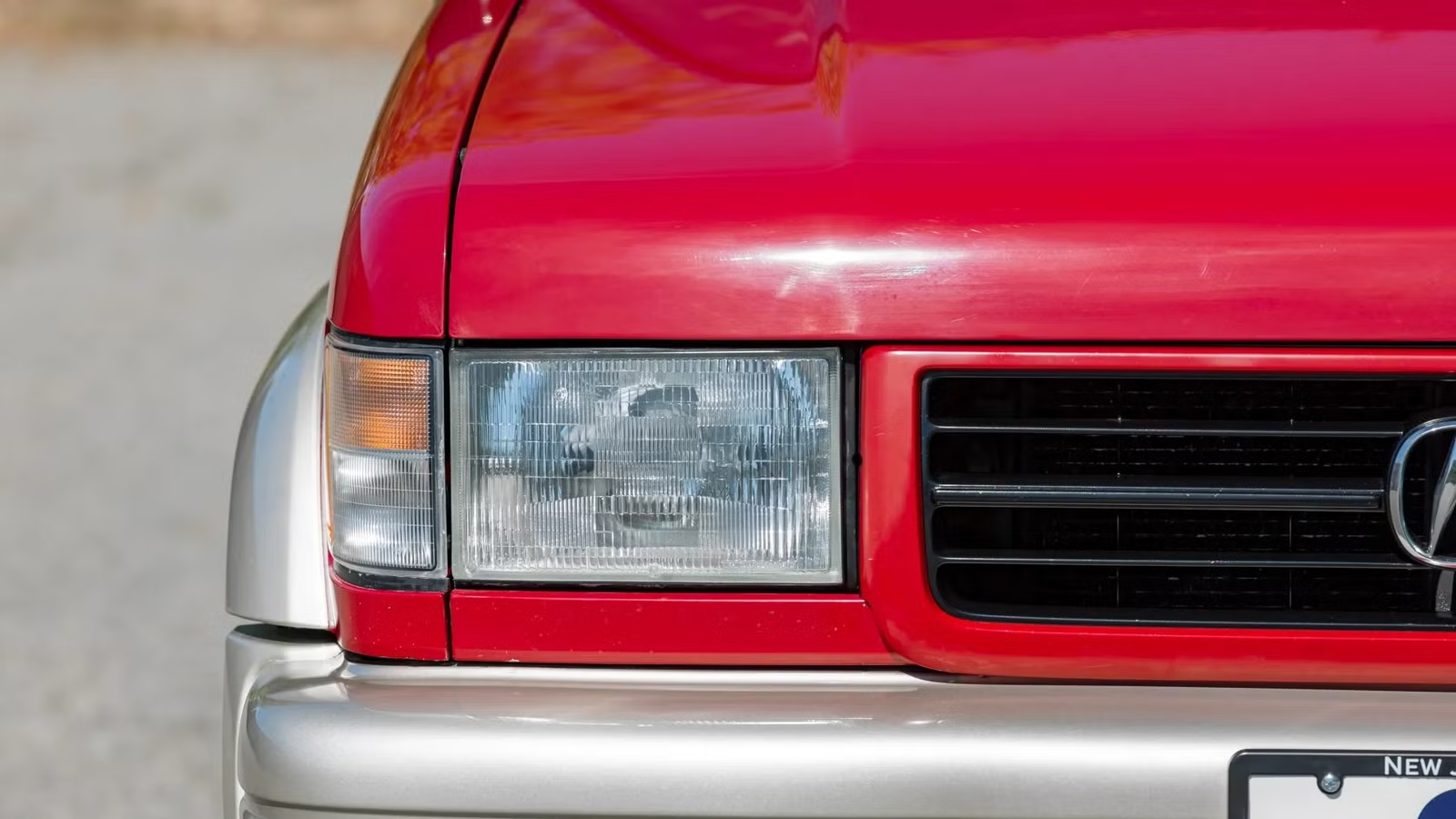
The SUV boom of the 1990s created a problem that money alone could not solve quickly: manufacturers needed credible four-wheel-drive vehicles, but developing one from scratch required years of engineering. Some found a shortcut. One rugged SUV architecture began appearing beneath Japanese, European, Australian and luxury badges, often changing its name and showroom identity without abandoning its basic mechanical formula. The most unusual example was a luxury SUV whose polished badge concealed a far more utilitarian family tree. How did one boxy 4×4 become the foundation for so many supposedly different vehicles?
The 1990s SUV Boom Created A Shortcut To Four-Wheel-Drive Credibility

By the 1990s, SUVs had become too important for manufacturers to ignore. Buyers increasingly wanted the raised seating position, four-wheel-drive image and versatility associated with traditional off-roaders, but not every company had a suitable vehicle in its portfolio. Building one was expensive. A manufacturer starting from nothing needed a chassis, suspension, driveline, body and production program before it could compete in the segment.
Badge engineering offered a faster alternative. Instead of funding every part of a new SUV, a company could source an established vehicle and adapt its equipment, styling and branding for a particular market. The underlying engineering investment had already been made; the new badge could open another showroom door.
The arrangement made particular sense when the donor vehicle was flexible enough to support several identities. A rugged four-wheel-drive sold as a work-oriented vehicle in one market could be fitted with more equipment and presented as a family SUV elsewhere. The same basic architecture could even enter a premium showroom.

One platform proved unusually suited to that role. Its construction retained the hardware expected of a serious four-wheel-drive vehicle, yet its suspension and packaging allowed manufacturers to sell it to buyers looking for something more refined than a stripped-back off-roader.
Beneath The Different Badges Was The Same Rugged Formula

At the center of the story was a conventional-looking but adaptable formula: a separate ladder frame, independent front suspension using torsion bars, and a multi-link rear suspension with coil springs. The combination gave the vehicle a traditional body-on-frame foundation while avoiding the simpler suspension layouts associated with some older utility vehicles.
The second-generation version of this architecture, introduced during the 1990s, became the basis for most of the vehicles in the wider rebadging network. Its appeal was not simply that it already existed. The platform could support genuine four-wheel-drive hardware while also accommodating the equipment and ride expectations of a more conventional SUV buyer.

That versatility mattered because the companies using the vehicle were not all selling to the same audience. Some versions were aimed at buyers who valued utility and off-road capability. Others were positioned around equipment, comfort or brand image. The basic engineering could survive those changes in identity.
Published tallies differ depending on whether regional variants and closely related models are counted separately, but the second-generation vehicle is commonly described as one of the most extensively rebadged SUVs of its era. The strangest destination for the platform was a luxury showroom in North America.
The Acura SLX Was A Luxury Badge Over An Isuzu Trooper

The vehicle was the Acura SLX, sold in the United States from 1996 through 1999. Acura officially described the model as jointly developed with Isuzu, and its relationship with the second-generation Isuzu Trooper formed the basis of the SLX’s unusual identity.
The original SLX used a 3.2-liter SOHC 24-valve V6 producing 190 horsepower and 188 lb-ft of torque, paired with a four-speed automatic transmission. For 1998, Acura introduced a 3.5-liter DOHC V6 rated at 215 horsepower and 230 lb-ft, along with Torque on Demand four-wheel drive. Those specifications gave the SLX the kind of performance and equipment expected from a luxury SUV of the period, but the vehicle was not the product of an entirely separate Acura SUV program.
The contradiction was therefore more substantial than a shared engine or supplier relationship. Acura sold a premium SUV whose fundamental architecture belonged to a vehicle family better known for rugged, body-on-frame four-wheel-drive duty. Its luxury badge also concealed the scale of the arrangement. The SLX was only one version of a platform that appeared under an extraordinary number of names around the world.
The Trooper Quietly Became A Global SUV Template

The common denominator was the Isuzu Trooper, known as the Bighorn in its home market. Its second generation traveled much further than the Isuzu badge. Japan received versions including the Honda Horizon and Subaru Bighorn, while Europe had the Opel Monterey and, in the United Kingdom, the Vauxhall Monterey. Australia and New Zealand received the Holden Jackaroo and, in certain versions and periods, the Holden Monterey.
Other markets expanded the network further. Chevrolet sold Trooper-derived versions in selected countries, while additional regional derivatives complicated any attempt to produce a single definitive count. Published sources commonly describe roughly a dozen models or derivatives spread across around 10 or 11 manufacturer brands, depending on how the names are classified.

The important point is not the exact arithmetic. A change of grille, badge or trim could make the same basic SUV appear to belong to a completely different product strategy. One buyer encountered a rugged Isuzu. Another saw a Holden. A European customer could enter an Opel or Vauxhall showroom. An American buyer could find the same family of hardware wearing an Acura badge.
Few of those vehicles were mechanically identical in every respect, and treating them as such would be misleading. Engines, equipment and market specifications varied. The rebadging network nevertheless shows how far one established SUV architecture could travel without requiring every company involved to create its own foundation.
Shared Hardware Did Not Make Every Version The Same

A shared architecture is not the same thing as a collection of identical vehicles. The ladder-frame chassis and suspension design established the common mechanical lineage, but individual versions could differ in engines, transmissions, four-wheel-drive systems, equipment and market-specific components.
The Acura SLX demonstrates the distinction. Its relationship with the Trooper was close enough to define the vehicle’s origins, yet Acura specified its own trim and, later in the model run, received changes including the 3.5-liter V6 and Torque on Demand four-wheel drive. Similar differences appeared elsewhere in the family as the platform was adapted to local regulations and customer expectations.
For enthusiasts, the value of understanding the common lineage is therefore not an excuse to assume universal parts interchangeability. A component that fits one market’s version may not automatically fit another. Model year, engine, drivetrain and regional specification still matter. The more useful lesson is architectural. A rebadged SUV can share the engineering DNA of a better-known vehicle without being mechanically identical to it. Knowing where the similarities end is just as important as recognizing where they begin.
The Rebadged Trooper Is Now A Different Kind Of Used-Car Shortcut

The same badge-engineering network that once gave manufacturers a faster route into the SUV market can now give enthusiasts a broader list of vehicles to investigate. Searching only for an Isuzu Trooper may exclude the Holden Jackaroo, Opel or Vauxhall Monterey, Honda Horizon, Subaru Bighorn or Acura SLX, depending on where a buyer lives.
Obscurity can occasionally work in a buyer’s favor, but no automatic price advantage should be assumed. A less recognizable badge may attract a different audience from the Trooper, yet market values depend on far more than the name on the grille. Condition, corrosion, maintenance history, drivetrain specification, parts availability and regional support should carry more weight in a purchase decision.

The Acura SLX also illustrates why a shared-platform search can produce unusual results. Someone looking for a period luxury SUV might overlook its relationship with the Trooper, while a buyer searching specifically for rugged Isuzu engineering might never think to investigate an Acura.
Manufacturers originally used the platform as a shortcut because developing an SUV from the ground up was expensive and time-consuming. Decades later, the same history offers a different shortcut. Understanding the family tree can reveal alternatives hiding behind badges the original engineers probably never expected to see on their work.
Sources: Acura

Related posts
Latest Post


No Comments