
Pontiac Stuffed One Of America’s Greatest Performance V8s In A Plain Sedan
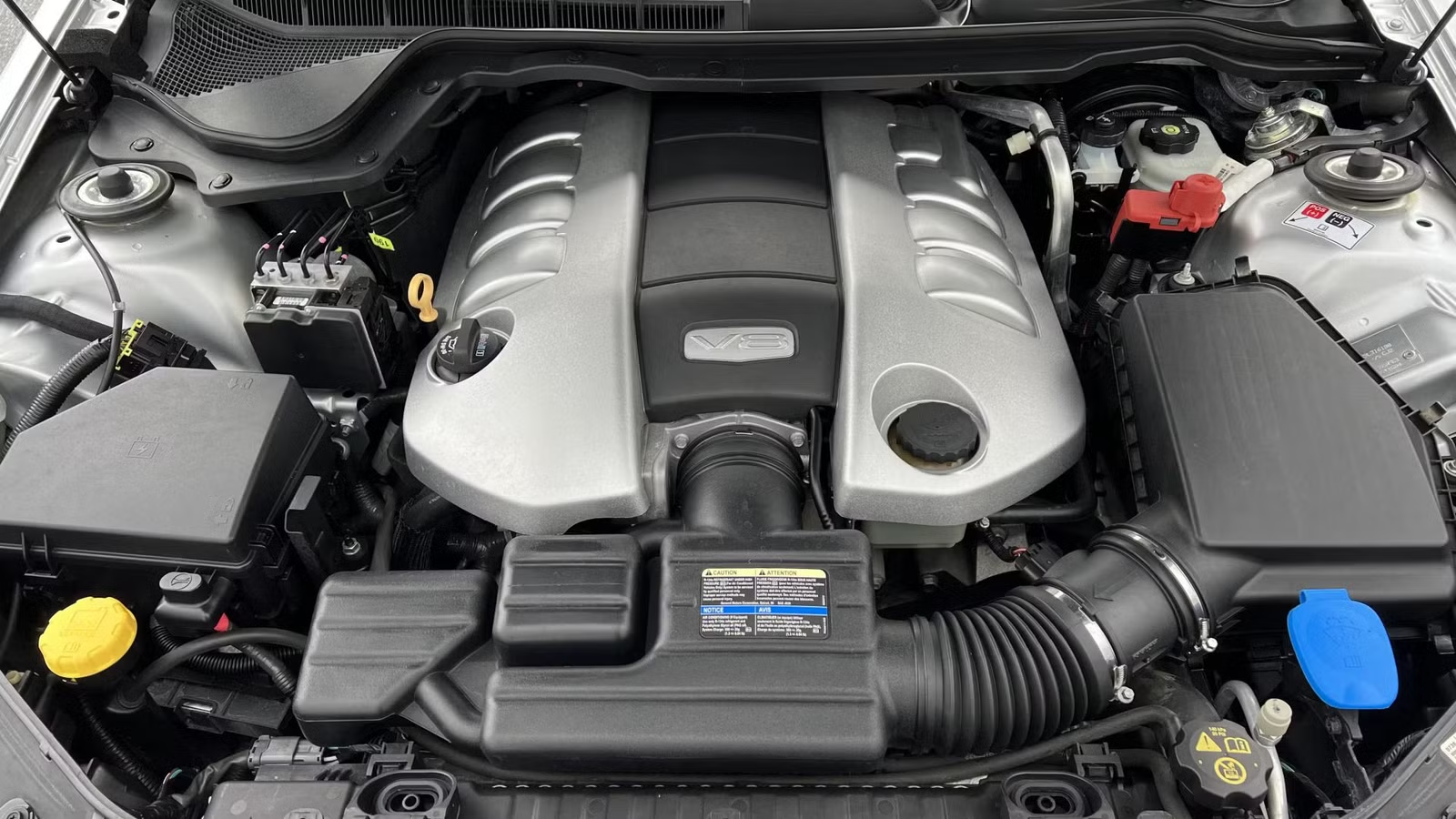
There was a time when the Pontiac brand was a go-to for anyone who wanted serious performance from one of Detroit’s Big Three. Sadly, the brand’s name and reputation have been lost to time. But for those who know, it kept on building great performance cars right up until the end.

One of those final performance models it made was given what’s arguably one of the best and most powerful General Motors engines ever built. While it was based on an architecture that’s commonplace in GM’s model lineup, its performance figures were anything but. That was especially shown in the plain-looking car it ended up in.
The Modern LS Engine Has Been One Of General Motors’s Most Enduring Engine Designs
Ever since it was introduced in 1997, the modern General Motors LS engine has been a cornerstone of GM’s performance cars. Those have obviously included many high-performance Chevrolets, as well as some high-performance Cadillacs. More modern high-performance Pontiacs also got various different iterations of the LS. Pontiac is especially associated with one particular version of the LS, and that version is the one we’re going to talk about right now.

The Generation IV LS3 V8 Is A Modern Small-Block With Serious Power

Part of the Generation IV line of LS V8s, the LS3 first showed up in 2008. At 6.2 liters in size, the LS3 is one of the bigger LS units out there. But it’s still small enough to fit under the small-block banner. At its introduction, it was rated at 430 horsepower and 424 lb-ft of torque. Later factory models that used the engine managed to push the power beyond the 450 hp mark. That’s some serious power for even a modern small-block V8.
The LS3 Was Put Into One Of Pontiac’s Greatest Sleeper Sedans Ever

The LS3 V8 would be a performance legend no matter what car it was put in. But it only helps that one of the cars that had it as an engine option is one of the most legendary sleeper sedans of all time. The Pontiac G8 GXP was the top-of-the-line offering of the short-lived G8 sedan. This variant exclusively came with the LS3, and Pontiac claimed an output of 415 hp and 415 lb-ft of torque. All that power gave the G8 GXP a claimed 0-60 mph time of just 4.7 seconds, and a factory-limited top speed of 146 mph.
Not only was the LS3 standard-issue on the G8 GXP, but you could also have it with a proper 6-speed manual transmission. That put it right into the upper echelon of enthusiast appeal. A subtle V8 muscle sedan with big power, plenty of practicality and the option to have a manual transmission? It’s hard to argue against the G8 GXP.
It Was A Captive Import Of An Australian Performance Legend
While the Pontiac G8 GXP seems like the most American muscle sedan you could think of, its true origins actually lay far away from Detroit. It’s a captive import of the VE-generation Holden Commodore HSV. North American Pontiac versions of this car were assembled in the same Holden plant in Adelaide as the Commodores that were sold in Australia and New Zealand, and shipped stateside later. You can’t get any closer to the true definition of a captive import than that.
Barely Any G8 GXPs Were Ever Sold

With how much enthusiast appeal it has, you’d expect that the Pontiac G8 GXP would have sold like hot cakes. Sadly, that didn’t happen. Only 1,829 GXPs were sold in 2009. That’s out of a total of 26,404 G8s across the board that year.
Part of those poor sales figures for the G8 GXP can be explained by its being a bit of a niche halo model for Pontiac. But a lot of it also has to do with Pontiac being on a downward spiral as a brand by that time. Pontiac would actually end up being discontinued as a brand entirely the following year. The death of Pontiac also meant the death of the G8, after only two model years of production and barely any cars sold relative to what Pontiac might have hoped.
The LS3 Appeared In A Host Of Other Performance Cars, Too

While we’ve focused on the Pontiac G8 GXP here, this awesome sleeper sedan was far from the only car that got the LS3. One of its earliest uses was actually as the base engine for post-2007 versions of the C6 Chevrolet Corvette, replacing the old 6-liter LS2. Its Chevrolet SS successor, which was based on the later VF-generation Holden Commodore, carried the LS3 over from the Pontiac G8 GXP.
Manual transmission versions of the 5th-generation Chevrolet Camaro SS used the LS3, too. There were also a few smaller automakers that took advantage of the LS3 being a dependable and readily available off-the-shelf engine, and based their wilder and more exotic offerings around it. The AC 378 GT Zagato, SIN R1 450, Arrinera Hussarya 33 and Bolwell Nagari 500 all used the LS3 engine. The engine in the Arrinera Hussarya 33 was supercharged, boosting the power up to 789 hp.
Sources: Holden, Pontiac, Chevrolet

Related posts





Latest Post


No Comments