
The First Toyota Ever Fitted With The Legendary 2JZ-GTE Is Now Dirt Cheap
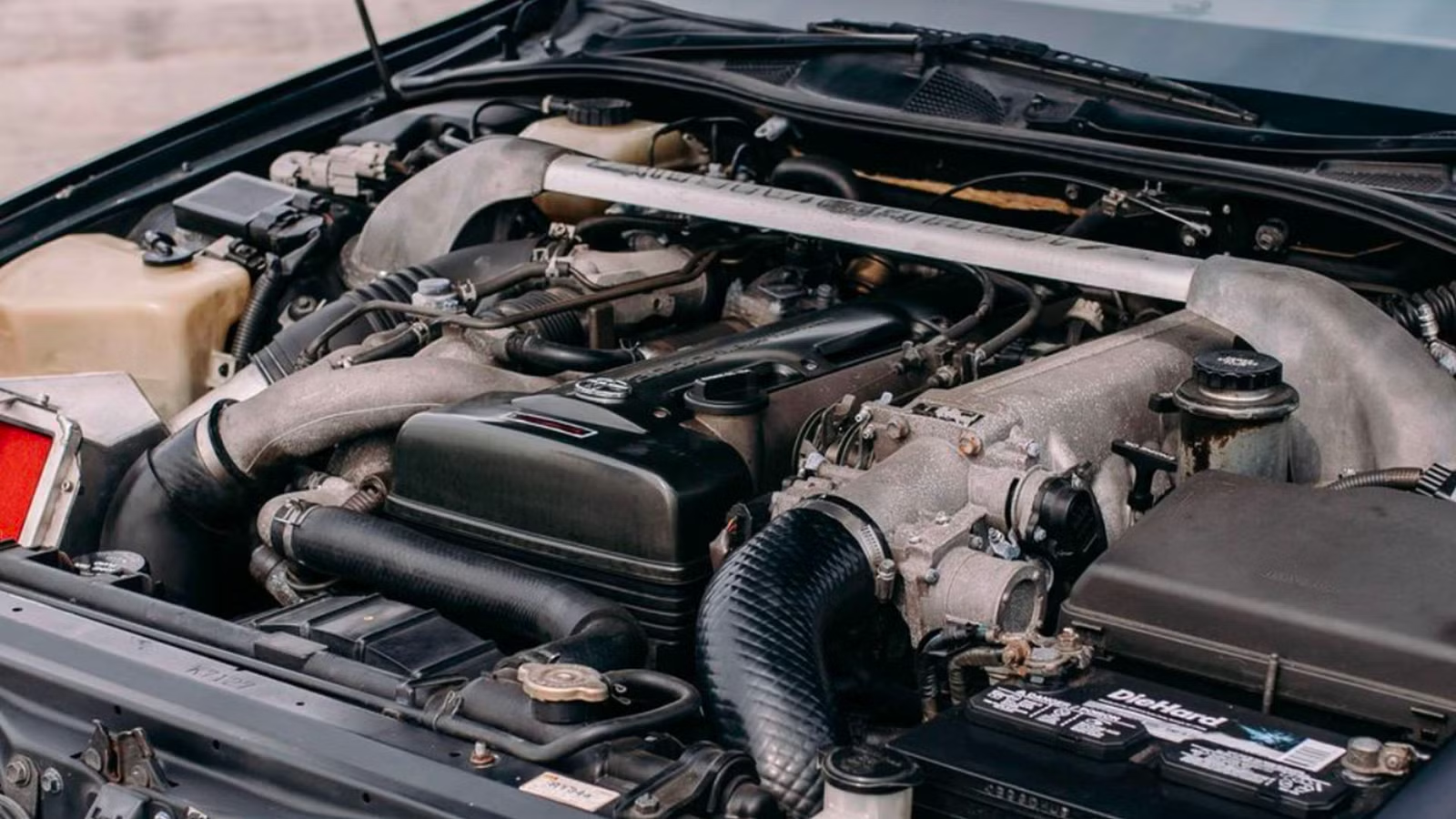
Few engines in automotive history have earned the kind of mythic status that Toyota’s 2JZ-GTE commands. Born in the early 1990s, this twin-turbocharged inline-six didn’t just power fast cars — it rewrote what enthusiasts thought a factory engine could do. Its combination of a stout iron block, conservative factory tune, and seemingly limitless headroom for boost made it a tuner’s dream from day one. Its starring role in a certain blockbuster franchise only deepened the legend. But long before the 2JZ became a Hollywood icon, it quietly debuted in a four-door family sedan most people have never heard of — and that car remains one of the most undervalued 2JZ platforms on the market. The Supra’s unforgettable appearance in the Fast and Furious The 2JZ’s capabilities in stock form were impressive, but tuners were captivated by the engine for its tunability and reliability. Some tuners have even pushed their 2JZs to their limits, making over 2,000 hp. Global markets saw the 2JZ-GTE power the Supra MkIV, for which it was developed. However, the Supra was not the first car to receive the iconic inline-6 engine. It was, in fact, a four-door family sports sedan designed for the Japanese Domestic Market (JDM), which is extremely rare to find today — but it doesn’t break the bank to buy a used one, unlike a Supra.
The 1992 Aristo Was The First Car With A 2JZ-GTE
Used 1992 Toyota Aristo 3.0 Sales And Values
 13 autotech Platform |
Mileage |
Condition |
 46 autotech Selling Price |
|
Cars & Bids |
79,000 Miles |
Modified |
$9,900 |
|
Bring a Trailer |
60,000 Miles |
Modified |
$13,750 |
|
Bring a Trailer |
60,000 Miles |
Modified |
$12,250 |
|
Bring a Trailer |
59,000 Miles |
Modified |
$14,950 |
|
Average Selling Price |
$12,713 |
||
Source: Classic.com
1992 Toyota Aristo – Highlights
- First car to use the iconic twin-turbo 2JZ-GTE engine and was a JDM special
- The four-door sedan featured the 2JZ-GTE before the MkIV Supra
- The Aristo later evolved into the highly successful Lexus GS
- Today, the Aristo is incredibly cheap, considering the values of used MkIV Supras
The 1992 Toyota Aristo sports sedan was the first car to use the iconic 2JZ-GTE, even before the Supra MkIV. The Aristo was a four-door sedan designed for the Japanese domestic market, making it a JDM special. The model later evolved into the Lexus GS for the global market.
The Aristo was available with various engines and had a substantial production run. However, fewer models equipped with the 2JZ-GTE engine were manufactured, which makes them quite rare. Despite housing one of the most coveted engines ever built, the first-gen Aristo from 1992 does not carry anything close to the astronomical values commanded by the Supra MkIV.
While they are extremely rare, Classic.com — an aggregator of used car sales from various auction sites and platforms — has recorded only a handful of 1992 Toyota Aristo listings with the 3.0 2JZ engine sold in the US. All examples were modified and had an average of 65,000 miles. One high-mileage example sold on Cars and Bids for just $9,900, making it remarkably affordable — especially when you consider that a MkIV Supra with a 2JZ sells for an average of $95,678.
Bring a Trailer records a modified 1992 Toyota Aristo with 59,000 miles sold for $14,950, which is the highest recorded sale for the model. According to Classic, a JDM 1992 Aristo 3.0 2JZ-GTE sells for an average of $12,713.
The Aristo Sedan Used The 2JZ-GTE Before The Supra MkIV
Toyota 2JZ-GTE Engine Specs
|
Manufacturer |
Toyota |
|
Years of Production |
1991-2002 |
|
Displacement |
2,997 cc (3.0-Liter) |
|
Configuration |
Inline-6 Twin-Turbo |
|
Power |
276 hp at 5,600 rpm |
|
Torque |
318 lb-ft at 3,600 rpm |
|
Transmission |
4-Speed Automatic |
|
Drive |
RWD |
|
Fuel Type |
Gasoline |
|
0-60 MPH |
~5.6 seconds |
|
Top Speed |
155 mph |
|
Notable Applications |
Aristo, Supra MkIV |
(Source: Toyota)
Toyota’s 2JZ-GTE Engine – Highlights
- Was manufactured between 1991-2002
- Initially developed for the MkIV Supra, but first used in the 1992 Aristo sedan
- Modest 276 hp output complied with the JDM gentleman’s agreement
- Tuners use the 2JZ-swap in various applications from sports cars, pickup trucks, and even German sedans
- The engine was exclusively available with a 4-speed automatic in the Aristo
The 2JZ-GTE is one of Toyota’s most iconic engines, manufactured between 1991 and 2002. It was initially developed for the MkIV Supra, yet Toyota deployed it first in the Aristo sedan. In standard trim, the 1992 Aristo used a naturally aspirated 2JZ-GE engine, but the model was also available with the twin-turbo 2JZ-GTE, which is the far more desirable of the two.
The 2JZ-GTE in the Aristo is a 2,997 cc (3.0-liter) inline-6-cylinder engine fitted with twin turbos. The engine was tuned to produce 276 hp at 5,600 rpm and 318 lb-ft of torque at 3,600 rpm. That modest output was dictated by the informal JDM gentleman’s agreement between Japanese manufacturers, which capped factory power claims at 276 hp.
The Aristo’s 2JZ-GTE runs an 8.5:1 compression ratio, with twin CT12B ceramic turbos operating in sequential fashion. The engine internals, however, were engineered with far greater performance potential in reserve — which is precisely why it became so popular among tuners. People have 2JZ-swapped American pickup trucks, various sports cars, German performance cars, and more.
While the engine in the Supra was available with a manual gearbox, the Aristo was exclusively paired with the A340E 4-speed automatic transmission. Sending power to the rear wheels, the 1992 Aristo was capable of an estimated 0–60 mph in 5.6 seconds, with a factory-limited top speed of 155 mph.
1992 Toyota Aristo: A Budget 2JZ Alternative To The Supra
Why The 1992 Toyota Aristo Is A Great Supra Alternative
- The Aristo was a JDM-exclusive model, making it rare but still affordable
- The Supra MkIV is worth over $81,800 on average today
- Easiest way to acquire a 2JZ-GTE-powered car
The twin-turbo 2JZ-GTE was largely found in the MkIV Supra for the global market. The MkIV Supra gained significant popularity when it featured in the Fast and Furious franchise. Since then, not only has the Supra’s value risen, but so has the value of the 2JZ engine. According to Hagerty, a Concours condition 1994 Supra with a 2JZ-GTE is worth $284,000, while a good-condition model is worth an average of $81,800.
Finding a used 1992 Toyota Aristo can be extremely difficult. However, as it doesn’t carry the cult status of the Supra, it commands far less money. While Toyota manufactured the Aristo sedan in series production with over 100,000 examples built, fewer than 10,000 units equipped with the twin-turbo 2JZ-GTE were made for the Japanese market. At an average price of around $12,713, the Toyota Aristo is a far more affordable entry point into the world of the iconic 2JZ.
The 2JZ Is More Than Just A Hollywood Hero
While the Fast and Furious franchise immortalized the MkIV Supra and the 2JZ engine in pop culture, it’s the engine’s inherent engineering that truly established it as the king of inline-sixes. The 2JZ-GTE’s architecture is so robust that the engine can handle over 1,000 hp with modified internal components. The iron block, durable internals, and high boost capability make it the go-to engine for tuners worldwide, equally at home on a drag strip, a time-attack course, or a drift track.
Sources: Toyota, Classic, Hagerty

Related posts






Latest Post


No Comments