
Buick Sold 465 lb-ft Of Torque As Luxury Before Muscle Cars Existed
Typically, the Pontiac GTO gets all the credit for launching the highly coveted muscle car era. However, earlier Buick models roared to life with high-performance specs years before automakers started competing to rule the drag strip. Before drivers became obsessed with raw muscle, power was marketed as a luxury feature. As a result, an impressive Buick engine is stuck in the GTO’s shadow, even though it arguably set the stage for muscle cars to exist at all.
Buick And Oldsmobile Were Locked In A Luxury Torque Battle

Way back in the late 1950s and early 1960s, General Motors had an internal battle for power happening across the country in multiple showrooms. Buick and Oldsmobile both wanted to earn the title of best luxury brand. To be the best, they thought they needed to pack a potent punch to turn up the thrill factor in luxury cruisers.
Oldsmobile came out swinging with the Rocket 394 V8 engine for the Starfire, 88, and the Super 88. The 394 cubic-inch (6.5-liter) V8 delivers between 315 and 345 hp and up to 440 lb-ft of torque depending on configuration. Its gear ratios range from 9.75:1 to 10.25:1, and the high-compression four-barrel configuration arrived in 1961.
The Oldsmobile Jetstar I and Oldsmobile Starfire were the fastest cars available with this engine. It helped these luxury performance options accelerate from 0 to 60 mph in about 7.5 seconds and complete a quarter-mile in around 16.3 seconds at 84 mph. Plus, these cars have a top speed of about 117 mph.

The Buick Nailhead V8 Came To Fight

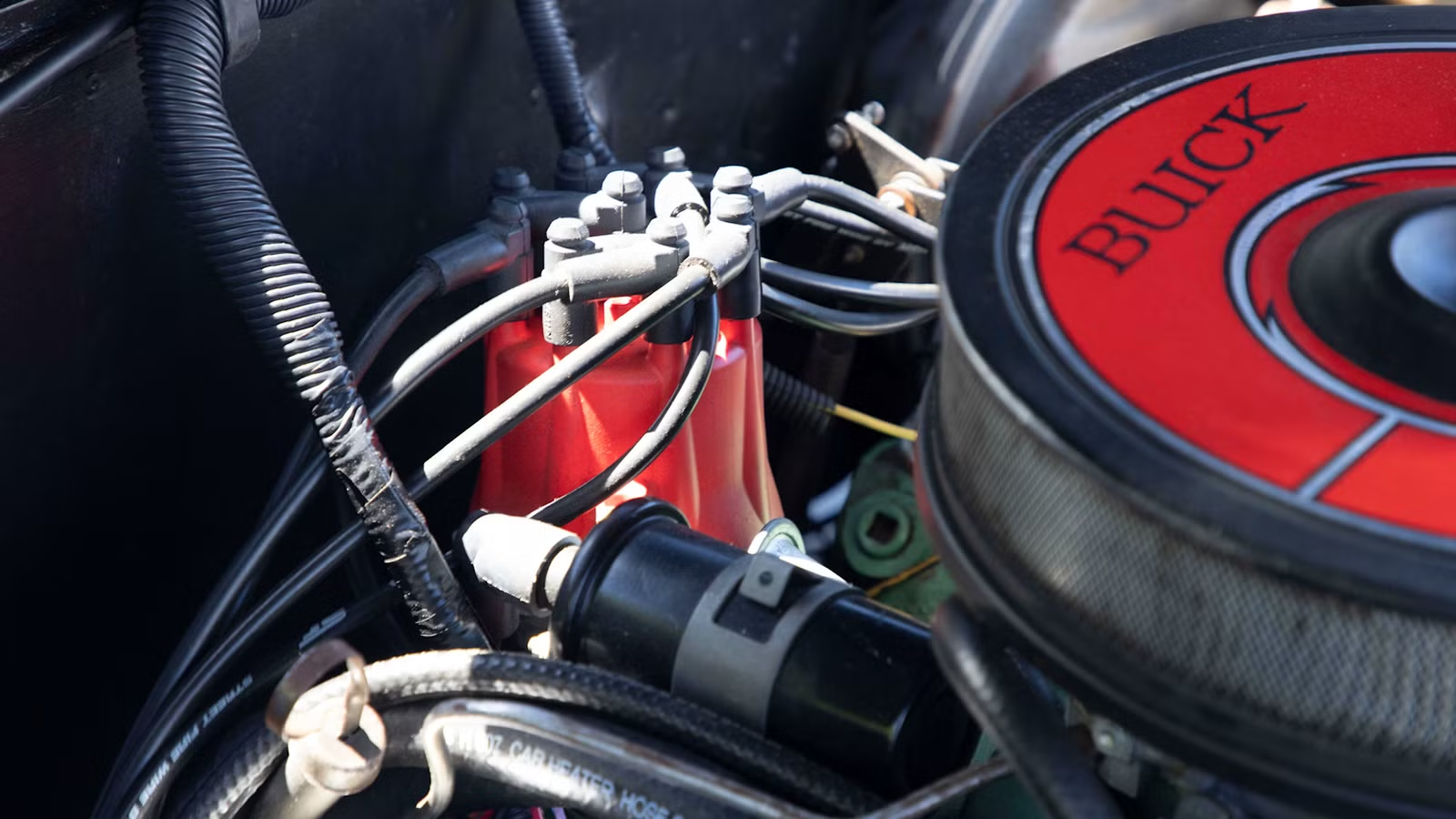
To battle the Rocket 394 V8, which led to the creation of the Rocket 88, and steal luxury buyers from Oldsmobile, Buick built its famous Nailhead V8 engine. The 401 cubic-inch (6.6-liter) V8 churns out 325 hp and 445 lb-ft of torque. Because it’s marketed for its torque, it’s often referred to as the Wildcat 445. Later, the Wildcat 465 or Super Wildcat was introduced.
This is when the displacement was increased, as the 425 cubic-inch (7.0-liter) V8 engine pumps out 325 hp with the standard single four-barrel setup and 360 hp with the Super Wildcat dual four-barrel configuration. Both options provide 465 lb-ft of torque. As a result, Buick earned bragging rights for having more low-end torque than the Rocket 394.
The Super Wildcat engine was found under the hood of the Buick Wildcat, Buick Riviera, and Buick Electra. This engine helped these cars accelerate from 0 to 60 mph in roughly 6.5 seconds and crush quarter miles in around 14.5 seconds at 87 mph. Also, they have a top speed of about 130 mph.

Meanwhile, the 1964 Pontiac GTO has a 389 cubic-inch (6.4-liter) V8 engine with up to 348 hp and 428 lb-ft of torque. It can accelerate from 0 to 60 mph in about 6.6 seconds with a 13.1-second quarter-mile time at 115 mph and a top speed of 122 mph. The Super Wildcat can definitely give it serious competition.
The Rocket V8 Is More Traditional

The Buick Nailhead V8 is a bit unique. It’s famous for its small vertical valves that are aligned nearly straight up and down while resembling a nail shape. It’s paired with narrow upright cylinder heads for a compact and narrow design to easily fit in tighter engine bays. The compact pent roof combustion chambers pair with a spark plug at peak.
This optimizes flame travel at lower peaks and produces tons of torque for the engine’s size. It also has high-lift camshafts and higher rocker arm ratios to compensate for the smaller valves and limited ports. It was uniquely designed to deliver tons of low-end torque to match the non-shifting Dynaflow automatic transmission.

Meanwhile, the Rocket 394 V8 has a more conventional design. It features an overhead-valve (OHV) layout with wedge-shaped combustion chambers paired with large intake valves to enhance efficiency. Its heavy-duty cast-iron block design includes large journal overlaps and a wide bottom end with heavy-duty forged connecting rods.
They have a 7.0-inch center-to-center width to reduce piston friction while maintaining a robust five main bearing layout. Because it has enlarged intake valve diameters, it supports the high-volume airflow demands of the displacement. The engine accommodates high factory combustion ratios ranging between 9.75:1 and 10.25:1.
But Builders Prefer The Nailhead V8

Hot rodders often prefer the Nailhead V8 over the Rocket 394 because of its narrow width. It’s compact compared to the larger options that also serve as a precursor to the larger Pontiac 389 V8. Although the 389 V8 does have superior breathing for raw power. The Nailhead is fast off the line but quickly runs out of breath.
Also, it has a shorter deck height, while the 394 hits the physical limits of its block architecture with thin cylinder walls. Compared to the Rocket V8, it has an attractive vertical valve cover design for a distinct, period-correct style to stand out at vintage car shows. Plus, there’s a high availability of classic multi-carburetor setups.
Parts for the 394 are a bit more scarce and can be more expensive to source. Later variants of the Nailhead have a displacement of up to 425 cubic inches. It delivers more power and torque than the Rocket V8 for smooth cruising. However, the Rocket V8 is still highly valued for its stout durability and bulletproof construction.
But The GTO Gets All The Attention

Despite being torque beasts and serving as high-power options that delivered thrills before the muscle car era, the Buick Nailhead and Oldsmobile Rocket don’t hold a candle to the Pontiac GTO’s 389 cubic-inch V8. But these engines are remembered for being in luxury cruisers, while the GTO is associated with starting the entire muscle car era.
The 1964 Buick Riviera fetched between $18,900 to over $70,000 depending on quality, condition, and if it has the Nailhead 425 cubic-inch V8 engine. Then the 1964 Oldsmobile Starfire rings in at between $10,000 and over $69,000, depending on condition and if it has a matching number 394 V8.
But the 1964 Pontiac GTO flies off the auction block with pricing ranging from $20,000 to over $120,000 depending on its quality, mileage, and engine. Of course, models with the tri-power 389 cubic-inch V8 demand higher premiums over other variants, especially when paired with the four-speed manual transmission.
Source: Hemmings, Automotive Heritage Foundation

Related posts




Latest Post


No Comments