
10 Reliable Motorcycles Under $10,000
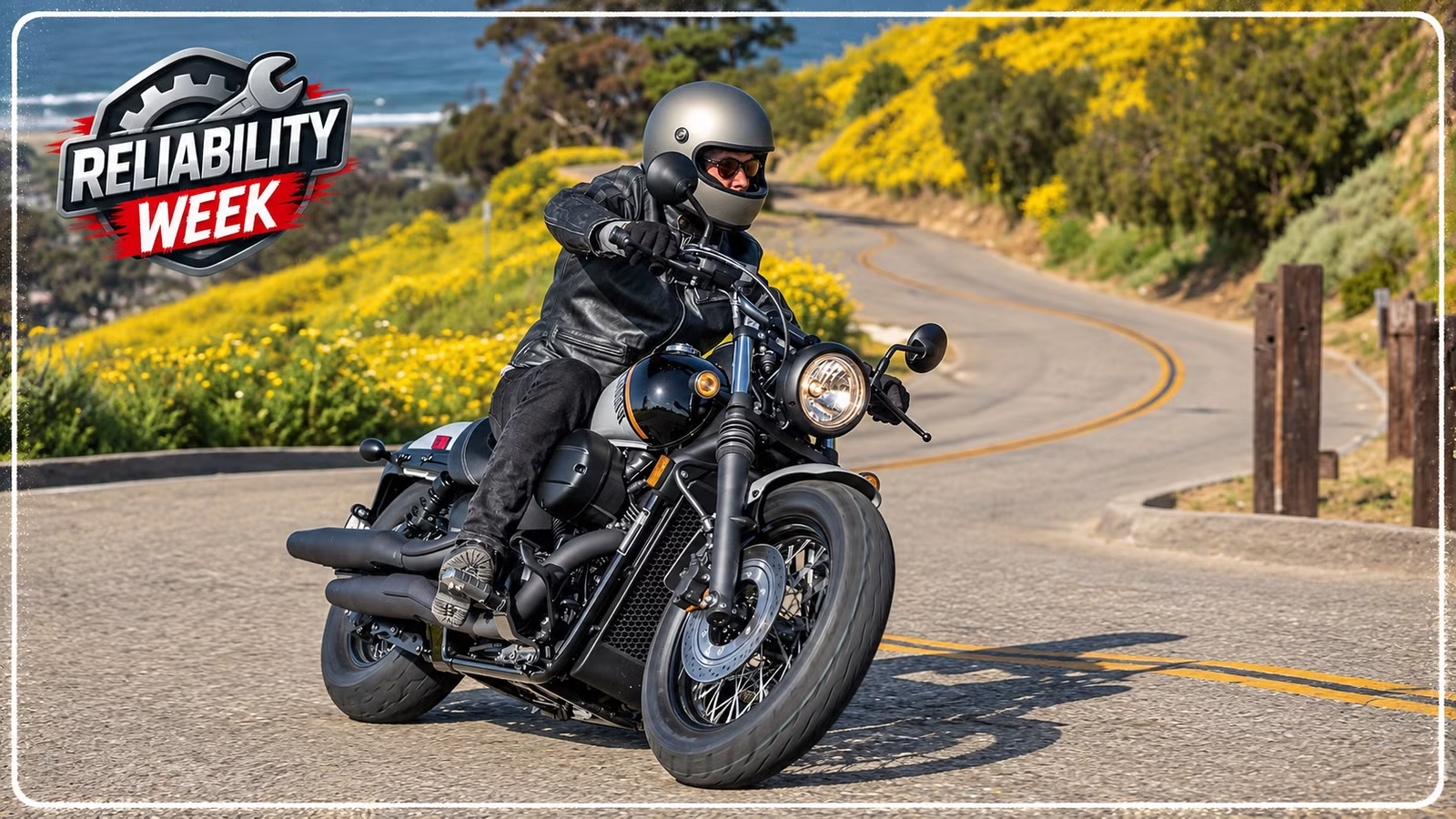
New motorcycle prices have steadily climbed, and a lot of the new options are unequivocally luxury products. Things are different below $10,000, though. Here is where manufacturers strip away the gimmicks and high maintenance bills, focusing on essentials first. The ability to rack up serious mileage without breaking a sweat is key. What is also surprising is the sheer variety of motorcycles available, from single-cylinders to parallel twins and even V-twins. These bikes do not chase complexity for the sake of it, instead choosing proven mechanicals. On that note, here are 10 reliable motorcycles under $10,000.
Honda Grom
Price: $3,599

The Grom is one of the most affordable Hondas. It essentially takes the idea that motorcycles are light and fun to an extreme as a minibike. You get an air-cooled single-cylinder engine that displaces 124 cc and generates 9.7 horsepower and 7.7 pound-feet, paired with a five-speed transmission. This is a proven engine in Honda’s lineup, serving duty without any issues for several years now. And if anything goes wrong, there is a cheap fix for almost everything.

Elsewhere, it has grown-up chassis bits with inverted front forks, a rear monoshock, and disc brakes. You can even have ABS on the front for an extra $200. Or add something else like luggage and a windscreen from the official accessories. The result is a motorcycle that is surprisingly fun, and that will make every commute an event to look forward to.
Kawasaki Ninja 500
Price: $5,399


The Ninja 500 is one of the most fun beginner bikes, so much so that this is the kind of entry-level sports bike that even experienced riders secretly love. Its 180-degree parallel-twin engine displaces 451 cc and generates 51 horsepower and 31.7 pound-feet of torque. This has been around the block more than a few times, which means that it is extremely reliable and ownership costs are low.

However, options can set you back a fair amount. ABS adds $400 to the base price, and if you want to keep up with the Joneses with the TFT instrument display, Bluetooth connectivity, and added accessories, you will have to shell out a whole $1,100 more for the Ninja 500 SE. There aren’t any mechanical changes for the extra price.
Honda NX500
Price: $6,899

The NX500 is not exactly a new model. This is essentially a rebadged CB500X with a different design and extra features. That also means that it has a deserved reputation for reliability and low maintenance costs while putting down endless miles. This is the kind of budget Japanese adventure bike that can do it all, even mild off-road work.

In reality, it is best suited to tarmac touring, and it can do that all day long thanks in part to its 471 cc parallel twin with its 180-degree firing order and a very usable 46.9 horsepower and 31.7 pound-feet of torque. The most recent update gave it switchable traction control, although the dual-channel ABS is not switchable; the 5-inch TFT display does have Bluetooth navigation, which should help its touring credentials.
Honda XR650L
Price: $6,999

The XR650L is one of the old-school middleweight dual-sport bikes that was engineered to truly do anything and go anywhere. Its large 644 cc single-cylinder engine is air-cooled and carbureted, and generates 43.6 horsepower and a massive 38.2 pound-feet of torque. It is sent out through a wide-ratio five-speed gearbox to the wheel.

This is also a dry-sump engine, which gives it massive ground clearance; the oil is stored in the frame, which also acts as an oil cooler besides being the oil sump. Despite this quirk, this is the kind of Japanese bike that mechanics rarely see, because it has stayed the same in all the decades that it has been on sale. Being barebones, there is nothing on it that can or will break.
Yamaha MT-07
Price: $8,599

The MT-07 is the kind of motorcycle that is very basic at first glance, but look at the data, and it outsells more glamorous rivals for a reason. The 270-degree parallel twin is one of the driving forces, with a displacement of 689 cc and 73 horsepower and 50 pound-feet of torque. You also get a ride-by-wire throttle with ride modes and switchable traction control in its latest avatar.

As for reliability, the MT-07 is technically unbreakable. The chassis, suspension, and engine have all stood strong in the test of time, with several riders abusing them over the years. In fact, the platform has proven so credible that Yamaha has three other bikes based on it!
Honda Shadow Phantom
Price: $8,699

Honda’s Shadow series is a cult classic, and it has been around for quite a long time. However, if you want to buy one new, there is only one variant available: that is the well-priced Shadow Phantom. This has the legendary 745 cc, 52-degree V-twin that is fuel-injected and liquid-cooled to produce 44.9 horsepower and 47.9 pound-feet of torque. Power isn’t its strong suit as you can see, but this mill will literally last forever thanks to its understressed nature.

Elsewhere, the bike harks back to simpler times. It looks like it came straight out of the ’90s—which it has—and remains a popular choice for those who want an inexpensive retro runabout. The Phantom does have a blacked-out look with spoked wheels and a rear disc brake with ABS that will appeal to a younger audience.
Suzuki V-Strom 650
Price: $9,299

Suzuki’s 645 cc 90-degree V-twin is a legendary engine, and it is such a good engine that Suzuki has updated it to meet current emission norms in the SV-7GX. Here, it is in its original form, dating back to the early 2000s. So long-term reliability is well tested and there’s a solution to every problem you can think of.

The V-Strom 650 itself can be had in either a more road-focused touring variant or one that can handle a little bit of off-road with spoked rims that nevertheless can handle tubeless tires. It has an instrument cluster that is part analog, part LCD, alongside suspension and brakes that are basic yet up to the task of whatever is demanded of them. The dual-channel ABS is a good addition, but the inability to turn it off at the rear will limit it off-road.
Honda NC750X DCT
Price: $9,499

Honda classifies the NC750X DCT as an adventure motorcycle, but in reality, it lies somewhere in a genre of its own. It shares its chassis and driveline with a pair of scooters in the Honda lineup and has a dual-clutch automatic gearbox with six speeds. It is also one of the rare modern motorcycles with an engine that prefers a long-stroke design.

This 270-degree parallel-twin engine displaces 745 cc and generates 57.8 horsepower and 50.9 pound-feet of torque. This is a really understressed package, so reliability is bulletproof and proven over the years. Oh, and what appears to be the traditional tank is a storage space in which you can accommodate a full-face helmet. It makes more sense than anything else if you want one bike for everything.
Kawasaki Vulcan 900 Classic
Price: $9,599

The Vulcan 900 Classic is quite similar to the Honda Shadow in that it is a cruiser that has been unchanged for two decades or more, and just like the Honda, it has a liquid-cooled, fuel-injected V-twin engine. This one has 55 degrees between the banks, displaces 903 cc, and generates 50 horsepower and 58.2 pound-feet of torque. The five-speed gearbox can make it feel a little out of breath on the highway, but ride it at sane speeds, and it has one of the longest tank ranges among cruisers.

The base Vulcan 900 is styled like an old-school American cruiser, complete with spoked wheels and whitewall tires, which means you get classic style without the headaches. If you prefer more modern styling, there is also the Vulcan 900 Custom, which has drag-bike styling with a blacked-out engine and exhaust, alloy wheels including a 21-inch front wheel rim, and drag-style handlebars. Whichever you choose, it is going to be one of the most reliable options under $10,000.
Suzuki GSX-8R
Price: $9,699

The GSX-8R is a relative newcomer to the segment and is based on the GSX-8S naked bike. It has the same running gear, with a 270-degree parallel-twin engine that produces 83 horsepower and 57.5 pound-feet of torque. Since its inception, the package has proven quite reliable, not just in regular conditions but also during proper abuse on the racetrack. This is thanks to an overall simple construction as well as good use of tech.

Speaking of which, there’s a ride-by-wire throttle offering three ride modes and three levels of traction control, although the dual-channel ABS is not switchable. You also get Suzukis’ counterbalancer system, which means the GSX-8R is more refined than you would expect.
Sources: Honda Powersports, Kawasaki USA, Yamaha Motorsports, Suzuki Cycles

Related posts



Latest Post


No Comments