
The Trike That Makes Every Passenger Happier
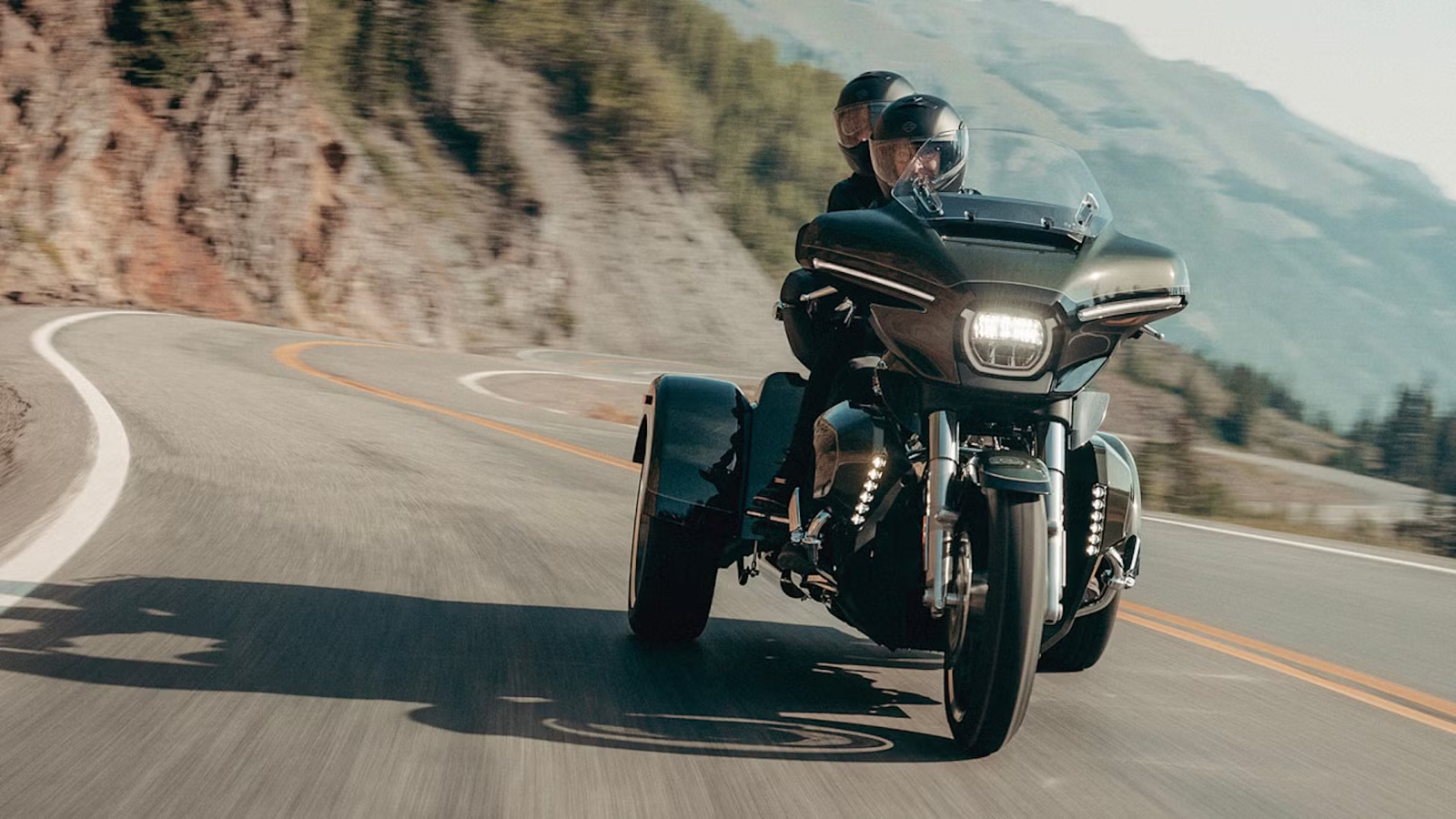
It’s undeniable that riding motorcycles is a physical experience. You have to move about and shift your body weight around. For instance, if you see a pothole coming up, it’s almost natural to try to get weight off the saddle to save your spine from taking the brunt of the impact. For a passenger, well, they’re purely at the mercy of the rider. Telepathic synchrony is wishful, and without a comms unit, a passenger barely has much in the way of comfort and control, depending entirely on the quality of the rear suspension. And if a passenger is going to be accompanying you on the majority of rides, then a trike is simply the better solution.
The Need For Building A Trike Around Its Passenger

Of course, you have the likes of the Honda Gold Wing Tour and its feature-loaded pillion perch, but the limitations stated earlier still remain the same irrespective. A trike does solve that problem by just adding a second wheel out back. The rider isn’t balancing the bike around the passenger anymore, or at all, so the passenger isn’t fighting for equilibrium on top of everything else already working against them.

Even the best of trikes don’t guarantee a smoother ride with two wheels at the back, especially if they’re bolted to a single rigid shaft. That’s exactly how Harley-Davidson built its three-wheel platform for the better part of two decades. A bump under the right wheel doesn’t stay under the right wheel on a solid axle.

The limitation of a solid rear axle setup is that any and all impact to the right rear wheel travels straight across to the left too and vice versa. Whoever’s sitting on top of that shaft, rider or passenger, gets the full effect of it with nothing in between to soak it up. Over the years, air suspension mods have helped matters, but a full rethink of the rear-end has been long overdue.


Finally in 2026, Harley-Davidson rolled out what it calls a second-generation Trike platform across all three models on sale. A brand-new rear suspension design is backed up by numbers that promise that the passenger has finally been prioritized, and there are plenty of reasons for them to rejoice.
The Harley-Davidson Street Glide 3 Limited Is The Trike That Passengers Will Love

With a rejig of Harley-Davidson’s Grand American Touring lineup this year, the 2026 Street Glide 3 Limited also benefited from a host of new changes that were much needed. It sits in the middle of three offerings; the Street Glide 3 Limited starts at $39,199, costing $3,800 more than the Road Glide 3 and a whopping $15,800 less than the tri-tone CVO.

The latter is significant because the non-CVO Street Glide 3 Limited runs the identical redesigned platform underneath. For the extra cash, the CVO does add a stronger engine tune, better wheels, two extra speakers, and basically more polish. The new suspension tech, however, is the main talking point and offers the same mechanical benefits in the Street Glide 3 Limited as well.
New De Dion Rear Suspension Doubles Wheel Travel

The Street Glide 3 Limited swaps the old solid rear axle for a De Dion-style setup, and rear wheel travel jumps from 2.3 inches to 5 inches as a result, a 117 percent increase. That figure is substantial because it indicates that a tangible enough benefit will be felt by anyone riding the older version and the new one back to back. What it also means is that 500-mile touring days just got a whole lot comfier.

Harley Trikes have evolved into a prominent personal touring motorcycle from their early days of commercial transport. With that, new tech is now expected, and the suspension is what demands it the most. New coil springs and emulsion shocks handle the damping, while a Watts linkage and sway bar add lateral stability. The whole assembly also trims 68 pounds of unsprung weight. Harley moved the rear preload knob too, tucking it just below the left passenger footboard, so dialing in stiffer damping for a passenger or a loaded Tour-Pak takes just a few seconds.
The Milwaukee-Eight VVT 117 Complements The New Suspension

Be it cars or motorcycles, better suspension almost always means better ability to handle more power. And for the Street Glide 3 Limited, which comes from the 1,923cc Milwaukee-Eight VVT 117 with its torque peaking at 129 lb-ft. Coming in at just 3,250 rpm, the variable valve timing widens the torque band and boosts low-end delivery, so the engine can pull hard right from the get-go. A torque curve that delivers a thick, even surge from low revs makes the power delivery predictable, benefiting the passenger from fewer surprise lurches as the rider rolls on the throttle.
Heated Seats, Closer Speakers, And A Redesigned Tour-Pak

Trikes aren’t just for old folks anymore. Most of the newfound love comes from a boost in the feature list, and the 2026 H-D Trikes have a lot of focus on the passenger. Heated seating with on-seat controls lets the passenger dial in their own temperature setting. The redesigned seat itself promotes a more natural hip position, and Harley widened the passenger’s portion specifically, a small change that adds up across a long day of touring. Cast aluminum grab rails give a passenger something solid to hold onto besides the rider’s jacket.

Audio is delivered via four Rockford Fosgate speakers at 50 watts per channel on the Street Glide 3 Limited, with two of them sitting closer to the passenger’s ears. They’re built into the redesigned Grand Tour-Pak as dedicated speaker pods, right behind the passenger’s shoulders. The Tour-Pak also features integrated LED lighting and a new luggage rack on top for soft bags. Between the trunk and the Tour-Pak itself, a combined 53.1 gallons of storage is on offer, plenty for two people packing for more than a weekend.
The Street Glide 3 Limited Against The Can-Am Spyder RT Limited

The closest competition for the Harley Street Glide 3 with a passenger-focused angle comes from the Can-Am Spyder RT Limited. It starts at $31,999, undercutting the Street Glide 3 Limited by $7,200, and it answers Harley’s new De Dion suspension with a self-leveling rear air shock. The tech enables automatic adjustment of preload for a passenger or a loaded top case without having to reach for a knob, even if conveniently placed. Plus, its own rear travel comes in at 6 inches, a half inch more than the Harley now offers.

Where the Can-Am gives ground is the engine. Its Rotax 1330 ACE triple needs 7,250 rpm to make its peak of 115 hp and doesn’t reach its torque peak of 96 lb-ft until 5,000 rpm. So it’s more of a mid-rev-range performer, whereas the Milwaukee-Eight VVT 117 offers power right from low revs. It’s the kind of surge that a passenger will be rocking back and forth with upon every instance of acceleration.

The Spyder does counter with a six-speaker BRP audio system, though the Harley still holds a storage edge, 53.1 gallons to the Spyder’s 47. Nevertheless, a Harley Trike has enough, and more, reasons to fall for it, and although well-matched feature for feature with the Can-Am, passengers should find the Street Glide 3 Limited’s low-rev torque and redesigned suspension more comforting and forgiving for spending a long day riding two-up.
Source: Harley-Davidson

Related posts




Latest Post


No Comments