
The World’s First Muscle Car Was Also Available As A Muscle Wagon
Many fans of American classics cite the low-cost, high-power Pontiac GTO as Detroit’s first muscle car. Few know that Mopar began dropping some of its hottest V8s into low-trim Dodges five years earlier. But there’s even more to the story than that. The same year Dodge pioneered the muscle car formula, it invented something else: the muscle wagon. Here’s the full scoop.
Detroit Was Building Muscle Cars Before Anyone Called Them Muscle Cars

During the 1950s, luxury and specialty cars spearheaded the horsepower wars. Think of the Cadillac Eldorado, Ford Thunderbird, and Chrysler 300. That final model, specifically, was named in celebration of its historic 1955 300-horsepower output.
These were top-trim vehicles. Even though many were available as coupes, some even with fastback styling, they were resplendent with luxury features. Zero-to-60 mph times were just one of those features that the “haves” enjoyed while the “have-nots” watched from the sidelines. Little did the Boss Hogg types of the world know, the order of things was about to change.

In 1964, Pontiac launched Regular Production Option 382 for its midsize Tempest. Checking the box added a 389-cubic-inch, 325-horsepower V8, stiffer suspension, and a previously unheard-of Pontiac badge: GTO. Drivers snapped up over 30,000 cost-effective GTOs in the first year alone. But Pontiac didn’t invent the formula.
The 1959 Super D-500 Put 345 HP In An Ordinary Dodge

Chrysler used a high-output version of the “FirePower” V8, with its signature hemispherical combustion chambers, to reach the 300-horsepower mark in 1955. Dodges of the 1950s got their own Hemi V8, though the “Red Ram” had a smaller displacement and lower output than the FirePower in the Chryslers. In 1956 and 1957, Dodges with the Hemi V8 also wore the company’s performance badge: D-500. For 1958, Chrysler kept its Hemi while Dodge pivoted to the lighter, more powerful B-series of big-block V8s with wedge-shaped combustion chambers.
For the 1959 model year, Mopar dialed the B-series engines up to 11 when it expanded the 361’s cylinders out to a 4.25-inch bore for a total displacement of 383 cubic inches. Dodge’s 383 V8 used a 3.38-inch stroke, 10.0:1 compression ratio, hydraulic lifters, and a single Carter AFB four-barrel carburetor to make 320 horsepower at 4,600 rpm and 420 lb-ft at 2,800 rpm. But Dodge was far from done.
The Super D-500 version of the 383 used a 260-degree performance cam and two four-barrel carbs to make 345 hp at 5,000 rpm and 420 lb-ft at 3,600 rpm, according to Dodge’s official numbers. But the most exceptional thing about these engines wasn’t their output. Unlike the highest-output Hemi engines, these big B-series V8s were available in any full-size Dodge. That included the top-trim Custom Royal, the regular Royal, and even the entry-level Coronet. And you could get any of these cars with the Super D-500 tune.

Price drives the point home. A four-door Coronet V8 listed at $2,707, and the Super D-500 package cost $540.45, putting the combination at about $3,247 before other options. A Chrysler 300E hardtop started at $5,319. The Chrysler’s dual-quad 413 made 380 horsepower, just 35 more than the Dodge, yet cost about $2,072 more. Put another way, the Dodge delivered about 91 percent of the horsepower for 61 percent of the price.
1959’s D-500 and Super D-500 cars also came with dual exhaust. The TorqueFlite automatic came standard with all 361- and 383-cubic-inch V8s. Buyers could also option any V8 car with the Sure-Grip limited-slip differential. Long story short, you could order a 345-hp/420-lb-ft Dodge V8 in an entry-level Coronet five years before the GTO. While the Pontiac GTO has the distinction of being the first affordable midsize muscle car of its kind, you could argue that the 1959 Dodge Super D-500s were the first muscle cars of any segment.
Yes, You Could Order All That Power In A Dodge Sierra Station Wagon

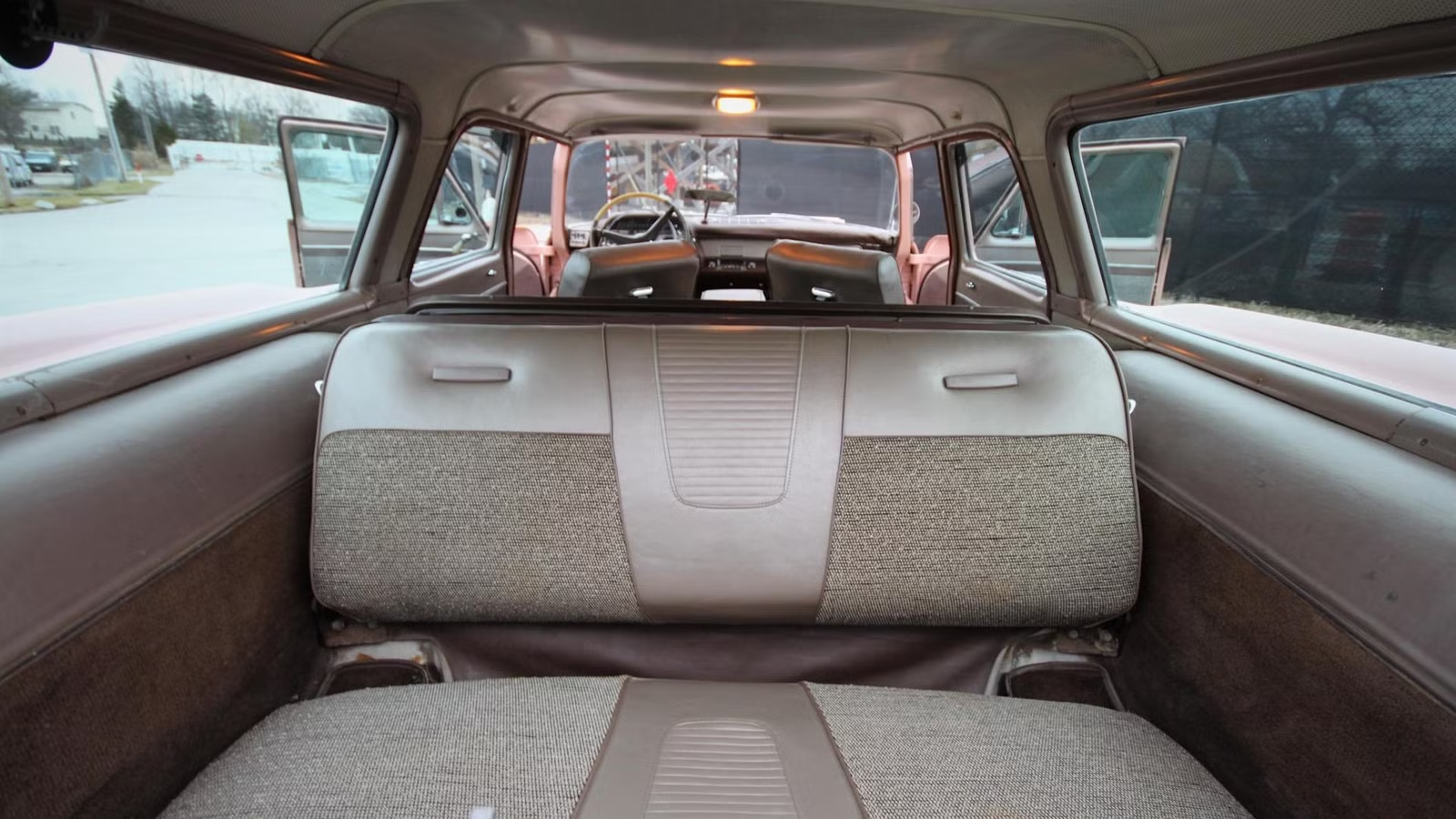
Dodge didn’t limit its new flagship engines to sporty Coronet coupes and convertibles. Buyers could opt for D-500 and Super D-500 station wagons. 1959 Dodge station wagons wore the Sierra name, in regular Sierra and Custom Sierra trims. Configurations included a two-seat/six-passenger version and a three-seat/nine-passenger version.
Dodge’s 1959 Sierras were big, heavy machines. They measured 216.4 inches overall, with a 122-inch wheelbase and 80-inch width. It’s unsurprising that every Sierra started with a V8. The Sierra got a 295-horsepower tune of the 361, while the Custom Sierra got a 305-horsepower tune. But the D-500 and Super D-500 tunes had even more muscle-wagon muscle.

Chrysler Corporation appeared to be pulling out all the stops to catch Ford’s and General Motors’ wagon sales. The Sierra wagons were resplendent with a long list of options beyond their high-test engines. These included swivel seats, Level-Flite air suspension, power tailgate glass in two-seat cars, power steering, power brakes, power seats, air conditioning, and a push-button radio.
How Dodge’s 1959 Muscle Wagon Stacks Up Against Its Descendants

Heavy 1950s station wagons needed a certain amount of power just to keep up with traffic. But when you look at the power-to-weight ratio of the Super D-500 tune of the 1959 Sierra, it’s obvious it was a muscle wagon far ahead of its time.
Dodge’s AMA figures put D-500 and Super D-500 wagon curb weights, including the 39-pound Engine Power Package allowance for these V8 cars, between 4,134 and 4,214 pounds. That means the 320-horsepower D-500 Sierras had a 12.9–13.2 lb/hp ratio. Meanwhile, the 345-horsepower Super D-500 Sierras had a 12.0–12.2 lb/hp ratio.

A decade later, Dodge was still slipping big blocks into long roofs. The 1969 Polara wagon could be ordered with a 440-cubic-inch V8, four-barrel carburetor, and dual exhaust. Interestingly, Dodge’s own literature distinguishes that wagon engine from the 440 Magnum available elsewhere. So this wasn’t quite a Road Runner with a third-row seat. But the basic muscle-wagon recipe was alive and well inside Mopar.
So how do the world’s first muscle wagons stack up to their descendants? Take, for example, the 1970 Oldsmobile Vista Cruiser with its legendary 455-cubic-inch engine option. Thanks to 11 years of technological improvement, that big-displacement Olds enjoyed 365 horsepower. With its 4,284-pound curb weight, it had a power-to-weight ratio of 11.7-pounds-per-hp.
Long story short, the 1970 Vista Cruiser only improved the power-to-weight ratio from roughly 12.0–12.2 lb/hp in the Super D-500 Sierra to 11.7-pounds-per-hp. Eleven years of muscle-car development, and the purpose-built Olds muscle wagon only edged the finned Dodge by a few tenths. That’s a pretty good argument that Dodge stumbled into the muscle-wagon formula early.
How The World Forgot About The First Muscle Wagon

When a Sierra D-500, VIN M374104525, came up for sale on Mecum, the auction house claimed Dodge only sold a handful of this configuration. It went so far as to call the Sierra “1 of an estimated 30 D500 wagons built in 1959.” Obviously, an auction house’s rarity claims should be taken with a grain of salt. But everyone can agree Dodge didn’t sell many of these first muscle wagons. Dodge sold 23,537 station wagons in 1959. That included 13,515 two-seaters and 10,022 three-seat wagons. The surviving factory figures break the wagons out by seating configuration, not by D-500 or Super D-500 equipment, so no defensible factory total for either muscle-wagon version has surfaced.
So why didn’t the Sierra become a household muscle-car name? Rarity certainly didn’t help. Neither did the timing. Dodge sold these cars years before buyers, magazines, and automakers had settled on “muscle car” as a recognizable category. By the time the GTO gave that formula a famous name, Dodge’s finned family hauler was already yesterday’s styling. The first muscle wagon may simply have arrived before anyone knew to remember it.

The Sierra Super D-500 was far from Dodge’s final muscle wagon. In fact, the new Dodge Magnum muscle wagon predated the resurrected Charger. The 2006 Magnum SRT8 achieved performance numbers the 1959 Sierra could only have dreamed of, despite its 4,379-pound curb weight. Its 6.1-liter SRT-tuned Hemi made 425 horsepower. According to period reviews, this third-gen Hemi could launch the Magnum to 60 mph in 5.1 seconds and run the ¼-mile in 13.6 seconds at 106 mph. Its power-to-weight ratio was 10.3-pounds-per-hp. That modern figure isn’t directly comparable to the Sierra’s old gross horsepower rating, but it makes a useful bookend. The Magnum SRT8 went far and it went fast, but it might not have ever gotten off the line if the Sierra Super D-500 hadn’t invented the entire muscle-wagon segment.
Sources: Mecum, Dodge, Oldsmobile

Related posts


Latest Post


No Comments