
The V-Twin That Quietly Became The Smart Buy
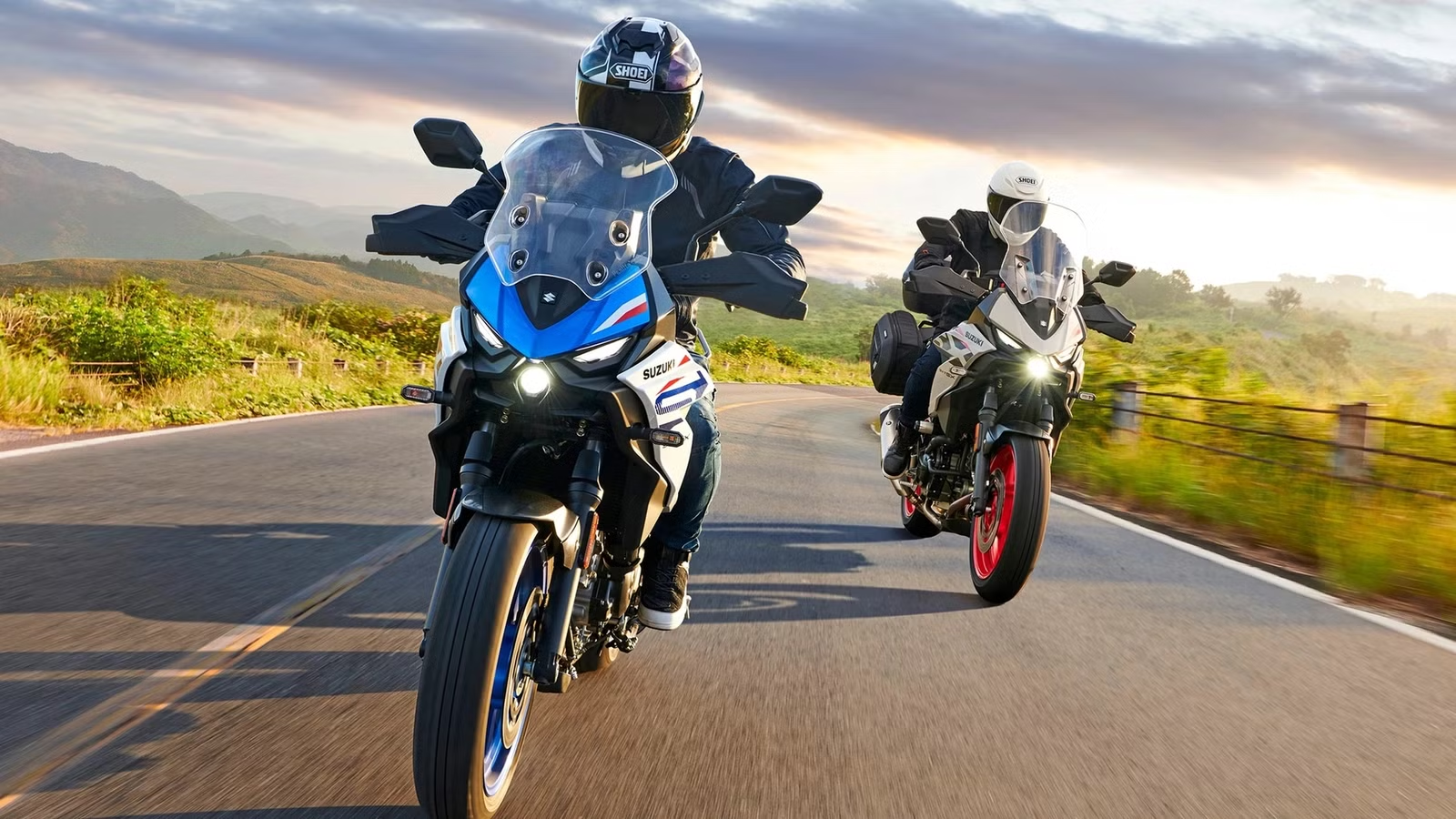
The 645cc V-twin powering the SV650 since 1999 didn’t get retired when Suzuki built a newer 776cc engine in 2023, and now it’s doing something new. There isn’t much technology exchange between cars and motorcycles, since just about everything in the two-wheeled world has to be engineered differently, but tech crosses over occasionally on newer bikes. Not that the V-twin engine is going to make an appearance in any car anytime soon (or ever), but it’s the segment name that, well, crossed over. Suzuki Cycles’ website now files this old but capable V-twin under a term borrowed straight from cars, “Crossover.” And this new machine is a really smart buy in its segment.
The Middleweight Crossover Segment Is Slowly Getting Hotter

As the word suggests, when a certain body type crosses over into another, a crossover is born. As much as that sounds weirdly PG-18, in car terms, it’s a fusion of, say, a sedan and an SUV or, more commonly, a hatchback and an SUV. Best of both worlds and master of none, you might argue, but there’s a solid global demand backing up this type of vehicle. Motorcycling adopted the label as well as the same philosophy. Adventure bike outlook with sport bike underpinnings and cycle parts. What’s not to love here?

This is why the popularity of such bikes is rising. Triumph, Honda, Suzuki, Yamaha, and BMW all have players in this crossover space, some even boasting multiple bikes. Things narrow down when you bring ‘V-twin’ into the mix, though. In fact, there’s only one true V-twin crossover right now, which is single-handedly taking the fight to inline-triple or parallel-twin rivals. It does that by offering stunning value in this heated space.
The Suzuki SV-7GX Is A V-Twin Crossover Bargain


Suzuki’s Crossover lineup has two bikes, and the 2027 SV-7GX is the newest kid on the block. In essence, it’s the modern version of an idea Suzuki tried a long time ago and shelved. Back in 1997, the XF650 Freewind was a mixed dual-sport running gear with street-leaning bodywork. A bike way ahead of its time, even before the term crossover was coined, and it never made it past Europe.

The SV-7GX finishes what the Freewind started back then, right when this category is ripe with contenders. And the value aspect comes from its starting price of $8,599, or $8,399 for the graphics-free trim, the SV-7GXV. Interestingly, the value proposition even extends to the motor, as it packs a reliable champ of an engine that has powered the SV650 and the V-Strom 650.
Why It Still Uses The 645cc V-Twin

For the SV-7GX, Suzuki had a newer engine sitting right there. The 776cc parallel-twin that powers the GSX-8R and S launched just a year apart from each other. With a newer bottom end and a 270-degree crank tuned for a broader spread of power, plus making meeting emission standards easier, reaching past it for the 645cc V-twin that’s been around since 1999 seems like a step backward. But it’s the pricing that’s a bigger factor, at which point Suzuki’s decision starts looking deliberate.

The 90-degree V-twin still makes 72.4 horsepower at 8,500 rpm and 47.2 lb-ft at 6,800 rpm, as well as packing the SV650’s reliability, but the output is really not the point here. Suzuki picking this engine hints at existing tooling for it. Twenty-seven years of production means the casting molds, the emissions certification path, and the supplier contracts are all already paid for, updated incrementally, with nothing requiring engineering from scratch. So, the SV-7GX gets to spend the savings elsewhere.
The SV-7GX’s Electronics Is Where That Difference Actually Went

Everything wrapped around the engine is new. Ride-by-wire throttle, three power modes, and a bidirectional quickshifter, none of which existed on this platform before. Plus, it now runs a five-mode traction control system that replaces the three-mode setup the V-Strom 650 has run for years, thanks to the ride-by-wire tech.

A 4.2-inch color TFT display runs Suzuki’s Ride Connect+ smartphone connectivity, with a USB-C port to keep a phone charged. Despite the contemporary bodywork, the tech isn’t exotic on its own, as rivals running newer, pricier engines have offered ride-by-wire and quickshifters for years. What’s notable is that Suzuki plastered the tech on an engine that’s possibly older than some of its buyers.
Suzuki Has Kept The Baby GX’s Chassis And Ergonomics Simple

The same logic that kept the engine unchanged carries into the chassis as well. Suzuki wrapped the value-focused SV-7GX around the SV650’s tubular steel trellis frame, running a 41mm fork with no adjustment beyond what the rear shock offers through seven steps of preload. Four-piston calipers bite twin 290mm discs up front, with a single 240mm disc doing braking work out back. Wheels are 17-inch cast aluminum wrapped in Pirelli Angel GT II rubber that rounds up the running gear.

Ergonomically, the SV-7GX splits the difference between its two donor bikes. The rider’s triangle is closer to the upright stance of the V-Strom 650, albeit being sportier. A seat height of 31.3 inches and curb weight of 465 pounds make it approachable for a rider stepping up or getting their first bike. Cruise control doesn’t make the cut here, and is the clearest sign of where Suzuki drew the line for pricier tech inclusion.
The SV-7GX Against The Kawasaki, Triumph, And Honda Crossovers

The Kawasaki Versys 650 LT ABS costs $10,399, and the extra $1,800 buys advantages like a 5.5-gallon tank for more range and a fork adjustable for both rebound and preload. But it’s heavier at 482.9 pounds, and its 649cc parallel-twin makes less power than the SV-7GX’s more character-rich V-twin. Elsewhere, the Triumph Tiger Sport 660 is the one with more power from its 659cc inline-triple. But it’s tech-laden with a six-axis IMU-linked cornering ABS and standard cruise control. It’s also a bike that is still priced competitively at $10,445, but that’s nearly a solid $2,000 more than the SV-7GX.

The Honda NC750X DCT brings an automatic gearbox into the mix, and adds a 23-liter storage compartment in place of a conventionally placed fuel tank. At $9,499, it’s the closest rival on price, but it’s also the heaviest of the four here at 497 pounds. Cost is the foremost factor here in favor of the SV-7GX, and all three rivals cost more. Yet, only the SV-7GX bundles ride-by-wire, a bidirectional quickshifter, and five-mode traction control into its $8,599 sticker price. That not only makes it a smart build by Suzuki, but possibly the smartest motorcycle buy of the year in this class.
Source: Suzuki

Related posts



Latest Post


No Comments