
Ford’s Forgotten Luxury Bruiser Has V8 Torino Cobra Power Without The Insane Price
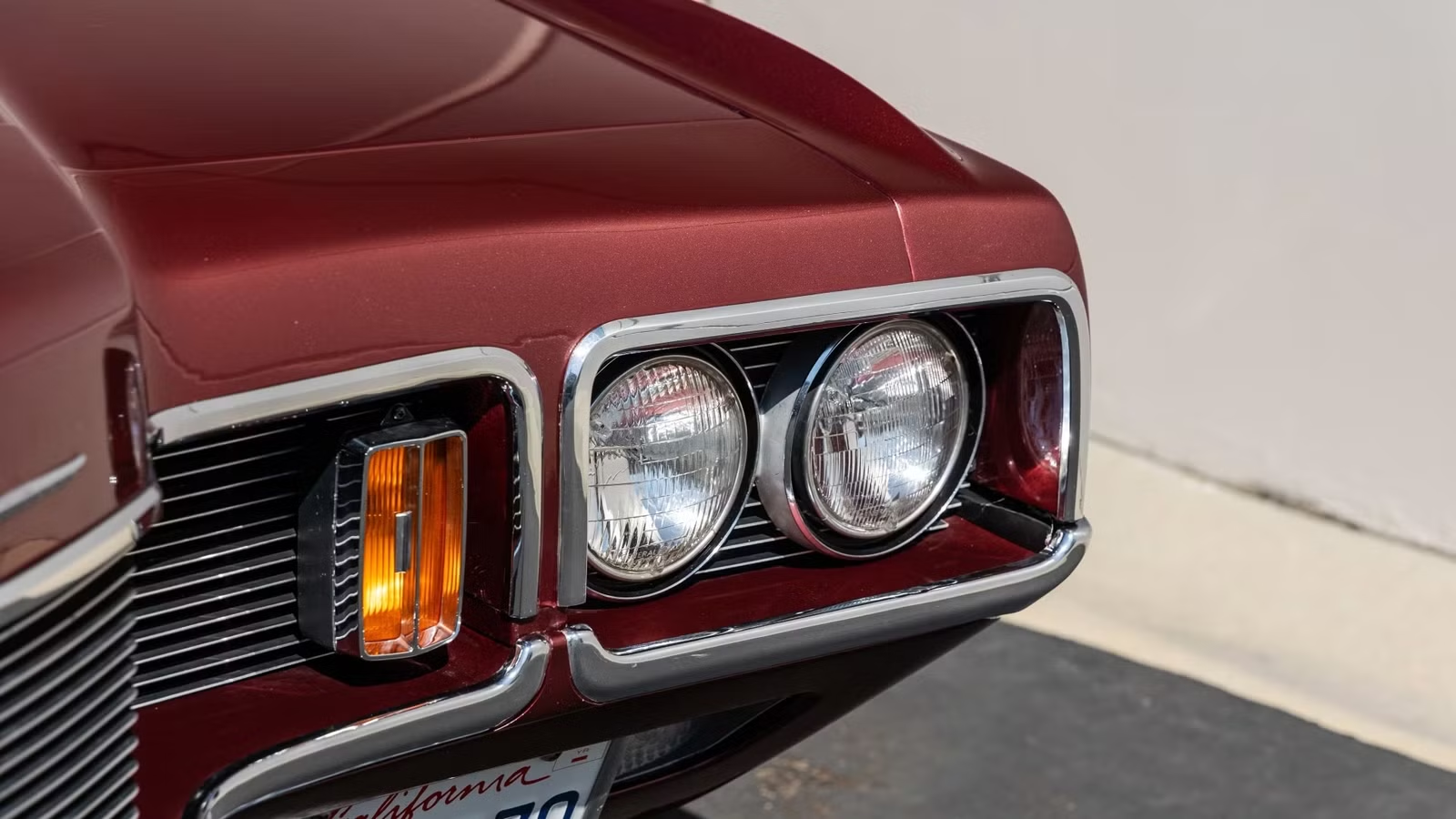
It’s like DNA doesn’t even matter when it comes to vintage cars, and that’s absurd. Despite delivering a similar potent punch as the Torino, one luxurious Ford coupe is being dismissed. It sells for the price of a used Toyota Camry, which is a slap to the face. Seriously, an iconic engine is hidden under plush amenities, and it sells for a fraction of the cost of Ford Torino models with stout power from the same engine family. But it’s being forgotten due to being marketed a bit differently.
The 1970 Ford Torino Cobra Steals The Spotlight

I have to give the 1970 Ford Torino Cobra its fair amount of credit for being one of the greatest muscle cars of the era. Avid collectors love to see it coming down the strip with its attractive sloping roofline and Coke-bottle body shape. Add the blacked-out grille, shaker hood, and Magnum 500 wheels to really get their motors running. But the true star is under the hood. The standard 429 cubic-inch (7.0-liter) Thunder Jet V8 comes out of the gate with 360 hp and 480 lb-ft of torque. Going for the available 429 Cobra Jet (CJ) variant increases the output to 370 hp and 450 lb-ft of torque. It’s hard to resist its Rochester Quadrajet four-barrel carburetor and 11.3:1 compression ratio.
However, the power gets turned up from there. Going for the 429 Super Cobra Jet (SCJ) drag pack gives you 375 hp and 450 lb-ft of torque with a Holley four-barrel carb, four-bolt main bearing caps, forged aluminum pistons, and an engine cooler. It’s believed to be highly underrated, with a real output that’s closer to about 425 to 450 hp.

The 1970 Ford Torino Super Cobra Jet can accelerate from 0 to 60 mph in about 5.8 seconds and complete a quarter mile in roughly 13.01 seconds at between 101 and 107 mph. It features a top speed of 136 mph. Muscle cars like the Pontiac GTO and Chevy Camaro hated seeing this beast on the track.

But The 1970 Ford Thunderbird Has Similar DNA

Unfortunately, the 1970 Ford Thunderbird sits in the Torino’s shadow, despite sharing its potent DNA. It features the standard 429 cu Thunder Jet V8 engine, which belongs to the 385-series big-block V8 family, like the Cobra Jet and Super Cobra Jet variants. In the Thunderbird, it produces 360 hp and 480 lb-ft of torque.
The Thunderbird is respectable, with the ability to accelerate from 0 to 60 mph in about 7.4 seconds. It covers a quarter-mile in around 16.4 seconds at between 83 and 85.6 miles per hour and has a top speed of roughly 120 miles per hour. It just never gained racing-enhanced engine variants to give it a little more muscle.

Unlike the Torino, the 1970 Thunderbird wasn’t designed for high-performance racing for NASCAR and drag strip dominance. It was built for smooth, luxury cruising, which is why the standard engine is paired with a three-speed automatic transmission for effortless power. Plus, the dual exhaust is tuned to suppress engine noise, though most enthusiasts would prefer a throaty, irresistible roar.
The Thunderbird has a body-on-frame build with a robust perimeter frame that includes complex rubber body mounts to prevent cabin vibration. It’s paired with the exclusive Ford variable-assist steering system that delivers increased fluid flow at lower speeds for easier parking, while reducing effort at highway speeds.
The Thunderbird Was Branded As A Dad Car

It’s safe to say the 1970 Ford Thunderbird doesn’t give a d@#* about its dad reputation as it gets ignored by a new generation. It rode on the same platform that was introduced in 1967, but got a significant redesign in 1970 that made it seem much longer than before thanks to a dramatic front-end update. It’s considered to be a full-size land yacht compared to the more compact, mid-size Torino. The Thunderbird is 215 inches long and 77.3 inches wide with a weight of 4,345 to 4,630 lbs, but still features impressive power for its size. The Torino is 206.2 inches long, 75.4 to 76.8 inches wide, and tips the scales at between 3,166 and 3,775 lbs.
The Thunderbird was marketed as a luxury cruiser and appealed to older, more mature buyers. By gaining four doors, it was seen as more family-friendly, and it wasn’t viewed as cool by younger drivers looking for thrills over practical performance and plush comfort.

The Thunderbird has a distinct Bunkie beak front grille and vinyl roof, which wasn’t seen as very trendy at the time. It hid the same standard engine as the Torino under deep pleated, button-tufted upholstery, enclosed wrap-around rear compartment seating, wood grain accents, cruise control with steering-wheel mounted buttons, power windows, power seats, and factory air conditioning.
The Thunderbird Is A 385-Series Steal

It might be worth giving the 1970 Ford Thunderbird another look if you want standard Thunder Jet V8 power for a fraction of the cost. Thunderbird models in poor condition that need significant mechanical or body restoration often sell for between $1,100 and $4,500. Examples in average condition with minor wear fetch between $10,500 and $17,000. Then the premium, highly original show-quality survivors often sell for around $20,000 to over $56,000. Four-door Landau models are a bit rarer than the two-door models. Also, the ultra-rare Thunderbird models that are equipped with the factory sliding sunroof often hold the most value.
But 1970 Ford Torino models with the same Thunder Jet V8 engine typically sell for between $25,000 and $28,000 when found in fair or project condition. Models in good or average condition that are ready for the road fetch around $39,000. Next, the Torino cars in excellent show car condition go for over $66,000.

However, don’t forget about the incredible Super Cobra Jet model. Torino models with this powerhouse sell for between $45,000 and over $105,000. Cars with the fastback SportsRoof usually hold the most value. Meanwhile, the Thunderbird gets left out of the conversation despite sharing Torino DNA, simply because it’s larger and more comfortable.
Source: Hemmings, Hagerty, How Stuff Works

Related posts

Latest Post


No Comments