
The Monstrous V12 Sedan Enzo Ferrari Wanted Was Buried By Fiat’s Lackluster Accountants
When you think about a Ferrari, your mind easily drifts to a low-slung, mid-engine two-door supercar. It has been that way since inception, as Enzo Ferrari made road cars primarily to fund his passion, which was racing. The idea of a practical, family-friendly Ferrari was treated as sacrilege by purists. But in the 1980s, Enzo Ferrari, a man notoriously rigid in his ways, had a desire to build the most exclusive GT sedan. It was a V12-powered, four-door luxury sedan that almost made it to production. But Fiat’s accountants killed the project.
Ferrari Needed To Grow, But Tradition Stood In The Way

The late 1970s were a period of intense identity reflection for Ferrari. The company had spent a decade perfecting the art of the mid-engine sports car with the 308 series and maintaining its front-engine grand touring lineage with the angular 400 series. But the global automotive landscape was shifting. The oil crisis of the 1970s had rewritten the rules of automotive luxury, and a new breed of wealthy buyers was emerging. These clients wanted the speed and prestige of a supercar but also the usability and elegance of a high-end luxury car.
Ferrari remained stubbornly committed to its two-door supercars. Meanwhile, Mercedes-Benz capitalized on this market with high-performance variants of the S-Class, Jaguar had the effortlessly smooth XJ12, and Maserati was proving that Italian flair could comfortably accommodate four doors with the Quattroporte.
The Luxury Sedan Market Was Changing Faster Than Ferrari

Maranello was not entirely blind to this shift. The 1976 Ferrari 400 GT was a clear admission that their customer base was changing. It had a front-mounted V12, a comfortable 2+2 configuration, and, most shocking of all to purists, an optional three-speed automatic transmission sourced from General Motors. It was a car designed for effortless high-speed cruising rather than attacking apices on a racetrack. The 400 GT proved that Ferrari buyers were willing to trade raw track performance for comfort. This created a massive dilemma for Enzo Ferrari. The company needed to grow, but doing so conflicted with the Ferrari way, and that tension prevented it from entering the four-door market.

One Design House Believed Ferrari Could Build A Four-Door Without Losing Its Soul

By 1980, the legendary design house Pininfarina was preparing to celebrate its 50th anniversary. They decided that the ultimate tribute to their history of designing Maranello’s finest machines would be to build the one vehicle Ferrari itself refused to make: a four-door sedan. The task of sketching this rule-breaker fell to Leonardo Fioravanti, the visionary design director at Pininfarina, who had already penned iconic shapes like the Ferrari Daytona, the 308 GTB, and the Berlinetta Boxer. Working alongside designer Diego Ottina, Fioravanti approached the project not as a compromised sports car, but as a masterclass in modern aerodynamics and clean styling. The car had to look like a Ferrari but also feel futuristic, cohesive, and worthy of the prancing horse badge.
The Ferrari Pinin Was The Sedan Enzo Ferrari Wanted To Build

The car was launched at the 1980 Turin Motor Show and was finished in a striking metallic silver paint. It was simply named the Ferrari Pinin, in honor of the design house’s founder. Visually, it looked like nothing else on the road, balancing traditional Ferrari aggression with an ultra-clean, futuristic aesthetic. The car was built on a Ferrari 400 GT chassis that had been stretched by 50 mm to accommodate a genuinely spacious rear cabin. The Pinin had classic, elongated proportions, with a long hood that sloped gently down to a wide egg-crate-style Ferrari grille. But it was the details that truly set the Pinin apart from the competition.
First, the A and B pillars were wrapped in flush-mounted glass, creating the illusion of a continuous, unbroken glass canopy around the cabin—a feature decades ahead of its time. The wipers retracted completely beneath the lip of the hood line to optimize aerodynamic efficiency and maintain a clean profile. Ultra-thin multi-lens headlights were specifically developed for the car. At the back, the traditional quad round Ferrari taillights were cleverly concealed behind a silver-painted mesh panel, rendering them invisible until the driver stepped on the brakes or activated the turn signals.

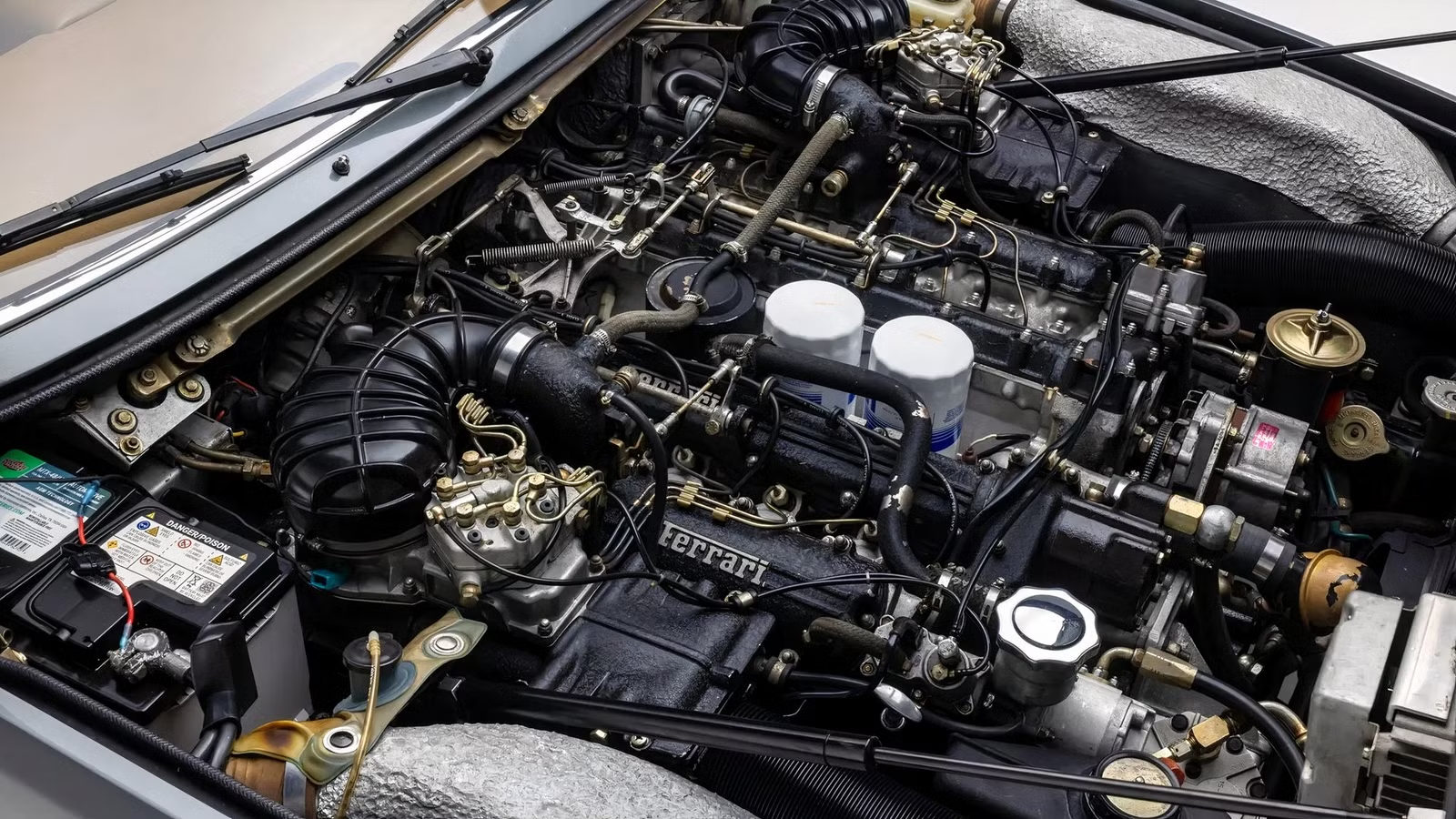
Under that long, sloping hood was supposed to sit a 4.9-liter flat-12 engine borrowed from the Ferrari 512 BB, but the show car was just a mock-up without a functional engine. Inside, it featured a fully digital dashboard that remained completely blacked out until the ignition key was turned, secondary climate and audio controls neatly integrated into the rear armrest for passengers, a multi-zone ventilation system, and Connolly leather throughout. Enzo Ferrari loved it and discussed putting the car into limited production. It was exactly the type of executive car he had always wanted to drive.
Fiat’s Accountants Ended The Dream Before It Began

However, Enzo Ferrari no longer held absolute control over his company. In 1969, he had sold a 50% stake in the company to Fiat, giving it final veto power over mass production projects. While Enzo championed the Pinin, Vittorio Ghidella, the clinical, numbers-driven chief executive of Fiat’s automotive division, looked at the project through a strictly financial lens and shut it down. The financial arguments against it were valid.
Engineering the Pinin’s unique flat-12 for long-term road reliability, crash compliance, and global emissions standards would require a massive capital investment that the boutique manufacturer could not afford. Second, Fiat management doubted whether Ferrari’s relatively small production facilities could match the build quality, NVH (Noise, Vibration, and Harshness) suppression, and long-term durability standards already established by heavyweights like Mercedes-Benz and Jaguar. Most importantly, Fiat was heavily focused on deploying its financial and engineering resources toward saving its own business, leaving no room for a low-volume, high-risk luxury experiment. The Pinin was quietly relegated to the status of a show car.
Ferrari Finally Built The Pinin Decades Later

Following its cancellation, the Pinin spent years as a piece of automotive art. In the mid-1980s, Jacques Swaters, a close personal friend of Enzo Ferrari and a prominent Belgian Ferrari importer, purchased the static concept car directly from Pininfarina to add to his renowned collection. The car remained in a preserved, non-running state for over two decades, passing through the hands of dedicated collectors who appreciated its historical significance but viewed it strictly as a static sculpture.
In 2008, the Pinin crossed the auction block at an RM Auctions event in Maranello. It sold for a modest €176,000 (approximately $202,000) to a visionary European collector who believed that a vehicle built by Ferrari and Pininfarina deserved to do more than sit quietly under a spotlight. They believed it deserved to breathe, roar, and be driven down the open road.
From Static Show Car To Running V12 Masterpiece

To turn this dream into reality, the new owner commissioned Mauro Forghieri’s Oral Engineering to undertake an extensive mechanical conversion in 2010. Forghieri was no ordinary engineer; he was the legendary former technical director of Ferrari’s Formula 1 team and the man who had overseen the development of the company’s iconic flat-12 racing engines during the 1970s. There was no one on earth better suited to breathe life into the dormant Pinin.
The restoration took roughly a year and a half of meticulous engineering work. Forghieri’s team sourced an authentic, era-correct 4.9-liter flat-12 engine from a 512 BB, making 360 hp and 331 lb-ft of torque. When the flat-12 turned over for the first time, the Pinin ceased to be a mere concept; it became a living, breathing mechanical masterpiece. In 2015, the now fully operational four-door Ferrari found its way to a new custodian, selling into the private collection of the Nobles family museum in California, where it remains today.
Ferrari Eventually Built The Cars The Pinin Predicted Four Decades Later

Ferrari had repeatedly sworn that the company would never build a four-door production vehicle, claiming that extra doors compromised the brand’s sporting DNA. Instead, they pushed the boundaries of practicality through unconventional two-door designs. They introduced the all-wheel-drive FF in 2011 and its successor, the GTC4Lusso, in 2016. Both had a shooting-brake layout to maximize rear cabin passenger space while technically abiding by the strict “two-door” company policy.
In 2022, Ferrari unveiled the Purosangue, another type of car they said they would never make. The Purosangue became the first Ferrari SUV and the very first four-door vehicle to enter mass production in Ferrari’s history. The evolution did not stop there. As the automotive industry moved toward electrification, Ferrari has given us the Luce. Boasting a striking price tag that mirrored the original €550,000 ($630,000) high-end auction estimates of the Pinin concept during its early 2011 resale valuations.
The Pinin Remains the Only Ferrari Four-Door Sedan In History

Despite the arrival of the high-riding Purosangue and earlier grand tourers, the 1980 Pinin retains a sacred position in the history of the Prancing Horse. It remains the only factory-backed four-door sedan ever to wear the Ferrari badge. The Pinin was not a design failure or a misguided marketing gimmick. It was a brilliant piece of forward-thinking engineering that accurately predicted the future of the luxury car market forty years before Ferrari finally embraced it. It stands as a beautiful testament to a time when a designer won Enzo Ferrari over but was not allowed to build what he had envisioned.
Sources: Ferrari, RM Sotheby’s, Classic Driver.

Related posts


Latest Post


No Comments