
10 Air-Cooled Japanese Superbikes Built to Last
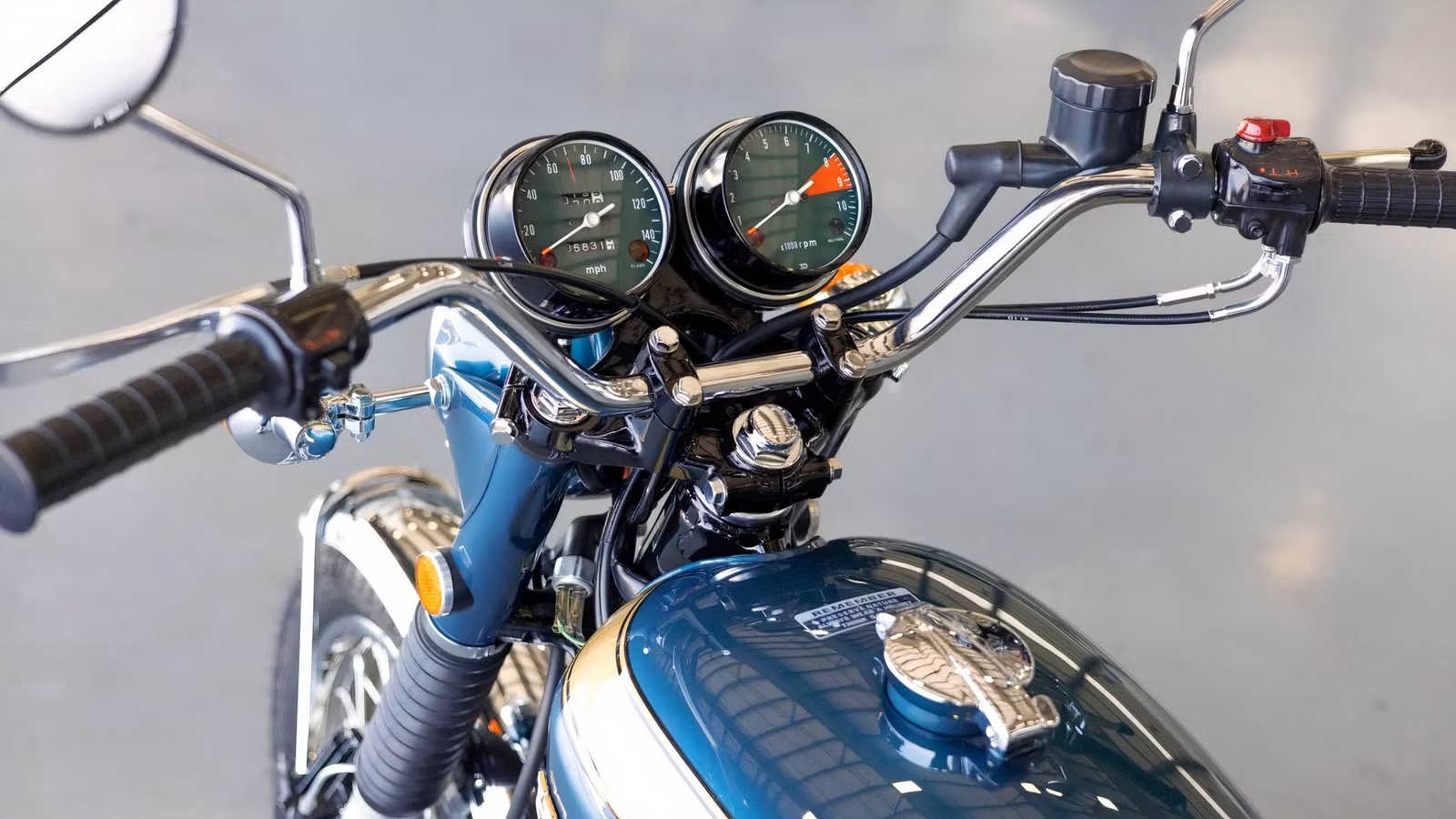
No radiators. No coolant hoses. No water pump waiting to fail. Just fins, oil, and metal cast heavier than it needed to be, and that’s the whole secret. These ten air-cooled Japanese classics didn’t earn a reputation for practically lasting forever by accident; they earned it by routinely clearing 100,000 miles on the original bottom end.
10
Honda CB750
Peak Power: 67 HP, Peak Torque: 44 lb-ft

Honda launched the CB750 in 1969 with a single overhead cam, doubled to DOHC a decade later in 1979, and didn’t chase numbers, just 67 horsepower from a conservative 9.0:1 compression ratio and thick crankcase castings that kept it under-stressed by design. Even better, valve adjustment required only a screwdriver and a feeler gauge on the kitchen table, not a dealer visit, so owners actually did it. Low stress plus simple maintenance turned out to be the whole formula, and the CB750 wrote the book on six-figure durability because of it. Owner archives are full of original SOHC bottom ends clearing 100,000 miles without ever cracking a case open. Parts are everywhere and the mechanicals are simple enough that it’s still one of the easiest classics to live with, not just admire in a garage.
9
Suzuki GS750
Peak Power: 68 HP, Peak Torque: 44 lb-ft

Suzuki’s first four-stroke inline-four arrived in 1976 as the 748cc DOHC GS750, taking the roller-bearing crank concept its rivals pioneered and quietly doing it one better, with a stronger oil pump and tighter bearing tolerances. A rigid double-cradle steel frame kept flex away from the engine mounts, and shim-over-bucket valves held their clearances for thousands of miles between checkups. Making 68 horsepower at 8,500 rpm, the GS750 proved multi-cylinder Japanese bikes could pair a tough bottom end with handling that didn’t feel like a compromise. Period road tests and modern owner registries both record survivors well past 100,000 miles on original pistons, rings, and crankshafts. That reputation still makes it the pick for riders who want mechanical simplicity over complex electronics.

8
Kawasaki Z1 / KZ1000
Peak Power: 82 HP, Peak Torque: 54.2 lb-ft

Kawasaki dropped the 903cc Z1 in 1972, then grew it into the 1,015cc KZ1000 by 1977, around a pressed-together crankshaft on heavy-duty roller and needle bearings, not the plain journal bearings that can score or seize if oil pressure dips. Drag racers noticed. They spent the rest of the decade cramming more power through those cases than Kawasaki intended, and the cases just shrugged it off. Stock output ran 82 to 90 horsepower, modest by later standards, but these big-bore fours built their reputation on abuse, not numbers. Touring riders and drag racers alike have pushed stock KZ bottom ends well past 100,000 miles on the original crank, an odd thing for such different riders to share. That toughness keeps them prized today for restorations and high-horsepower builds alike.
7
Suzuki GS1000
Peak Power: 90 HP, Peak Torque: 61.5 lb-ft

Suzuki rolled out the 997cc DOHC GS1000 in 1978, the GS750 stretched to liter-class size, and somehow trimmed nearly 50 pounds off rival frames like the ones of Yamaha XS1100 while doing it. The needle-and-roller bearing crank carried over, paired with deeper cooling fins and a larger oil capacity that kept temperatures in check through hours of highway cruising instead of cooking the center cylinders. Making 90 horsepower at 8,500 rpm, the GS1000 didn’t just talk a good game; it won endurance races like the Castrol Six Hour to prove it. Touring riders regularly logged 120,000 miles or more on stock engines without ever pulling the bottom end apart. It’s still one of the most dependable 1,000cc air-cooled superbikes you can buy today.
6
Kawasaki KZ1000-P Police
Peak Power: 92 HP, Peak Torque: 63 lb-ft

Produced from 1982 through 2005, the KZ1000-P was Kawasaki’s dedicated municipal fleet bike, built on the 998cc J-series engine and making roughly 88 to 92 horsepower. This bike had one job: guard the streets, serve, and protect. Built for severe municipal duty, hot idling, curb hits, and wide-open pursuits, the KZ1000-P spent two decades proving its toughness on the clock, not on paper. Departments typically ran them 50,000 miles or more, some well past 100,000, before decommissioning and auctioning them off. Used examples today are affordable, durable, and backed by a deep pool of replacement parts.
5
Yamaha XS1100
Peak Power: 95 HP, Peak Torque: 66.5 lb-ft

Yamaha arrived late to the liter-bike party in 1978 with the 1,101cc DOHC XS1100, built more like a freight train than a motorcycle. Its 8-valve inline-four made 95 horsepower and 66.5 lb-ft of torque, sent through a shaft final drive that eliminated chain wear and adjustment altogether. Tall 5-speed gearing let the engine loaf at low RPM on the highway, resulting in less mechanical wear over long journeys. At over 600 pounds wet, the XS1100 earned a reputation for shrugging off long-distance abuse that would put lighter bikes in the shop. Rally riders have documented 150,000 to 200,000-plus miles on stock engines and shaft-drive units without a major teardown. For low-maintenance, high-mileage touring, the Eleven still holds its own.
4
Suzuki GSX-R750 (1985-1987 SACS)
Peak Power: 106 HP, Peak Torque: 52 lb-ft

The original 1985-1987 GSX-R750 bridged air cooling and modern superbike design with the Suzuki Advanced Cooling System, or SACS, and the idea was delightfully low-tech. Instead of heavy liquid-cooling radiators, SACS used a high-volume oil pump to spray oil jets at the undersides of the piston domes and combustion chambers, giving race-level heat control without a single radiator, water pump, or coolant hose. At 388 pounds dry on a claimed 100 horsepower, the early GSX-R750 undercut its 750cc rivals by 20 percent or more, and its oil-cooled engine won the 1985 Le Mans 24 Hours in its first season. Street survivors still handle high-RPM use well past 80,000 miles on nothing more than basic oil changes. Every liquid-cooled sportbike that followed owes something to an engine that never needed a radiator to keep up.
3
Suzuki GSX1100S Katana
Peak Power: 111 HP, Peak Torque: 70.9 lb-ft

The 1981 GSX1100S Katana took the GS1100E’s running gear and wrapped it in radical Target Design bodywork that either turned heads or turned stomachs. Its 1,074cc 16-valve TSCC engine made 111 horsepower on the same roller-bearing crank and 5-speed transmission, with a small fairing scooping air across the cylinder fins at speed. Built for high-speed European touring, the Katana held up well on sustained autobahn runs, and owner registries there document bikes crossing 150,000 kilometers (over 93,000 miles) on original hardware. That love-it-or-hate-it styling and over-engineered GS mechanicals still make it a favorite for restomod builders today.
2
Suzuki GS1100E
Peak Power: 108 HP, Peak Torque: 67 lb-ft

The 1,075cc GS1100E showed up in 1980 with Suzuki’s new 16-valve Twin Swirl Combustion Chamber head, for better air-fuel mixing and 108 horsepower without cooking the cylinders. Underneath sat the strongest version of Suzuki’s roller-bearing crank yet, wrapped in reinforced crankcases built to shrug off serious torque. That reinforced bottom end made the GS1100E a favorite base for drag racers chasing power with a supercharger or nitrous bolted on. For street riders, oil changes and routine valve adjustments were enough to push the odometer past 100,000 miles without a single mechanical failure.
1
Honda CB900F / CB1100F Super Sport
Peak Power: 110 HP, Peak Torque: 72.2 lb-ft

Honda’s CB900F, 1980-1982 in the US, and CB1100F, 1983, took endurance-racing know-how straight to the street. Their 901cc and 1,062cc DOHC 16-valve engines used dual cam chains to cut valvetrain whip and stretch, and Honda rubber-mounted the engines to keep high-frequency vibration off the chassis and the rider’s hands. Making 95 to 108 horsepower between the two, they didn’t just look the part; Freddie Spencer proved it by winning Daytona’s opening round on one in 1982. On the street, well-maintained examples still deliver 80,000 to 100,000 miles on original pistons and cylinder bores. Fourteen years after the CB750 started this story, the CB1100F carried it forward through the decades.
Sources: Honda, Suzuki, Yamaha, Kawasaki, Mecum

Related posts

Latest Post


No Comments