
Why This Honda CBR Is The Japanese Sports Bike That Can Do It All
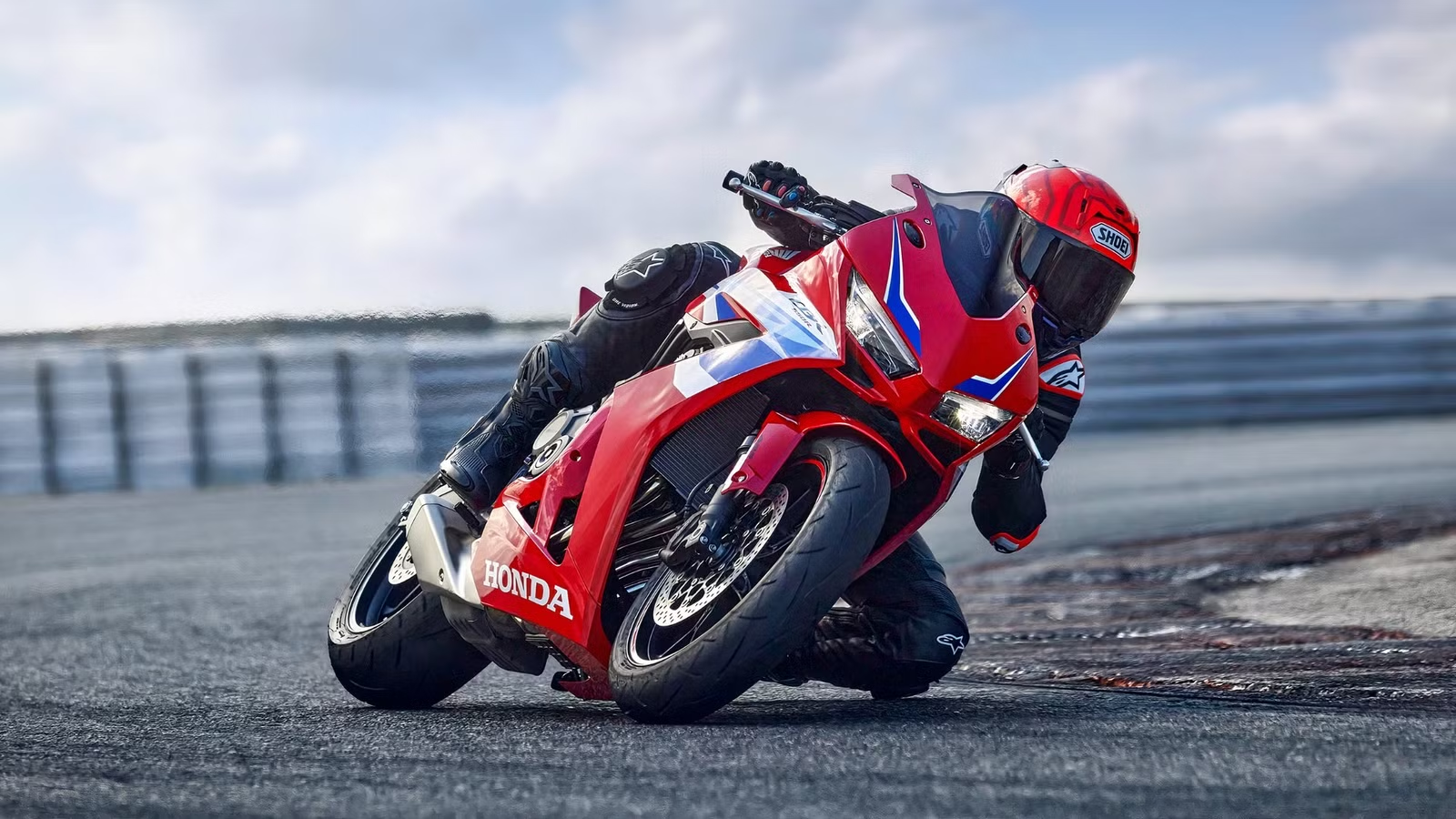
Few segments in motorcycling spark as much debate as the middleweight sports bike class — and for good reason. These machines have to earn their keep across a wide range of riding situations, from canyon carving on weekends to grinding through rush-hour traffic on Monday morning. One bike in this class has quietly built a reputation for doing exactly that: a Honda with a four-cylinder engine, a sharp Fireblade-inspired look, and a powertrain trick that no rival can match. It offers a relatively relaxed rider triangle by sports bike standards, and that clever powertrain feature is the primary reason this machine works equally well as a track tool, a daily commuter, a corner carver, and an occasional highway companion.
The Honda CBR650R E-Clutch Can Do It All
Price: $9,199

As the only fully faired middleweight sports bike with an e-clutch, the Honda CBR650R knows how to stand out. Pivoting from its aggressive and sporty character to a more usable and road-friendly setup, the Honda is a sports bike designed to do it all. Sure, it looks aggressive, like its liter-class big brother, but the aggression essentially ends there. The combination of a linear inline-four and a clever electronic clutch elevates the daily rideability and practicality of this CBR. The chassis and hardware are refreshingly straightforward, and the technology suite includes only what is genuinely needed to enhance the riding experience. A TFT color display brings Honda RoadSync to the party — Bluetooth connectivity that lets the rider handle calls, messages, music, and navigation through dedicated handlebar toggles. While the CBR650R is fundamentally a sports bike, its relatively relaxed rider triangle and linear power delivery make it a machine you can genuinely live with every day.
An Inline-Four Engine That Is Both Sporty And Practical
The Magic Ingredient Here Is An E-Clutch
Honda has tuned the CBR650R’s inline-4 for usability rather than outright performance. The 649 cc four-cylinder produces 93 horsepower and 46 pound-feet of torque — figures that arrive at 12,000 RPM and 9,500 RPM, respectively, making this a genuine high-revving screamer. Honda has simply spread that performance across a broader, more accessible powerband. Pair that with the e-clutch system, and you have a four-cylinder sports bike that is designed not to intimidate a newer rider.
How Does The E-Clutch Work?


Honda’s e-clutch uses two small electric motors to engage and disengage the clutch automatically — think of it as the motorcycle equivalent of an automated manual transmission in a car. The system does not eliminate the traditional clutch lever; instead, it acts as an alternative, and the rider can override it at any time. In practice, it functions as both a clutch and a blipper rolled into one. The rider is not required to use the clutch lever even when coming to a complete stop — the e-clutch handles that automatically. It also doubles as a parking brake of sorts, since the clutch engages automatically when the motorcycle is switched off. And if you simply prefer the old-fashioned way, Honda includes an off switch in the menu that returns the CBR650R to a conventional transmission and clutch setup.
Advantages Of Honda’s E-Clutch
- No stalling
- Reduced rider fatigue
- Clutchless gear shifts
- Offers manual override
- Doubles up as a quickshifter
- Smooth and precise gearshifts
- Easier for new riders to learn to ride a motorcycle
Engine And Gearbox Specs
|
Engine Configuration |
Inline-four; Liquid-Cooled |
|
Engine Displacement |
649 cc |
|
Bore X Stroke |
2.6378 X 1.8110 in. (67 X 46 mm) |
|
Compression Ratio |
11.6:1 |
|
Power |
93.8 HP |
|
Torque |
46.4 LB-FT |
|
Fueling System |
PGM-FI Electronic Fuel Injection With 32 mm Throttle Bodies |
|
Transmission |
6-Speed Manual With E-Clutch |
|
Final Drive |
Chain drive |
A Great First Middleweight For Road And Track
Simple Underpinnings That Make Things Work

The 649 cc four-cylinder engine sits in a steel diamond frame, suspended by 41 mm inverted forks up front and a preload-adjustable monoshock at the rear. The front forks use Showa’s Separate Function Fork Big Piston design, which splits the spring and damping functions between the two fork legs for more refined suspension feedback. The version fitted to the CBR650R is a cost-conscious implementation, however, and does not offer any external adjustability.
Chassis And Hardware Specs
|
Frame |
Steel Diamond Frame |
|
Front Suspension And Travel |
41mm Inverted Forks With 4.7 inches Of Travel |
|
Rear Suspension And Travel |
Preload-adjustable Monoshock With 5.0 inches Of Travel |
|
Front Tire And Wheel Size |
120/70-17 Tire Wrapped Around A 17-inch Alloy Wheel |
|
Rear Tire And Wheel Size |
180/55-17 Tire Wrapped Around A 17-inch Alloy Wheel |
|
Front Brakes |
Dual 310 mm Discs Coupled To Radial-mounted 4-piston Fixed Calipers |
|
Rear Brakes |
240 mm Disc Coupled To A Single Piston Floating Caliper |
Braking is handled by 310 mm dual discs up front and a single 240 mm disc at the rear, with floating calipers at both ends and dual-channel ABS as standard. The tire sizes strike a balance between track capability and road comfort, while the chunky 180-section rear adds a welcome dose of visual drama.
Looks Like A Mini Fireblade
Sans Integrated Winglets

The CBR650R’s design refresh draws clear inspiration from the CBR1000RR-R Fireblade SP, sharing its sharp LED lighting assembly and sweeping fairing lines. The front fascia neatly conceals twin air ducts positioned below the headlights. A Grand Prix Red color option is available, directly echoing Honda’s flagship sports bike. The official accessories catalog is focused rather than exhaustive, but it covers the essentials for comfort, styling, and practicality:
- Tank bag
- Rear seat bag
- Tank pad
- Knee pads
- Passenger seat cowl
Dimensions And Weight
|
Length |
83.9 inches |
|
Wheelbase |
57 inches |
|
Rake |
25.5 degrees |
|
Trail |
4.0 inches |
|
Seat Height |
31.9 inches |
|
Ground Clearance |
5.2 inches |
|
Curb Weight |
466 pounds |
The Only Automatic Sports Bike In The Segment
Rivals Fall Behind In Practicality
The most affordable rival to this Honda is the Kawasaki Ninja 650, though it trails significantly in outright performance. In terms of power, the Triumph Daytona 660 comes closest and is also priced lower. Like the Honda, Triumph has taken the balanced approach — blending daily rideability with genuine sportiness — with the revived Daytona nameplate. That may not sit well with purists, but it is a smart play for attracting new riders. Even so, the CBR’s e-clutch and TFT display alone go a long way toward justifying the premium over the Triumph.
2025 Honda CBR650R E-Clutch Vs Rivals
|
Honda CBR650R E-Clutch |
Kawasaki Ninja 650 |
Triumph Daytona 660 |
Yamaha YZF-R7 |
Suzuki GSX-8R |
|
|
Starting Price |
$9,899 |
$7,399 |
$9,195 |
$9,199 |
$9,699 |
|
Engine |
649 cc Inline-4; Liquid-Cooled |
649 cc Parallel-Twin; Liquid-Cooled |
660 cc Inline-3; Liquid-Cooled |
689 cc Parallel-Twin; Liquid-Cooled |
776 cc Parallel-Twin; Liquid-Cooled |
|
Power |
93.8 HP |
67 HP |
95 HP |
74.8 HP |
83.1 HP |
|
Torque |
46.4 LB-FT |
48.5 LB-FT |
50.9 LB-FT |
50 LB-FT |
57.5 LB-FT |
|
Transmission |
6-Speed Manual With E-Clutch |
6-Speed Manual With Conventional Clutch |
6-Speed Manual With Conventional Clutch |
6-Speed Manual With Conventional Clutch |
6-Speed Manual With Conventional Clutch |
|
Curb Weight |
458.5 pounds |
423.4 pounds |
443 pounds |
414 pounds |
452 pounds |
The Yamaha R7 is priced similarly to the Triumph and undercuts the Honda, yet it trails in performance despite carrying a larger engine. The Suzuki GSX-8R, meanwhile, is the rival that comes closest to matching the Honda’s price. It brings a distinctive look and a relatively fresh parallel-twin engine to the segment, and while its displacement exceeds the CBR’s, it still lacks the character of a four-cylinder and falls short on peak power.
Sources: Honda Powersports, Kawasaki, Triumph, Yamaha Suzuki

Related posts
Latest Post


No Comments