
The Windsor V8 Wagon Ford Never Sold in America
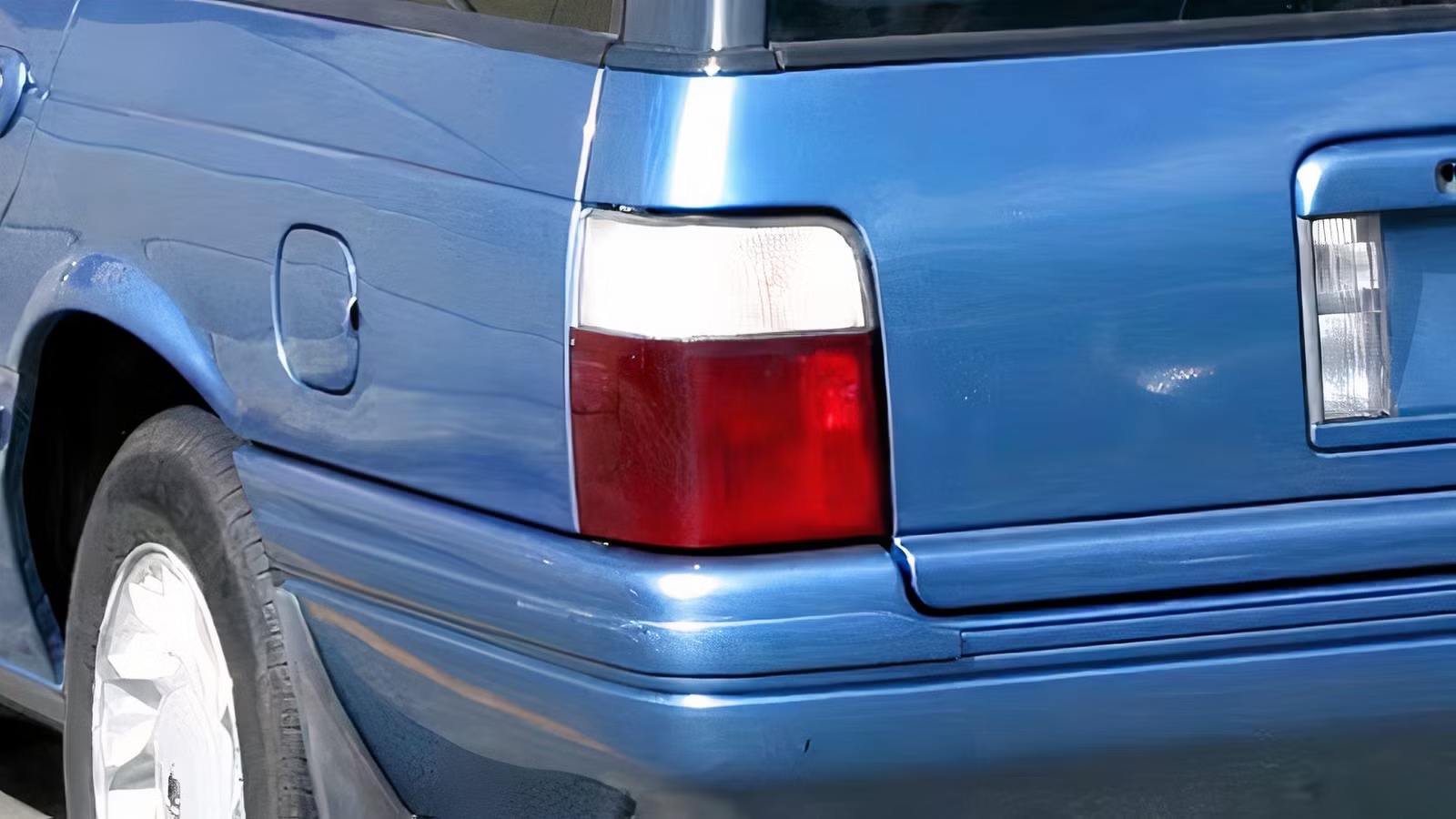
Picture Ford’s legendary 5.0-liter V8 in a station wagon. And not just any station wagon: an unassuming people mover that packs a tow rating high enough to embarrass your neighbor’s SUV. Or midsize pickup truck. Sounds too good to be true? Ford actually built this rootin’ tootin’ long-roof monster. But the Blue Oval never sold it in the U.S.
Fans Of RADWood-era Fords All Know The Windsor V8

Every generation of Ford fans has its V8. Boomers can talk about FE big-blocks all day. Younger enthusiasts worship the Coyote. Almost anyone who loves a Blue Oval born in the 1980s or 1990s has a soft spot in their heart for the Windsor V8. And to be fair, it may be the most honest engine in history.
The Windsor V8’s motto might as well be, “In displacement we trust.” Its calling card: low-end torque. It created its power the old-fashioned way: cast iron block, two valves per cylinder, and pushrods making the entire thing sing. While many more “advanced” engines of the day left drivers stranded, Windsors just kept going. And they proved absurdly simple to repair.

Even its name is no frills. “Windsor” is just the name of the Canadian factory town across the Detroit River where Ford has built multiple generations of V8s. The Windsor was honest enough to stamp its hometown on its valve covers and call it a name. If Forrest Gump were an engine, I like to think he’d be a Windsor V8. And this engine might be tied to as much of American history as Mr. Gump.

Ever heard of the fox-body Mustang with its famous 5.0 HO? What about the V8-powered F-150 bullnose, bricknose, or aeronose? Or the same era’s full-size Bronco? How about the Crown Victoria/Mercury Grand Marquis/Lincoln Town Car that seemed to account for every single taxi, police car, and limo in the U.S. for decades? I thought so. In that case, you’ve heard of the Windsor V8. The only thing America never got a Windsor V8 in was a wagon. But entire continents did.
Australia Was Already Running V8s In Family Wagons

In the modern USA, we’ve been convinced towing a trailer requires an SUV or a truck. And performance is left to coupes or sedans. So it’s difficult to imagine a high-output wagon. But the tradition of muscle wagons has a long proud history in Australia. In 1968, the Holden Monaro HK GTS 327 wagon concept borrowed a 327 cu-in Chevy V8. The result was a 250 horsepower wagon that never actually hit the market. But the image proved so popular, that Holden sold the Torana LH SLR 5000 in the 1970s, with its proprietary 308 cu-in V8 that made approximately 240 horsepower. That’s enough power to scare off a rabid kangaroo!
By 1990, Holden had realized that buyers would pay for wagons that could actually corner. The HSV VN Sport Wagon (90-91) mated Holden’s 241-horsepower 5.0-liter V8 with an automatic or 5-speed manual. Toss in big brakes and a sport suspension, and you had a real track monster.

Mitsubishi realized there was a serious Australian market for performance wagons and launched the Magna Sports Wagon in 1991. Its 3.0-liter V6 was comparatively practical for day-to-day life, and that may be why it lasted through the 1996 model year. Australian wagons could also tow a ton (or two). The 1995 Holden Commodore VS wagon was rated for a 4,630-pound braked payload. When Subaru tried to launch its Liberty Touring Wagon in Australia, it knew towing was important to the market. So it advertised its wagon with a 3,306-pound tow rating.
Ford has long been a major play in the Australian market. Its wagons were less slammed minivans and more “mate, hold my Foster’s.” But by the early 90s, its best was yet to come.
Australia’s Windsor-Powered Family Hauler Americans Never Got To Buy

Ford introduced the “EF” generation of its full-size Australian car chassis in 1994. It was available as a sedan or wagon. The entry-level model name was Ford Falcon, while luxury vehicles on the same chassis were badged as the Ford Fairmont. And both badges were available with the 5.0-liter Windsor V8.
This EFI engine made 228 hp at 4,500 rpm and 294 lb-ft at 3,000 rpm. The vehicle was rated for a braked trailer up to 5,071 pounds—depending on the vehicle’s configuration. Ford introduced the “EL” generation of this chassis in 1996.
In the 1994–1996 generation, buyers could pair the 5.0-liter V8 with a 5-speed stick-shift transmission. But Ford has not kept records of how many wagon buyers actually opted for this configuration. Starting in 1996, the EL-generation Falcon only built stick-shift V8 cars in one trim. That was the XR8 performance sedan. The XR8 was never available as a wagon, so a V8/stick shift was no longer available in a wagon body.
Not Every Falcon/Fairmont Trim Came As A Wagon

The entry-level 1994-96 (EF generation) Ford Falcon trim was the GLi, available as a sedan or wagon. The mid-trim option was the Futura, also available as a sedan or wagon. The luxury version of the platform was the Ford Fairmont, which you could order as either a sedan or a wagon. The 5.0 wasn’t locked behind a paywall: Ford Australia let buyers option even an entry-level trim car with a V8.
There were two interesting outliers. The absolute top trim, the “Ford Fairmont Ghia,” had a high-end audio system as well as a generous chrome grille and a high-output engine. It was only available as a sedan.

Ford’s high-performance variants were the XR6 and XR8. The XR6 had a 4.0-liter inline six-cylinder with a 2.5-inch exhaust that helped it make 220 hp, along with sport suspension and either a manual transmission or an automatic with tuned shift points. It was available as a wagon. The XR8 was a similar car but had—you guessed it—a Windsor V8. The XR8 was not available as a wagon.
The EL-generation Falcon dropped in October 1996. It’s easy to spot because Ford began installing grilles (albeit decorative and non-operational ones) on all trims, not just luxury Fairmont cars. Ford kept the same trims and configurations with one major difference:
Every single non-XR8 V8 car now came with a four-speed automatic transmission. One major technical change was a rollback. The EF came with a coil-pack ignition system. When buyers complained it was unreliable, Ford swapped the EL back to a distributor-style ignition system.
Finding A V8-Powered Ford Wagon May Take Some Luck

Ford’s late-1990s V8 Australian wagons are generating a ton of online buzz right now. And for good reason. They’re an exotic muscle wagon with a known engine. And they now qualify for the U.S. rule allowing the import of any vehicle 25+ years old. There’s only one problem: Even if you went to search the Outback yourself, you’d be hard-pressed to find one of these unicorns.
The good folks at Australia’s “Ford Mods” forum know EF and EL Falcons as well as anyone down under. One user (the proud owner of a Fairmont Ghia) reached out to Ford Australia to track down production numbers for V8 wagons.
It appears that Ford Australia didn’t start tracking these numbers until the EL generation. In 1996, it built just 40 V8 wagons (10 Falcon GLi V8 wagons and 30 Ford Fairmont V8 wagons). In 1997, those numbers rose to 36 Falcon GLi wagons with a V8, and 68 Fairmont wagons with a V8 (104 in total). That’s just 144 V8 wagons across the entire generation.
Go back in time to the EF generation (1994-1996), and Ford’s paperwork wasn’t separating sedan and wagon trim. We do know that during this generation, it built 215 GLi V8s, and 775 Fairmont V8s (both sedans and wagons). Based on these numbers, a quick back-of-the-envelope calculation puts the wagon take rate during the EL generation at around 27%. Project that to the EF generation V8 production numbers, and I’d estimate Ford Australia sold fewer than 300 V8 wagons during the Falcon/Fairmont’s EF generation. That’s 440 between the two generations. These things are rarer than a Tasmanian devil.
Sources: Ford Mods, Old Car Brochures, Cars Guide, Unique Cars, and Which Car

Related posts

Latest Post


No Comments