
Herbie Wertheim Pays $40M for Ferrari Luce at Monterey Auction
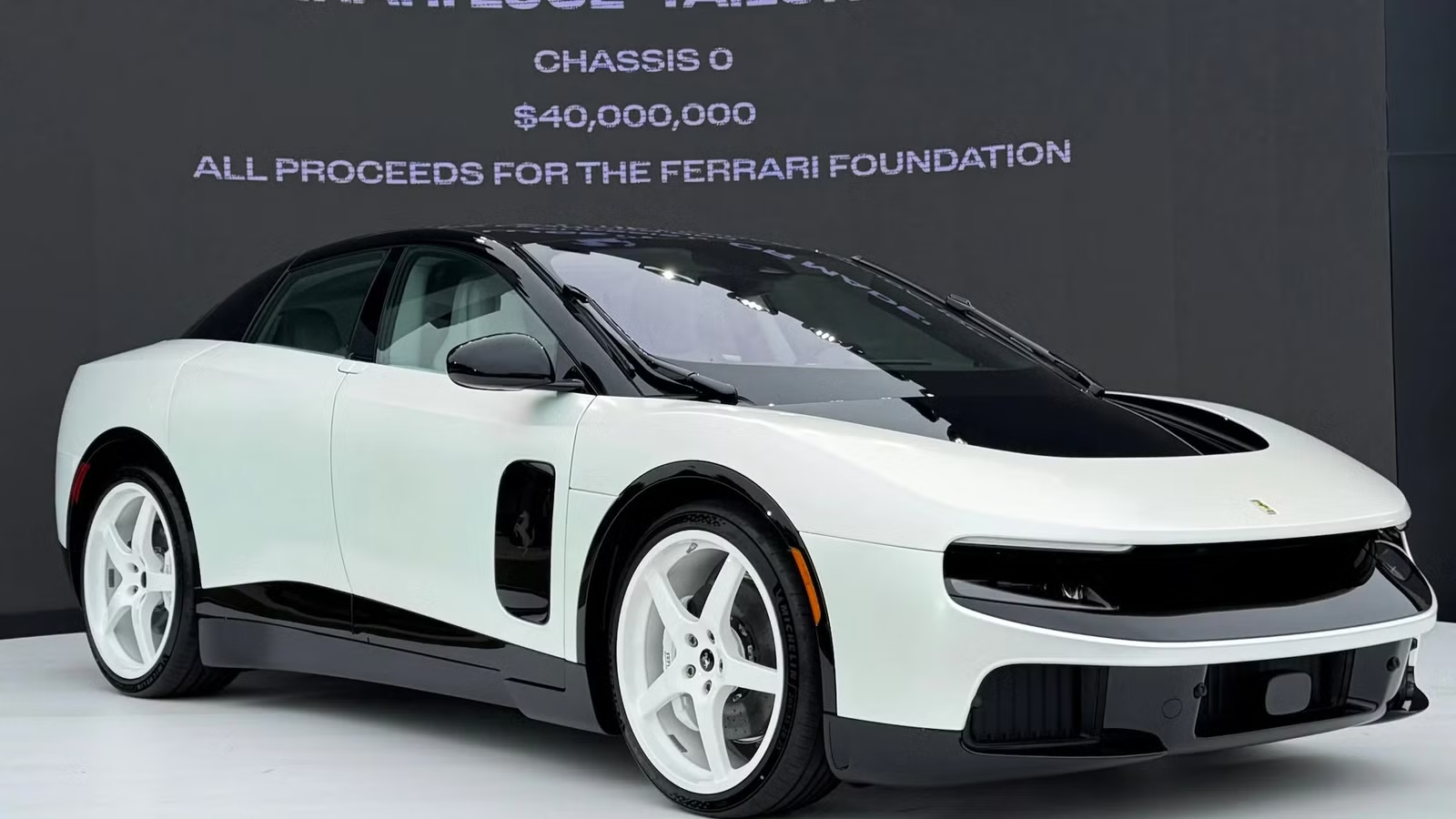
When the hammer fell Saturday night at RM Sotheby’s Monterey auction, the winning bidder for Ferrari‘s polarizing Luce EV was kept anonymous. The number — $40 million, 36 times the car’s $1.1 million pre-sale estimate — did the talking instead. Now the buyer has been revealed: Dr. Herbert “Herbie” Wertheim, an 87-year-old billionaire optometrist, inventor, and philanthropist who Forbes has called the greatest investor most people have never heard of.

Wertheim’s identity reframes the entire Luce story. This wasn’t a hedged bet on an EV nobody asked for. It was a deliberate, pattern-driven statement acquisition from one of the world’s most prolific collector-buyers — a man who pulled the exact same move at the exact same event twelve months earlier. Ferrari didn’t build the Luce for the internet’s opinion. It built it for people like Herbie Wertheim.
From a Bakery Apartment to 100 Patents and a $4.9 Billion Fortune
Wertheim was born in Philadelphia in 1939 and grew up in Florida, where his working-class family lived above a bakery. Dyslexic and struggling in school, he was charged with truancy at 16. A judge gave him a choice: join the US Navy or face the consequences. He took the Navy, and credits it with turning his life around.

The scientific breakthrough came in 1969, when Wertheim became the first to establish that ultraviolet light causes cataracts and damages human eyes. He developed the first UV-absorbing dye for plastic eyeglass lenses and founded Brain Power Inc., which grew into the world’s largest manufacturer of optical tints and ophthalmic chemicals. He holds more than 100 patents and copyrights. From 1970 onward, the profits went into the stock market — Apple and Microsoft at their IPOs, and eventually the largest individual stake in aerospace and defense company Heico. Forbes pegs his current net worth at $4.9 billion. The Horatio Alger Association recognized him as a distinguished American in 2011.
The Philanthropist Behind the Red Fedora
Wertheim is as recognizable for his signature bright red fedora as for his giving. In 1977, he founded the Wertheim Family Foundation, which has since funded the construction of churches, zoos, libraries, and research centers, along with lecture series, scholarships, and performing arts programs. His philosophy on wealth is characteristically direct. The Horatio Alger Association once quoted him: “Getting up every morning and doing what you want to do, that’s success. It doesn’t take money to be happy. Money just gives you more choices.”
The Ferrari Foundation purchases fit squarely within that framework. All proceeds from both the Luce sale and last year’s Daytona SP3 auction went to The Ferrari Foundation to support educational initiatives. Wertheim effectively wrote a $40 million check to charity — and because the Ferrari Foundation operates as a recognized 501(c)(3) public charity, the gap between the Luce’s fair market value and the hammer price is a substantial tax write-off. Philanthropy and collecting, structured as one transaction.
The Luce’s Rocky Debut and What $40 Million Says About Ferrari’s Real Buyer

The Ferrari Luce had one of the more turbulent unveilings in recent memory. When the car broke cover in May 2026 — designed by former Apple creative director Sir Jony Ive and his business partner Marc Newson — Ferrari’s share price dropped more than 8% on the Milan stock exchange. Former Ferrari chairman Luca Cordero di Montezemolo said the car was “risking the destruction of a legend.” Italy’s deputy prime minister piled on. Ferrari’s own global marketing director admitted the magnitude of negative reaction caught the company off guard.
None of that touched Wertheim’s bid. The Chassis 0 he acquired is a fully bespoke build: Madreperla Semi-Gloss exterior paint that shifts from green to violet depending on the light, matching white wheels and brake calipers, and a cabin trimmed in Le Mans metallic leather from hand-selected Swiss hides. Under the skin, the Luce runs four electric motors — 141 horsepower at each front wheel, 476 horsepower at each rear — for a combined 1,050 horsepower and a claimed 0–62 mph time of 2.5 seconds. Delivery is scheduled for the first quarter of 2027, after the car returns to Maranello.

This is the second consecutive year Wertheim has made this move. At Monterey Car Week in 2025, he paid $26 million for a Tailor Made Ferrari Daytona SP3 at the same charity auction format. The Luce purchase wasn’t an impulse — it was a sequel. Ferrari said earlier this year that the Luce “really is a different sort of Ferrari for a different sort of Ferrari client.” Wertheim is exactly that client: someone for whom a $40 million bid is a philanthropic vehicle as much as a collector acquisition, and for whom the exclusivity of Chassis 0 — the first production Luce off the Maranello line — carries weight that no amount of internet criticism can diminish.
The Luce’s production-spec cars, priced at roughly €550,000 ($640,000), are reportedly already sold out for 2026, with strong early demand noted in China. The $40 million hammer price was never a signal about what a Luce costs — it was a signal about who Ferrari is actually building it for. Herbie Wertheim, red fedora and all, just made that point clearer than any press release could.

Related posts

Latest Post


No Comments