
The Ford Race V8 So Dominant It Got Outlawed, Then Hidden In Rancheros
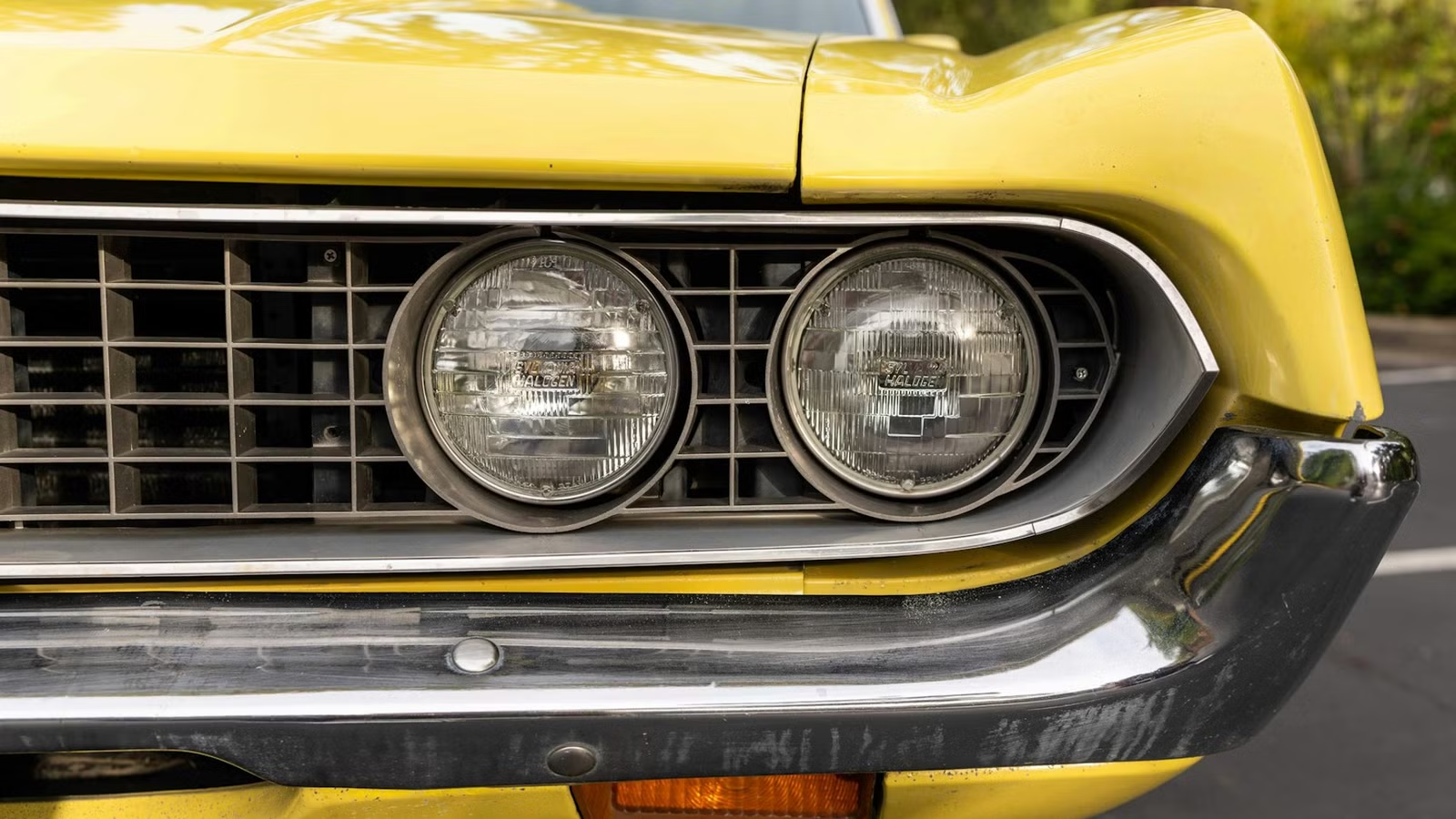
Uh oh, one naughty Ford V8 engine got slapped with penalties for being too hard to beat. Rivals did whatever they could to slow this powerhouse down until it achieved its legendary outlaw status. However, muscle cars, especially one in particular, soak up all of its glory, and that’s not fair. The engine made cars famous just for winning races.

However, it has plenty of other important uses. After facing even more struggles, it was dropped in the Ford Ranchero and other heavier vehicles. This led to the engine becoming increasingly popular despite looking like it had less power on paper. It proved that looks can be deceiving as they have survived for over a decade.
It turns out that the engine is pretty easy to modify, so people have spent years giving it extra torque. Now collectors don’t want the word to get out as it’s still incredibly easy to work on. Its horsepower can easily be boosted to meet the demands of various projects. Plus, when you find it outside famous muscle cars, it’s significantly more affordable.
The 351 Cleveland V8 Was Born To Race

From 1970 until 1974, the Ford 351 Cleveland V8 engine was in production as it dominated the racetracks, which put a massive target on its back. Competitors failed to outrace it with its innovative ‘mid-block’ design. Technically, it’s a small-block V8, but its taller deck height, distinct architecture, and wide pan rails make it feel like a mid-block.
It was built to bridge the gap between small and big block power and did quite well. The 5.7-liter V8 configuration with a two-barrel carburetor set up delivers between 250 and 290 hp and 294 to 300 lb-ft of torque. Then the four-barrel carburetor setup produces between 285 and 300 hp and 380 to 385 lb-ft of torque. Last but not least, the High Output or Boss variant churns out 330 hp and 380 lb-ft of torque.
|
Engine |
HP |
Torque |
|
351 Cleveland V8 two-barrel |
250 – 290 |
294 – 300 LB-FT |
|
351 Cleveland V8 four-barrel |
285 – 300 |
380 – 385 LB-FT |
|
351 Cleveland V8 Boss / HO |
330 |
380 LB-FT |
Ford’s Advanced Engines unit designed the engine for NASCAR and Trans AM racing with modular castings and canted valves to take in and expel air extremely efficiently. For the Boss variant, Ford was able to fit 2.19-inch intakes without obscuring them against the cylinder wall. Thin wall casting helped to reduce its weight and a forged aluminum nodular iron crankshaft and connecting rods were designed to withstand the stress of high engine speeds.
This engine differs from the Windsor, which had the camshaft first and crankshaft last. Instead, the Cleveland oiling system prioritizes the main crankshaft bearing to improve high-PPM durability. Plus, it has a dry intake manifold. Coolant doesn’t flow through the intake manifold cover, as the thermostat is housed directly in the block to reduce the risk of leaks and to keep temperatures cool.
The Rarest Ford Small Block V8 Engine Produced In The ’70s
A last hurrah for the muscle car era: the rarest Ford small block of the ’70s revealed.
The Mustang 351 Gets All The Credit

Ford enthusiasts love to celebrate the Mustang Boss 351 as it gets all the glory for winning races. The Cleveland V8 engine helped the Boss 351 win the stock car class and win at the Pikes Peak International Hill Climb as it shattered class records. It also dominated the NHRA Pro Stock class in the mid-1970s.
Ionic race car driver Allan Moffat drove a Boss 302 that was modified to run the 351 cubic-inch V8 to increase its power. As a result, he won 101 out of 151 races, making the Mustang one of the most successful cars in motorsport history. The Mustang 351 is so popular for winning that it still takes NHRA class wins such as the Winter nationals and New England Nationals today.
The 1971 Boss 351 Mustang can accelerate from 0 to 60 mph in about 5.7 seconds and will cover a quarter-mile in roughly 13.8 seconds with a top speed of 130 miles per hour. While this is all impressive, it overshadows other important cars that helped the engine survive once it came under scrutiny.
Rivals Couldn’t Stand The 351 Cleveland

We all know that if you’re not first, you’re last. But that didn’t mean the 351 Cleveland V8 engine didn’t create sore losers and enemies who were willing to do anything just to slow it down. The Mustang Boss 351 beat the Chrysler 426 Hemi and Chevrolet 427, which racing organizations simply couldn’t let fly.
It was embarrassing big block engines, so racing officials hit it with extremely harsh weight-to-cubic inch penalties. It was hit harder than anything the legendary Hemi was slapped with. Plus, drivers found ways to modify the engine by replacing the ports with custom plates, adding even more scrutiny.
Sanctioning bodies started to impose limits on modifications and tighten the rules to avoid the engine from being exploded and to help rivals survive. But because racing bodies weren’t allowed to outright ban it, they kept using penalties and questioning to force it into a corner. The engine achieved outlaw status as racing bodies had to consistently restructure rulebooks to try and diminish its competitive edge.
Ford Made One Muscle Car That Nobody Remembers
It seems bizarre that high-profile company like Ford would have an anonymous ride, but they produced one of the most obscure classic muscle cars ever.
Then Rising Emission Standards Struck

On top of all the racing drama, the entire muscle car era was under attack. It wasn’t designed to handle the lower-octane unleaded fuel that became standard. It relied on high-compression and closed-quench combustion chambers for high flame travel, making it incompatible. Plus, newly mandated catalytic converters choked out its power.
Also, the canted-valve design that gave the 351 Cleveland an excellent ability to breathe depended on a notch in the piston dome. As a result, the piston ring sat lower on the piston, leading to a larger gap that allowed unburned fuel and hydrocarbons to collect. As a result, passing modern emission tests was extremely difficult.
In order to lower compression while reducing harmful exhaust emissions, Ford switched the Cleveland to open-chamber cylinder heads and dished pistons. This helped it remain compliant, but it looked weaker on paper due to the shift from its gross 280 horsepower to net 266 horsepower in the 351 Cobra Jet.
The Ford Ranchero Kept The 351 Cleveland Alive

The 351 Cleveland V8 engine had plenty of life outside the racetrack. Basically, the Ford Ranchero had the same chassis and a similar muscle truck identity to the Ford Torino. Because the vehicles had the same engine bay, mechanical DNA, and assembly lines, it was very cost-effective to drop the Torino GT engine into the Ranchero.
This allowed Ford to highlight its dual-purpose appeal as a high-performance truck with light-duty utility capabilities. The Ranchero 351C quickly gained a reputation for being able to haul during the week and race on the weekends as people interested in muscle cars were looking for more practical alternatives instead.
The Mercury Montego also shared the same platform as the intermediate-sized Ford Torino. Because the engine was lightweight, it was perfect for the mid-range muscle and performance that the sporty mid-sized car needed to provide. Each of these vehicles are unsung heroes that showed the engineering excellence of the 351 Cleveland. Also, Ford invested in its factory pretty heavily, so it had tons of them to offload.
The Cleveland V8 Lived On For Years

While the 351 Cleveland V8 engine was discontinued in America back in 1974, it survived in Australia until 1982. In America, the plug was pulled due to soaring insurance premiums for high-performance cars, increasing fuel costs, and rising emissions regulations. Ford discontinued it in favor of the 351 Windsor because it was more adaptable to new emissions constraints.
Australians love this engine because it powered numerous victorious race cars. The engine helped drivers dominate the Australian Touring Car Championship and the Bathurst 1000. Plus, the Australian variant has unique cylinder head configurations that pair well with small-port 2V heads to deliver excellent low-end street torque.
Collectors still eagerly try to find the 351 Cleveland V8. Of course, it represents peak muscle car power and is quite famous for its legendary engineering. However, the V8 engine is also easy to modify to unlock extra horsepower for various project builds. It also has an abundance of aftermarket support thanks to having the same dimensions with other Ford small block engines.
Source: Engine Labs, Hemmings

Related posts






Latest Post


No Comments