
The Honda Retro Bike That Rivals The Triumph Bonneville At A Lower Price
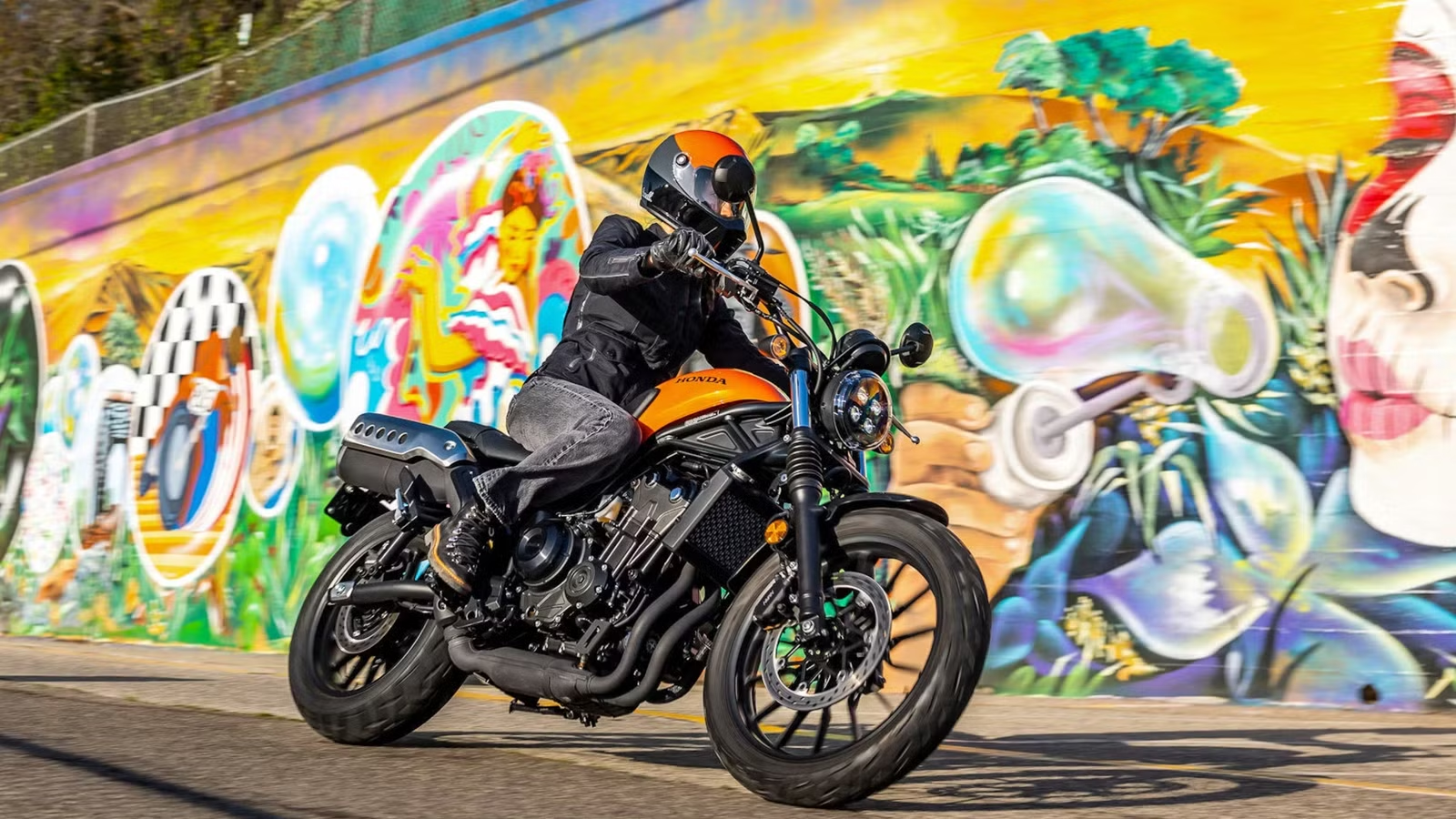
The retro motorcycle segment has quietly become one of the most competitive corners of the two-wheeled world. What started as a niche nostalgia play has matured into a legitimate market category, with manufacturers from Tokyo to Hinckley investing serious engineering resources into bikes that look like they belong in the past but ride like they were built for today. Whether you want a machine that’s genuinely vintage or one that simply wears classic styling over a modern chassis, there has never been more choice — or better value.

Of all these machines, the Triumph Bonneville stands out as one of the very best retro bikes on the market, pairing a timeless design with thoroughly modern internals. The catch, as always, is the price. With an MSRP in the low-to-mid teens, it is not a cheap way to scratch that nostalgic itch. Shopping used can bring the cost down considerably, but if you are open to pre-owned options, a couple of Japanese alternatives deserve serious attention.
Retro Done Right Is A Hard Line To Walk
There are those who might argue that simply getting a classic motorcycle is a better, cheaper option. But most people do not want to deal with all the added maintenance that entails, and that is understandable, especially if the bike will be used as a primary means of transportation. Retro bikes offer a way to own a classic-style motorcycle with a reliable, modern engine underneath.

Kawasaki has had the Z650RS available for quite some time now, and it offers a lot of value on the used market. With an authentic retro design, it certainly looks the part, and its trusty 650 parallel-twin delivers relatively sporty performance alongside an impeccable reliability record.

Yamaha offers the XSR700, which received a significant update in 2024. Finding a bike from that model year will save a little cash, and it won’t be meaningfully different from a brand-new example. While its styling leans a touch more modern than some rivals, the CP2 engine is a genuine point of difference. The XSR700 is a little down on power compared to some bikes in this space, but that also makes it a degree more accessible for newer riders.
The 2023 Honda SCL500 Is An Underrated Used Bargain
Price Range: $4,000 – $6,000

With so many great retro options available, the SCL500 flies under the radar a little. The asking price of the new model is a little high for what you get, but a three-year-old example represents solid value. These bikes will most likely be out of warranty by now, but Honda’s 471cc parallel-twin has been around for well over a decade and has proven more than capable of racking up over 100,000 miles.
Trade value sits at just under $4,000, while retail value comes in just under the $6,000 mark — meaning you can save over $2,000 with minimal risk. For those keeping score, that is also roughly half the price of a new Bonneville, for what is most certainly not half the motorcycle.
Powered By A Bulletproof Twin-Cylinder Engine
Power: 46 Horsepower

Although the SCL500 has only been around for a few years, this 471cc engine has been doing duty across Honda’s CB range for well over a decade. Like most Honda products, it has proven to be metronomically reliable. CB500X owners have generally accumulated the most miles, with those bikes regularly surpassing the 100,000-mile mark.
Peace Of Mind Guaranteed

While the same could be said for other Japanese bikes competing in this space, the peace of mind that comes with a Honda is hard to beat. It isn’t just a matter of mechanical reliability, either. Honda has an unrivaled dealer network, making it easy to find parts or get your bike serviced no matter where you live. As long as you keep up with basic maintenance, this bike will outlast you.
The SCL500 Is New-Rider Friendly

While 46 horsepower might not look like much on paper, the SCL500 is impressively light for a retro machine, tipping the scales at just 425 pounds. That is almost 80 pounds lighter than the modern Bonneville, so even though the Triumph is more powerful on paper, its power-to-weight ratio is actually quite similar. The overall performance gap is incremental, and the Honda is by far the more approachable of the two bikes.
Power delivery is smooth and linear, which is ideal for any new rider. A used option is always a smarter bet for someone just starting out, too. Falls and mild tip-overs are part of the learning experience, but going down on a heavier bike can end the whole journey early. You also won’t feel nearly as bad about scuffing a used motorcycle.
Simple Motorcycling At Its Best

In terms of features, you don’t get much. ABS is standard fitment, and so is a slipper clutch — notably, the aforementioned XSR700 does not include a slipper clutch. Both are features every new rider benefits from. Beyond that, it is just an engine and two wheels, about as simple as a motorcycle can get. There will be those who want more technology, and there are plenty of motorcycles out there that offer more for less.
This is a simple bike for those after an unfussy, unhurried kind of motorcycling experience. More experienced riders might prefer something with a bit more power, but if you were considering a Bonneville, speed was likely never the priority — so the SCL500’s mild-mannered nature shouldn’t put you off. For new riders who like how retro bikes look, a used SCL500 presents itself as an ideal starting point.
Chassis, Suspension, And Weight Specifications
|
Chassis |
Steel diamond |
|
Front Suspension |
41mm conventional fork (5.9-in travel) |
|
Rear Suspension |
Dual rear shocks (5.7-in travel) |
|
Weight |
425 lbs |
Honda SCL500 Vs. Royal Enfield INT 650


Set the SCL500 aside for a moment, and the first bike that comes to mind as a Bonneville alternative is the Royal Enfield INT 650. This Enfield seemingly offers much the same old-school British twin experience, with a smaller engine and a lower starting price. Kelley Blue Book puts the 2023 INT 650’s average value at around $4,100, putting it in roughly the same ballpark as the SCL500. So which one should you choose?

The INT 650 is a perfectly good retro motorcycle in most regards. It’s powered by a characterful parallel-twin with plenty of personality, and as far as looks go, the INT 650 is among the most authentically retro bikes out there. Where it falls short is weight, which matters for newer riders. Compared to the SCL500’s 425 pounds, the INT 650 tips the scales at nearly 480 pounds — making the Honda the easier motorcycle to maneuver in city traffic.

Reliability and long-term ownership costs are another factor when buying used. The INT 650 has proven to be reasonably dependable, but it still suffers from some fit and finish issues. It also cannot match Honda’s inherent durability or its vast service network, which makes the SCL500 a simpler and more affordable motorcycle to own over time. So, as capable as the INT 650 is as a Bonneville alternative, the SCL500 stands out as the more sensible pick — an ideal entry point for anyone chasing a retro experience on two wheels.
|
Specs |
Honda SCL500 |
Royal Enfield INT 650 |
|---|---|---|
|
Engine |
471cc parallel-twin |
648cc parallel-twin |
|
Power |
46 HP |
47 HP |
|
Torque |
32 LB-FT |
38.3 LB-FT |
|
Seat Height |
31.1 in. |
31.69 in. |
|
Weight |
425 LBS |
478.4 LBS |
Source: Honda, Kelley Blue Book

Related posts

Latest Post


No Comments