
Hiroshi Okuda, Toyota CEO Who Championed The Prius And Changed The Auto Industry, Dies At 93
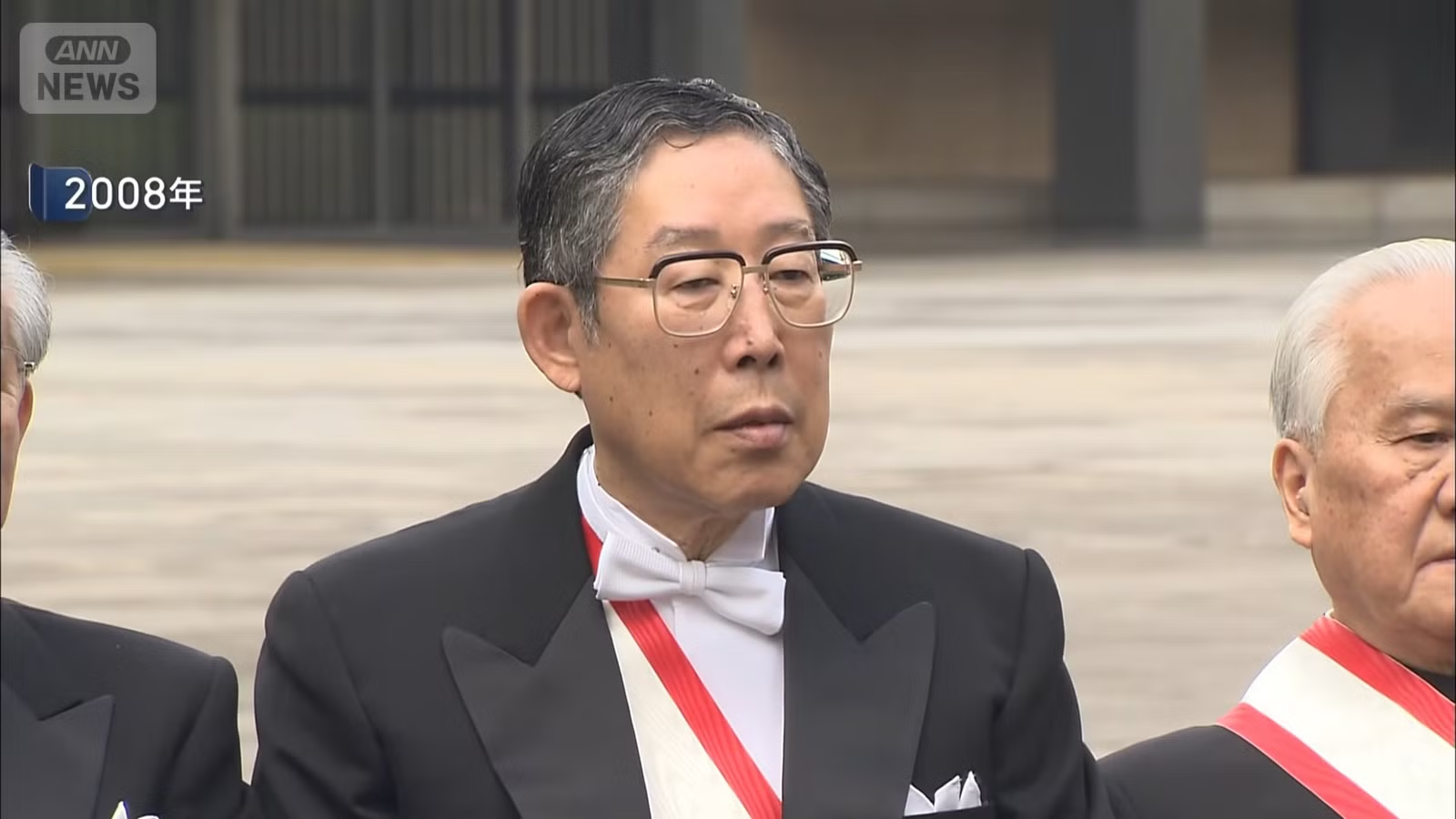
Hiroshi Okuda, the Toyota president and chairman who pushed his engineers to build the world’s first mass-produced hybrid car a full year ahead of schedule, died August 16 at age 93. Toyota confirmed his death was due to natural causes. He served as president and then chairman of Toyota from 1995 to 2006, capping a 45-year career at the company.

The Prius he championed went on to sell more than six million units across successive generations, forced every major automaker to develop competing hybrid programs, and established a technological foundation that still underpins Toyota’s lineup today. Few executives in automotive history can claim a single decision that reshaped an entire industry. Okuda made that decision in a conference room in the mid-1990s when he looked at an engineering team and asked, simply: “Can you do it in 1997?”
The Man Who Moved the Prius Timeline by a Year
Hybrid development inside Toyota began around 1993 under the internal codename G21 — a project aimed at building a car for the 21st century. The engineering team, led by Takeshi Uchiyamada, estimated they could have a production-ready vehicle by 1998. Okuda rejected that timeline outright.

His reasoning was both strategic and politically astute. The Kyoto Climate Conference was scheduled for December 1997, where world governments would gather to forge a landmark agreement on greenhouse gas emissions. Okuda saw the alignment clearly: Toyota could debut the world’s first mass-produced hybrid at the exact moment the global conversation about carbon was reaching its peak. He ordered the team to accelerate. The first-generation Prius rolled off the line in December 1997 — days after the Kyoto Protocol was adopted — and went on sale in Japan that same month. The timing was deliberate. Uchiyamada has also been credited as the “father of the Prius” for overseeing the engineering program, but the mandate to build it, and build it fast, came from Okuda.
Building Toyota Into a Global Automaker

The Prius was Okuda’s most celebrated bet, but his broader legacy was transforming Toyota from a Japanese exporter into a multinational manufacturer. When he became president in 1995, Toyota sold roughly 1.1 million vehicles in the United States annually. By the time he stepped down as chairman in 2006, that figure had grown to 2.5 million. Global sales rose from 4.6 million units to 7.92 million over the same period.
That growth was built on factories. Toyota announced a new plant in Princeton, Indiana, in 1996; the Huntsville, Alabama, facility came online in 2003; San Antonio, Texas, followed in 2006. The company also expanded manufacturing into France, Poland, the Czech Republic, China, India, Mexico, and Russia during his tenure. The Camry, already gaining ground in the American sedan market, became the dominant nameplate in its segment through that decade. Okuda understood that building cars where you sell them was not just good politics — it was the only sustainable strategy for a company with global ambitions.
An Outsider Who Rewrote the Rules

Okuda was born in central Japan and graduated from Hitotsubashi University in Tokyo in 1955, joining Toyota shortly after. His rise to the top was notable precisely because he was not a member of the founding Toyoda family, which has long held significant influence over the company’s direction. He was, by most accounts, the first non-family leader to hold the presidency in decades.
He used that position to challenge entrenched habits. He dismantled seniority-based promotion structures and pushed younger managers — often men in their 50s rather than their 60s — into leadership roles, a meaningful departure from Japanese corporate convention at the time. He was known for being outspoken and direct, qualities that made him an unusual figure in a culture that often prizes consensus. He was also a black belt in judo, which perhaps says something about his comfort with confrontation. He is survived by a son; a private funeral was held for close family, with a farewell gathering planned for a later date.
A Legacy That Outlasted the Prius Badge
The ripple effects of Okuda’s hybrid gamble are still visible across the entire automotive landscape. Toyota’s hybrid technology, refined through successive Prius generations, now runs through the company’s crossovers, SUVs, trucks, minivans, and luxury models. Competitors who dismissed the Prius as a niche experiment in the late 1990s spent the following two decades building their own hybrid programs to catch up.
Okuda’s tenure was not without complications — his aggressive push for scale contributed to the quality strains that led to Toyota’s massive recall crisis in 2010. But the core strategic vision held. Sticking with hybrids while rivals chased pure battery-electric vehicles has proven, at least for now, to be the more commercially durable path. The question Okuda posed to his engineers nearly 30 years ago — why not 1997? — turned out to be one of the most consequential questions anyone has ever asked in this industry.

Related posts





Latest Post


No Comments