
10 V8-Powered Cars That Define American Performance
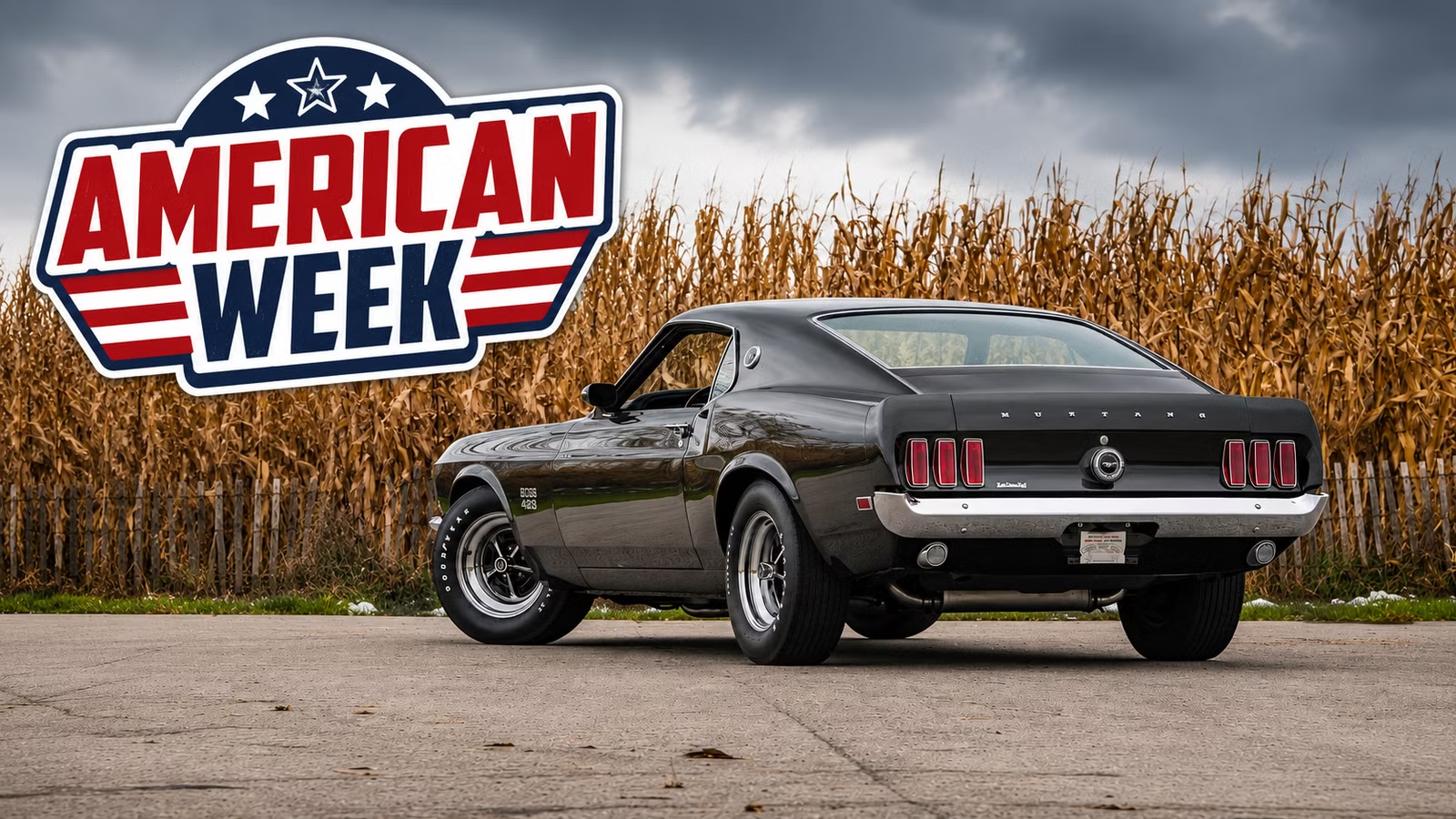
There’s nothing more quintessentially American in the auto world than a V8. The market may be lacking new everyday V8s today, but there are still a few around that get the job done in the most thunderous and torque-rich fashion possible. Throughout the 20th century, American marques were the rulers of the V8 market, and everything from muscle cars, sports coupes, and sedans had them.

Today, we tend to have to look toward the serious performance and supercar market for one, but what is being achieved now from them is a million miles from the first iterations. Whether you like old-school V8 power or modern V8 insanity, American brands have turned out some of the best. Below are 10 American V8-powered cars that set the standard for performance.
Models are listed in ascending order based on maximum horsepower, from the lowest to the highest.
1963 Chevrolet Corvette
Engine: 5.4-Liter V8 | Maximum Horsepower: 360

As the only model year of the iconic “Split-Screen” Corvette, the 1963 model laid down the foundations for what a sports coupe/muscle car should be. It looks the part with a long hood, raked windshield, angled roofline, and wide stance, and sounds the part thanks to the rumbling idle and crackling exhaust note when you downshift. The 1963 Chevy Corvette Sting Ray (before the Stingray) is the first model year of the C2 generation, and is available with one engine: a 327-cubic-inch Generation I Small-Block V8. There are four different power levels you could have originally chosen from.
In the base model (L75), 250 horsepower is the maximum output; you get a single four-barrel carb. An optional choice for the L75 was to have an upgraded four-barrel carb, which results in 300 horsepower; the L76 model gets a larger four-barrel carb and solid lifters, shooting out 340 horsepower, and the most powerful iteration (the L84) has the following specifications.
|
Spec |
1963 Chevrolet Corvette L84 |
|---|---|
|
Engine |
5.4-Liter NA V8 |
|
Transmission |
Four-Speed Manual |
|
Horsepower |
360 hp |
|
Torque |
352 lb-ft |
The 1963 L84 Corvette gets a Rochester mechanical fuel injection system (often called “Fuelies”) and can hit 60 mph in around six seconds, topping out at a reported 150 mph.
According to Classic.com, the average auction price for a C2-gen Corvette is $126,340—real collector’s money. However, the 1963 “Split Screen” is even more expensive. The most expensive 1963 model that has sold in recent years via auction went across the block for $1.1 million. It’s easy to see why: the ’63 “Split-Screen” was a one-year production run for Chevy, and only approximately 10,900 were ever made.
1969 Pontiac GTO Judge
Engine: 6.6-Liter V8 | Maximum Horsepower: 370

The ’69 Pontiac GTO Judge was one of the finest examples of “rebellious” Pontiac muscle cars of the 1960s, arriving at just the right time before emission rules tightened and the strangled engines of the malaise era took hold. Today, auction prices for the ’69 GTO Judge range from $21,500 for well-worn examples to $220,000 for near-mint models.
The “Judge” package transformed the already potent Pontiac GTO into one of the most recognizable performance cars of the ’60s and really helped to heat up the muscle car wars. While the GTO debuted as a value-focused option and stripped-down rival to the Plymouth Road Runner, you could originally equip Pontiac’s legendary 400-cubic-inch Ram Air IV V8 as part of the “Judge” package, which raised the output from 350 horsepower in the base GTO to 370 horsepower in the Judge.
|
Spec |
1969 Pontiac GTO Judge |
|---|---|
|
Engine |
6.6-Liter NA V8 |
|
Transmission |
Four-Speed Manual or Three-Speed Automatic |
|
Horsepower |
370 hp (Officially) |
|
Torque |
445 lb-ft |
The Ram Air IV V8 gets a lightweight aluminum intake and round-port heads, and while Pontiac rated it at 370 horsepower, it is widely agreed that the real figure is closer to 400 horsepower. It is thought that Pontiac advertised the output as lower to avoid higher insurance costs for buyers.
Alongside the muscular engine, the Judge also comes equipped with a rear spoiler, bold paint jobs, a T-handle Hurst floor shifter, and functional hood scoops (a first for the GTO). 0–60 mph times have been clocked at around five to six seconds, and quarter-mile times have been clocked in the low 14-second range.
Ford Mustang Boss 429
Engine: 7.0-Liter V8 | Maximum Horsepower: 375

Built for the 1969 and 1970 model years only, the Ford Mustang Boss 429 is among the finest expressions of America’s favorite pony car. At first glance, it looks somewhat like a 1960s Mustang, but then you realize the massive hood scoop, front chin spoiler, flared fenders, and the small BOSS 429 decal near the rear spoiler.
Then you hear the uneven yet thunderous bark of the semi-hemispherical 7.0-liter (429-cubic-inch) Cobra Jet HO V8 under the hood. There aren’t many American V8-powered cars that sound as fierce as the 429 Boss. It has the following engine specifications.
|
Spec |
Ford Mustang Boss 429 |
|---|---|
|
Engine |
7.0-Liter NA V8 |
|
Transmission |
Four-Speed Manual |
|
Horsepower |
375 hp |
|
Torque |
450 lb-ft |
Rest-to-60 times have been recorded at between 5.3 and 6.5 seconds depending on test conditions, and a quarter-mile time of around 14 seconds at 103 mph is genuinely impressive.
The Boss 429 models are one of, if not the most iconic Ford Mustangs ever created. It was built to homologate the V8 under the hood so it could be used for NASCAR. Ford’s standard assembly lines couldn’t accommodate the wider engine, so unfinished Boss 429 models were sent to the Kar Kraft facility in Michigan for specialized finishing.
Just 1,358 models were built between 1969 and 1970, so they are not easy to find (only 22 have been sold via online auction in recent years). If you do find one and want to buy it, it will cost you between $175,000 and $1 million.
1970 Chevrolet Chevelle SS 454 (LS6)
Engine: 7.4-Liter V8 | Maximum Horsepower: 450

Widely regarded as one of the most iconic muscle cars ever built, the 1970 Chevrolet Chevelle SS 454 (LS6) commands deep admiration among V8 enthusiasts. This machine represents the golden age of American V8 and muscle car power and is arguably one of the last model years of “real” muscle cars in the U.S.
Under the hood is a massive 7.4-liter (454-cubic-inch) big-block V8. Power is sent to the rear wheels, and an all-around aggressive look is delivered through the classic short-deck, long-hood proportions of mid-size performance car design; you can get to 60 mph in just 5.1 seconds. That’s not bad for something built 56 years ago that tips the scales at up to 4,000 pounds. It has the following specs.
|
Spec |
1970 Chevrolet Chevelle SS 454 (LS6) |
|---|---|
|
Engine |
7.4-Liter NA V8 |
|
Transmission |
Four-Speed Manual or Three-Speed Automatic |
|
Horsepower |
450 hp |
|
Torque |
550 lb-ft |
While the engine output was reportedly and deliberately understated at 450 horsepower, with the real figure believed to be closer to 500, the Chevelle SS is more than just classic muscle car looks and power. It was actually quite refined and high-tech for its day; it came with wood trim, bucket seats, and the originally available RPO ZL2 Cowl Induction hood with a scoop. This clever system means that when you hit the throttle, a flap opens and, with the help of a vacuum pump, pulls cold air straight into the carburetors for additional power.
Today, the average auction price for a 1970 Chevelle is $102,539; however, the Chevelle SS LS6 models tend to sell for a lot more. The lowest price fetched for a ’70 Chevelle SS LS6 at auction in recent years is $71,000. The most expensive example was a highly original model in mint condition, and it sold for $770,000.
2026 Cadillac CT5-V Blackwing
Engine: 6.2-Liter Supercharged V8 | Maximum Horsepower: 668

The 2026 performance sedan market may be leaning toward turbo-fours and inline-sixes, but Cadillac is still providing the V8 goods with the 2026 Cadillac CT5-V Blackwing. Priced at $98,900, the new Blackwing combines exceptional luxury with a hand-built supercharged LT4 V8 (with a 1.7-liter supercharger) that can launch you from standstill to 60 mph in as little as 3.4 seconds with the automatic transmission.
Top speed is just north of 200 mph, meaning you get supercar-level acceleration and top speed with a V8, all in one package. There isn’t much not to like about the new CT5-V Blackwing, and it is one of the last of a generation of massive American V8s that truly perform. The new CT5-V Blackwing has the following engine specifications.
|
Spec |
2026 Cadillac CT5-V Blackwing |
|---|---|
|
Engine |
6.2-Liter Supercharged V8 |
|
Transmission |
Six-Speed Manual or Ten-Speed Automatic |
|
Horsepower |
668 hp |
|
Torque |
659 lb-ft |
Beyond the impressive sprint times, the Blackwing gets Magnetic Ride Control, which manages damping and helps maintain stability; Performance Traction Management, which includes Launch Control with Line Lock; an active sport exhaust with quad exhaust outlets; and Brembo brakes on all four corners.
2026 marks the final year of both the CT4 and CT5 sedans, making this the last chance to buy a new CT5-V Blackwing. There are rumors that the CT5 will return one day, but we are skeptical that it will have a V8 under the hood.
2023 Chevrolet Corvette Z06
Engine: 5.5-Liter V8 | Maximum Horsepower: 670

The Chevy Corvette has always represented bang-for-your-buck driving, but the 2023 Chevrolet Corvette Z06 takes things to a new level. Today, you can pick one up for between $88,500 for the convertible and $99,300 for the coupe. That may sound like a lot of money, and it is, but original prices sat between $109,295 and $117,000.
Then there is the engine under the hood. The 2023 Corvette Z06 is equipped with a naturally aspirated flat-plane-crank V8 (LT6) that has a redline of 8,600 rpm and can get you to 60 mph in around 2.7 seconds. Plus, quarter-mile times have been clocked in the high 10-second range. Engine specifications are as follows.
|
Spec |
2023 Chevrolet Corvette Z06 |
|---|---|
|
Engine |
5.5 NA V8 |
|
Transmission |
Eight-Speed DCT Automatic |
|
Horsepower |
670 hp |
|
Torque |
460 lb-ft |
The V8 is one thing, but the Z06 is built for much more than straight-line speed. It gets Magnetic Ride Control 4.0, an electric limited-slip differential, an extra 3.5 inches of width over the standard 2023 Corvette to accommodate massive rear tires, Brembo brakes as standard, a front splitter, front dive planes, an optional rear wing, optional carbon-ceramic brakes, and functional cooling intakes for the transmission and rear brakes. In essence, the 2023 Corvette Z06 is supercar DNA and Ferrari-esque performance at a fraction of the price.
2021 Dodge Charger SRT Hellcat Redeye
Engine: 6.2-Liter Supercharged V8 | Maximum Horsepower: 797

As one of the most powerful production performance sedans ever created, the 2021 Dodge Charger SRT Hellcat Redeye is one of the defining American V8 cars. It is loud, fast, powerful, and aggressive-looking. Today, used prices are reasonable for a car of its caliber, averaging around $60,600.
Under the hood is a HEMI V8 paired with a massive 2.7-liter twin-screw supercharger, with power sent through a TorqueFlite eight-speed automatic transmission to the rear wheels. It has the following engine specs.
|
Spec |
2021 Dodge Charger SRT Hellcat Redeye |
|---|---|
|
Engine |
6.2-Liter Supercharged V8 |
|
Transmission |
Eight-Speed Automatic |
|
Horsepower |
797 hp |
|
Torque |
707 lb-ft |
This combination of power and hardware translates to 0–60 mph times of 3.5 seconds, top speeds of 203 mph, and quarter-mile times of 10.6 seconds at 129 mph. In short, it is a showcase of V8 power at its most extreme. Six-piston Brembo calipers sit up front; the “Widebody” kit adds an extra 3.5 inches of width over other Dodge Charger models from 2021; the SRT Torque Reserve pre-fills the supercharger before you floor it; and adaptive damping suspension accommodates different driving styles.
2026 Ford Mustang GTD
Engine: 5.2-Liter Supercharged V8 | Maximum Horsepower: 815

Built to prove that American V8 power is just as exciting as anything the European supercar market offers, the 2026 Ford Mustang GTD is the most powerful production Mustang ever created. Under the hood is a supercharged Predator V8 that delivers maximum power at 7,400 rpm and maximum torque at 4,800 rpm.
The top speed of the new Mustang GTD is 202 mph, and it has posted a 6:40.835 lap time at the Nürburgring. To put that into perspective, the fastest Ferrari around the German track was the Ferrari 296 GTB, which did it in 6:58.70. The 2026 Mustang GTD has the following engine specifications.
|
Spec |
2026 Ford Mustang GTD |
|---|---|
|
Engine |
5.2-Liter Supercharged V8 |
|
Transmission |
Eight-Speed DCT Automatic |
|
Horsepower |
815 hp |
|
Torque |
664 lb-ft |
The GTD is not an inexpensive Mustang, with a starting price of $328,000, but you do get immense power, near-50:50 weight distribution, an eight-speed transaxle with a carbon-fiber driveshaft, Brembo carbon-ceramic brakes, an active aero system, lightweight magnesium wheels, and race-bred inboard pushrod rear suspension, which helps reduce unsprung mass and allows the tires to grip the pavement in fast corners.
2027 Chevrolet Corvette ZR1X
Engine: 5.5-Liter Twin-Turbocharged V8 Hybrid | Maximum Horsepower: 1,250

The Corvette has come a long way since the C1 debuted in 1953, and the 2027 Chevrolet Corvette ZR1X proves there is still life in the V8 yet. The bi-turbo flat-plane crank LT7 V8 in the new ZR1X is paired with a 1.9-kWh battery and a high-output electric motor. You get eAWD as standard, and a dual-clutch transmission handles swift gear changes.
Magnetic Selective Ride Control 4.0 is tuned to keep the car planted and manage the immense power; an optional ZTK Track Performance Package offers an aero kit that can generate substantial downforce; and large 16.5-inch carbon-ceramic brakes handle stopping duties. On top of that, the new Corvette ZR1X gets you over 1,200 horsepower from the powertrain , with the following specs.
|
Spec |
2027 Chevrolet Corvette ZR1X |
|---|---|
|
Engine |
5.5-Liter Twin-Turbocharged V8 Hybrid |
|
Transmission |
Eight-Speed DCT Automatic |
|
Horsepower |
1,250 hp |
|
Torque |
828 lb-ft |
The immense power from the V8-and-motor combination and all the track-focused hardware translate to 0–60 mph times of 1.89 seconds, a quarter-mile time of 8.99 seconds at 157 mph, and estimated top speeds approaching 230 mph. The ZR1X effectively builds on the lessons learned from the Corvette ZR1, taken further in every respect. It is impressive, but you have to pay handsomely for it. Chevy says that starting prices are $227,500 and top out (before any extras) at just shy of $250,000.
Hennessey Venom F5 Evolution
Engine: 6.6-Liter Twin-Turbocharged V8 | Maximum Horsepower: 2,031

There are powerful V8-powered American cars, and then there is the Hennessey Venom F5 Evolution. This total beast has a Fury V8 under the hood that can shift out over 2,000 horsepower and 1,445 pound-feet of torque. When the first American V8 hit the roads in the 60-horsepower 1907 Hewitt Touring Car, it is unlikely anyone imagined this would be the result.
The Hennessey Venom F5 is already a formidable machine, with 1,817 horsepower on tap, but if that isn’t enough, you can opt for the Evolution package for an extra $285,000. This adds a reworked Fury V8 with Precision 7680 turbos, titanium exhaust valves, and revised billet aluminum pistons, along with more F1-inspired aerodynamic elements in the form of enhanced front splitters and dive planes, and adaptive suspension. The F5 Evolution has the following engine specifications.
|
Spec |
Hennessey Venom F5 Evolution |
|---|---|
|
Engine |
6.6-Liter Twin-Turbocharged V8 |
|
Transmission |
Seven-Speed Automated Manual or Six-Speed Manual |
|
Horsepower |
2,031 hp |
|
Torque |
1,445 lb-ft |
Hennessey has made a name for itself by turning nearly everything it touches into a rocket, and the Evolution is by no means an exception. 0–200 mph times have been recorded at 10.3 seconds; quarter-mile times have been clocked at 9.5 seconds at 173 mph; and top speeds are estimated to be around 311 mph.
Sources: Bring A Trailer, Classic.com, Ford, Chevrolet, Hennessey, and Dodge

Related posts



Latest Post


No Comments