
The Inline-Four Touring Motorcycle That Makes 500-Mile Days Feel Easy
As much as parallel-twins and V-twins take over, the charm of an inline-four engine remains unbeaten. The benefits are smoothness, a linear spread of power, and buttery tractability (with the right tune). Accordingly, such engines have found themselves in nearly all kinds of bikes, ranging from small-pot sub-250cc sports bikes and mid-spec cruiser bikes to everything in between.

That ‘between’ also includes touring motorcycles, as we’ve seen some staggering inline-four tourers by a variety of bikemakers. The number has surely gone down in recent times, but there are still a handful of brilliant examples on sale. Only one of these is truly well-suited and proven for making 500-mile days easy, however.
Inline-Four Touring Bikes Mainly Comprise Sport-Tourers Today
If you look at the touring motorcycle world, you’ll find them in all shapes and sizes. The Honda NC750X has a scooter-inspired construction, the Harley-Davidson Street Glide 3 Limited is a full-dresser three-wheeler, and the Moto Morini Calibro Bagger is a budget cruiser-type tourer. However, when you add the filter of an inline-four engine, you’re mainly left with sport touring bikes.


These can be either proper sport-tourers (with sports bike-like bodywork and a slightly nose-heavy appeal) or crossover-type sport tourers (with an ADV-like aesthetic, tall suspension, and 17-inch wheels). Examples of the former comprise the Kawasaki Ninja H2 SX and Suzuki GSX-S1000GT+, whereas the latter type includes the BMW S 1000 XR and Suzuki GSX-S1000GX+.

What further narrows down the search is the 500-mile-a-day context. We believe the crossover-type machine should be your choice for this, given the large stature, better overall comfort, and more versatile underpinnings. After all, a proper sport-tourer will surely shine on good roads and twisties, but it will wear you out on bad stretches where a crossover would glide without a worry due to its ADV-like suspension. That limits your options to three bikes, out of which a Kawasaki takes our vote.
The Kawasaki Versys 1100 SE Checks All Necessary Boxes For 500-Mile Days

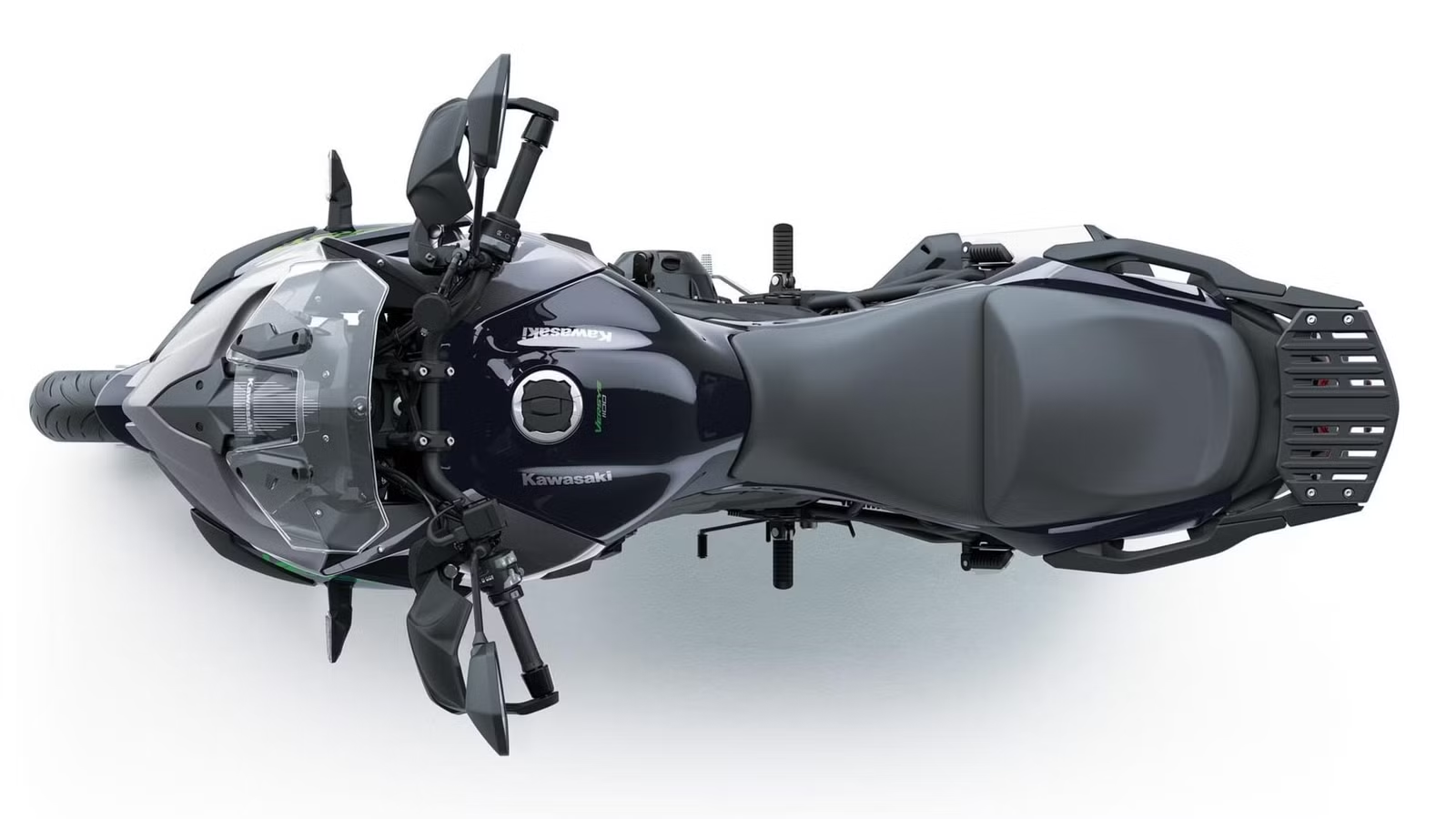
We’re talking about the Kawasaki Versys 1100 SE. It is Team Green’s flagship crossover today, so you get everything you’ll need to enjoy your 500-mile days with ease. That includes a torque-loaded inline-four engine, electronic suspension, waterproof hard panniers, and all the necessary creature comforts. For all this, Kawasaki charges you $19,499–right in the ballpark of its rivals.
Speaking of which, there are two inline-four alternatives for the Versys: the GSX-S1000GX+ and the S 1000 XR. Both of them have lower starting prices by a few hundred dollars and sportier intentions due to their superbike-derived mechanicals. The latter includes the engine, which is what can work against them.

Although detuned, the superbike engines are still high-strung compared to the Versys. That means lower fuel efficiency (Suzuki and BMW claim 37 MPG, while Kawasaki claims 42 MPG) and higher wear on internals. Oh, and the S 1000 XR lacks some key features in base trim. So you’ll need to add some options, which will take the MSRP beyond the Versys’. Thus, if 500-mile days are your priority, the Kawasaki should be your inline-four pick.
Here’s How The Versys 1100 SE Justifies Its ‘Flagship’ Tag

We’ve already told you the Versys 1100 SE serves as the flagship in Kawasaki’s touring range. Sure, we have larger bikes like the Vulcan 1700 range, but the Vulcan duo hasn’t received any notable updates in decades. In comparison, the Versys went under the knife just last year. The updates made it better than ever, too, focusing on incremental changes to refine the package. Here are all the details:
A New 1,099cc Inline-Four Engine With More Power

Since its debut in 2012, the inline-four Versys has had Kawasaki’s 1,043cc inline-four engine. That changed last year with the introduction of a new 1,099cc powerhouse. This engine builds on the previous one by adopting a 3 mm longer stroke, a new piston shape with a higher compression ratio, a new intake funnel length, a new intake port shape, and a new cam profile. Accordingly, the output rises to 133 horsepower and 82.5 pound-feet, kicking in at 9,000 RPM and 7,600 RPM, respectively. For reference, the previous bike made 118 horsepower and 75 pound-feet.
Updated Gearing Makes Freeway Touring Easier

While the engine has more juice, Kawasaki has worked on the gearing to boost touring abilities. The fifth and sixth gears are longer here to reduce stress on the engine at freeway speeds. That inevitably contributes to the above-mentioned 42 miles per gallon claimed efficiency. As for service intervals, they lie at every 7,600 miles (or once a year), with valve checks every alternate year. Being a Kawasaki, the maintenance should be cheap.
Electronic Long-Travel Suspension Brings Unmatched Versatility

Long-travel suspension is a common occurrence on crossovers. But fully electronic suspension is rare. So the 1100 SE having it as standard is a big deal. You get Showa’s Skyhook EERA (Electronically Equipped Ride Adjustment) technology, comprising 43 mm USD forks and a BFRC monoshock. Kawasaki Electronically Controlled Suspension technology (KECS) joins hands with the system, using information from the IMU and ECU every 10 milliseconds.
The result is electronic rebound and compression adjustment on the fly, along with three preload settings (rider only, rider with luggage, and rider with passenger and luggage). If you still can’t find the balance, the preload can be further fine-tuned by 10 levels. What’s also impressive is the presence of four base settings: Sport, Road, Rain, and Rider mode (Manual).
17-inch Wheels And Aluminum Chassis Round Off The Mechanicals

Moving on, the focus here is on tarmac riding first and broken patches later. Thus, you’ll find sporty 17-inch alloy wheels and 120/180-section tires, topped with dual 310 mm front disc brakes and a single 260 mm rear disc. Likewise, there’s an aluminum chassis hiding under the bodywork–something we usually see on sportier bikes. That also helps limit the weight to 571 pounds wet (without saddlebags). Other key dimensions include:
- Seat height: 33.1 inches
- Tank capacity: 5.5 gallons
- Wheelbase: 59.8 inches
- Ground clearance: 5.9 inches
- Suspension travel: 5.9 inches
There’s No Shortage Of Safety Or Comfort Features
Considering this is near-$20,000, you’d expect some high-end features. And that’s what the Versys 1100 SE gets you. Safety-wise, a six-axis IMU and ride-by-wire ensure two power modes, three modes of traction control, cornering ABS, and a two-way quickshifter. Then, the creature comforts comprise heated grips, cruise control, cornering lights (mounted on the fairing), and smartphone connectivity (to enable vehicle info, riding log, phone notifications, and turn-by-turn navigation). All this while, the saddlebags are lockable and waterproof with a quick-release clamp to make life easier.

How do you access these technologies? Well, via a semi-digital instrument cluster with an analog tachometer and a large rectangular TFT on its right. A plethora of information with varying brightness levels and two display modes is present. Kawasaki says, “The first mode was designed with touring in mind; the easy-to-read, calm layout offers a substantial amount of information immediately. Whereas, the second mode was designed with sport riding in mind. Important information is prioritized and presented graphically for easy digestion”.
Source: Kawasaki

Related posts


Latest Post


No Comments