
The World’s First V10 Production Car Changed America’s Torque Game
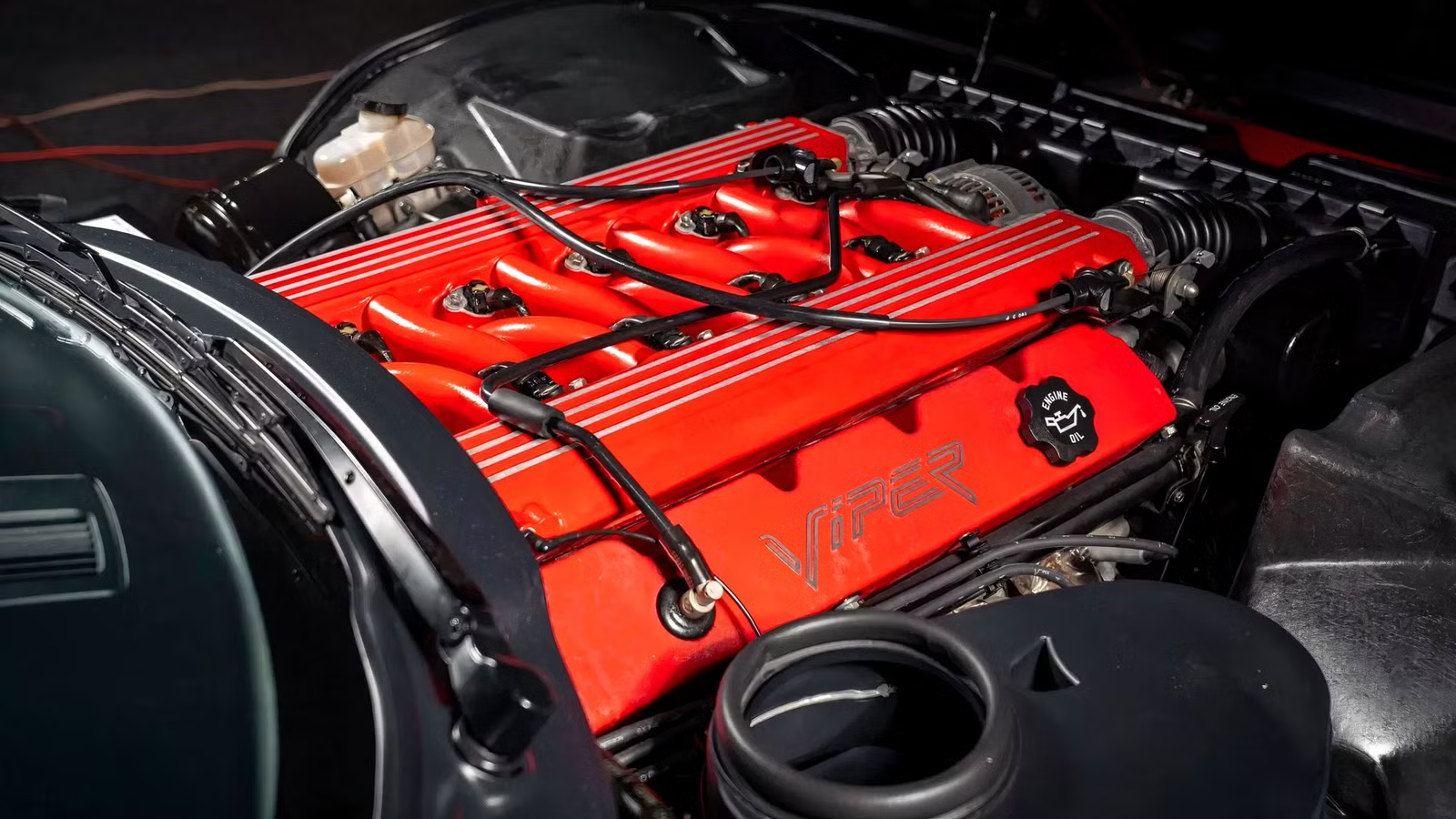
For thirty-three years, one American engine held a torque record that nobody in Detroit could touch, not the biggest big blocks of the muscle car era, not the imported exotics that followed it. Dodge eventually ended that reign, but not in the way most enthusiasts remember it. The car most people credit with breaking the record was not the same car that actually did it, and two versions of one nameplate played very different roles more than a decade apart.
A Torque Record Nobody Could Touch

The record belonged to the 1970 Buick GSX Stage 1, built during the brief window when General Motors lifted its displacement caps on intermediate models. Its 455-cubic-inch V8 carried a modest factory rating of 360 horsepower, but the real number was torque: 510 lb-ft at just 2,800 rpm, a figure that outmuscled every big block Chevrolet, Pontiac, and Oldsmobile could throw at it that same year. Buick buried that output inside a comparatively understated body, more boulevard cruiser than drag strip regular, which only added to the legend once enthusiasts realized what was hiding under the hood.
Torque figures across the muscle car era rose and fell with each new model year, yet nothing else Detroit built, and nothing arriving from overseas, matched that 510 lb-ft mark for the next three decades. Emissions regulations gutted big block output through the 1970s and 1980s, and the Buick’s number quietly became an industry footnote that insiders still measured everything against. Collectors have caught up to that history too, with the best documented Stage 1 cars now selling past $236,500 at public auction.
American Engineers Chase a New Kind of Engine


Breaking that record eventually required an engine format American manufacturers had barely touched in a performance application. Rather than stretching an existing V8 further, one Detroit automaker looked toward something with two more cylinders, a configuration usually reserved for European exotics or, oddly enough, heavy-duty trucks. That kind of engine promised the low-end shove a torque record demands, but nobody had proven it could survive in something built for a public road.
The idea took shape inside a small skunkworks team chasing a modern successor to a legendary American roadster of decades past. Their solution borrowed hardware from the least glamorous corner of the automaker’s own lineup, a truck engine nobody expected to end up chasing a muscle car legend, and reworked it with outside help most buyers never would have guessed was involved.
The Dodge Viper Changes America’s Torque Game

That car is the Dodge Viper, and its record-breaking story actually starts with a version that never came close to breaking any record at all. The original 1992 Viper RT/10 arrived as the first production car ever built around a V10 engine, an 8.0-liter unit rated at 400 hp and 465 lb-ft of torque. That was enough for a sub-five-second run to 60 mph and a 164 mph top speed, numbers that stunned the industry in 1992, but the torque figure fell well short of the Buick’s 510 lb-ft. The Viper introduced the format. It did not yet own the record.
Breaking it took another eleven years and a heavily reworked version of the same engine. The redesigned 2003 Dodge Viper SRT-10 grew its V10 to 8.3 liters and produced 500 hp and 525 lb-ft of torque, enough to clear the Buick’s mark and finally end its 33-year run. The SRT-10 also dropped its 0 to 60 time under four seconds and pushed top speed to roughly 190 mph. Two different Vipers, then, carry two different titles: the 1992 original as the first V10 production car, and the 2003 redesign as the car that actually rewrote America’s torque record.
How a Truck V10 Became a Sports Car Icon

The V10 underpinning both cars did not start life as a sports car engine. Chrysler’s truck division had already designed an iron-block 8.0-liter V10 for heavy-duty pickups, and when a small team pushed to build a modern successor to the Shelby Cobra, Chrysler turned to Lamborghini, then a Chrysler subsidiary, to rework it into something roadworthy. Lamborghini’s engineers built a new aluminum block and cylinder heads around the truck engine’s core architecture, carrying over its pushrod design while cutting weight substantially. That collaboration is what let a truck-derived engine eventually chase, and catch, a muscle car legend instead of just hauling cargo.
What a Record-Breaking Viper Costs Today

A 1992 Dodge Viper RT/10 in good condition trades in the high forty thousands, with independent market data and price guides landing within a few hundred dollars of each other, climbing well past $100,000 for a concours-quality example. Its most direct rival at the time was the 1992 Chevrolet Corvette ZR-1, which made 375 hp and 370 lb-ft from its own 5.7-liter V8 at a manufacturer’s suggested retail price of $65,318 and now sits at just $22,500 in good condition. The Viper’s torque advantage over its homegrown rival was real from day one, even before it ever caught the Buick.
The 2003 SRT-10 tells a similar story, with values settling around $52,000 for typical examples and climbing toward six figures for the most documented cars. Its closest domestic rival, the 2003 Chevrolet Corvette Z06, made 405 hp and 400 lb-ft from a 5.7-liter V8 for $51,435, undercutting the Viper’s price by a wide margin while still trailing it on outright torque.
The Viper’s Lasting Torque Legacy

The Viper’s V10 program never lost its identity across either generation. Both cars used the same fundamental architecture, an aluminum block, pushrod V10 built for low-end shove rather than high rpm drama, and both traced their lineage back to a truck engine nobody expected to end up on a torque leaderboard. That the record eventually fell to a heavily reworked version of the same nameplate, rather than a brand-new engine altogether, says something about how committed Dodge stayed to the format from the very beginning.
Buick’s 510 lb-ft stood as a genuine engineering achievement for 33 years, longer than most manufacturers keep any single record intact, and it took a purpose-built American V10 to finally move past it. The Viper’s place in that story is unusual: one version introduced the engine architecture, and a completely different version, over a decade later, finished what it started. Few nameplates in American performance history can claim to have opened and closed the same chapter.
Sources: Hagerty, Classic.com, Bring a Trailer, Buick, Dodge

Related posts



Latest Post


No Comments