
The 903cc Japanese V-Twin Engineered To Outlive Its Owner
When it comes to the utmost refinement, reliability, and longevity, the Japanese motorcycle manufacturers have an edge. This is due to a combination of clever yet conservative engineering and a consistent approach to refining and improving components rather than bombarding new bikes with bleeding-edge technology. We do criticize Japanese marques like Suzuki for being “boring” for these very reasons.

But that is also why a Suzuki is easier on the wallet than many of its European and American counterparts. Here, we focus on a very special Japanese V-twin that is not only designed to outlive its owner but also offers a character akin to that of Harley and Indian V-twin cruisers. This Kawasaki cruiser bike recreates the American old-school charm very well, maintaining a reliability quotient that cannot be outclassed.
Japanese Motorcycles Are Engineered For Longevity
Expanding on what was mentioned earlier, Japanese motorcycles are designed to last much longer than their counterparts. All components are designed with precise manufacturing tolerances, which help ensure consistent, understressed performance across all fronts rather than pushing for maximum aggressiveness. The big four Japanese motorcycle makers are also known to have a strict philosophy of continuous improvement.

Instead of constantly chasing radical redesigns, they improve on existing, trusted mechanical components in a staggered manner. This helps improve refinement, reliability, and durability. The concept of refining elements over the years helps manufacturers iron out even the slightest inconsistencies and transform a motorcycle into a near-perfect offering.
The Secret Lies In Its Low-Stress Components, Specifically Engines

The tolerances of all engineered components on a Japanese motorcycle are tight. This allows for precision levels within microns, ensuring uniform parts that fit together with minimal friction. Furthermore, long-standing Japanese motorcycle components undergo rigorous testing to catch design flaws and reduce early failure rates.
The engines are also further souped up with conservative tuning and understressed components. Redlines and outputs are safely capped to keep internal components under low thermal and mechanical stress. This helps with longer engine life and extended service intervals.
How Japanese Cruiser V-Twins Deliver Soul AND Reliability (Unlike Everything Else)
Beating Americans At Their Own Game — Without Sacrificing Reliability

The extensive focus of Japanese manufacturers on making “the perfect motorcycle” does have repercussions. Carefully designing a fail-safe layout for every component makes engines rather mundane and predictable. It is by no means a bad thing, but the quest for refinement also deprives these engines (especially the age-old V-twins) of sensory drama.
American V-twins might not be as refined or as flawless as their Japanese counterparts, but they do leave a lasting impression on riders. However, there are exceptions, including the V-twins on Japanese cruiser bikes. Since these are designed to mimic the American V-twin charm, there is a certain degree of sensory drama present. At the same time, being Japanese, these V-twins are high on refinement and reliability with features like low-stress components, liquid cooling, and relaxed engine tuning. The result is a long-lasting Japanese V-twin with a soul, and Kawasaki builds the perfect cruiser around this engine.
The Kawasaki Vulcan 900 Classic V-Twin Is Designed To Outlive Its Owner

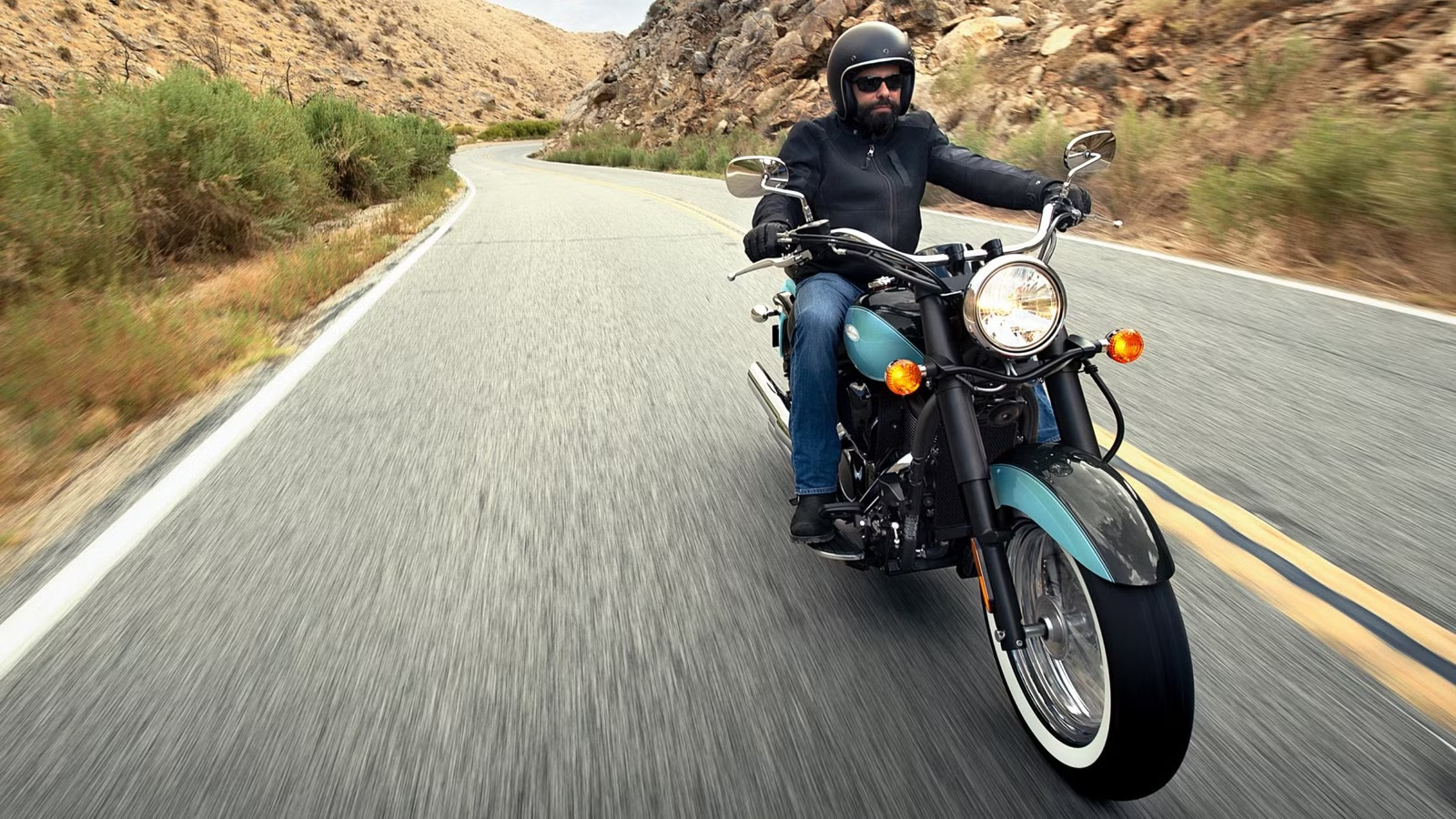
The Kawasaki Vulcan 900 Classic is a charming old-school cruiser bike that follows Japanese engineering perfection to a T. This is also why, despite being unchanged for over 20 years, the Vulcan 900 Classic is still alive and kicking. All these years of refinement have helped create a timeless cruiser bike that can outlive its owner.
This is courtesy of its simple mechanical technology, minimal electronics, and sturdy underpinnings. However, the most important reason this near-immortal cruiser bike remains relevant today is that its V-twin’s character remains unchanged, forming a core defining factor of the Vulcan 900 Classic.
It Is A Low-Stress And Simplified V-Twin

The 903 cc V-twin is designed to outlive its owner thanks to its conservative and simplified construction. It is an overbuilt V-twin derived from decades of Kawasaki engineering prowess. The engine has changed very little since its inception in 2006. This has helped Kawasaki iron out even the slightest of niggles and make this a flawless powerplant that can live forever with just basic care.
Furthermore, it has been designed to be future-proof, with a reliable fuel injection system and liquid cooling since 2006. Supporting components also help its longevity with features like a low-maintenance final belt drive and a wide-ratio five-speed gearbox. This fairly simple engine, with four valves per cylinder and a single overhead camshaft, produces 51 horsepower and 58.3 pound-feet of torque. All of these features help the Kawasaki Vulcan 900 maintain a steady 7,500-mile maintenance interval.
Traditional Yet Proven Underpinnings

The Vulcan 900 Classic is underpinned by a semi-double-cradle frame designed for long-haul comfort. Suspension duties are taken care of by 41 mm Showa telescopic forks up front with 5.9 inches of travel. The rear gets a Uni-Trak swingarm with a seven-way adjustable preload shock and 4.1 inches of travel.

Braking duties are courtesy of a single 300 mm hydraulic disc up front and a 270 mm disc at the rear. Both ends have a two-piston floating caliper. Grip duties are taken care of by chunky 130/90 front and 180/70 rear whitewall tires wrapped around 16-inch front and 15-inch rear spoked wheels.
Harley-Like Styling And Ergonomics Make This Kawasaki A Desirable Cruiser Bike

Despite being a mid-size cruiser bike, the dimensions of the Vulcan 900 are similar to those of a full-sized cruiser bike. It has a wheelbase of 64.8 inches, a length of 97.0 inches, and a width of 39.6 inches. This, when coupled with its classic-vibing design cues like a muscular teardrop tank, a tank-mounted instrument cluster, a hidden softail-style rear monoshock, and a wide 180mm rear tire, gives it an American makeover.
Other design cues that uphold its old-school Harley-like charm include whitewall tires, a chrome two-to-two exhaust system, deep-valanced fenders, and a gorgeous dual-tone paint job. The ergonomics are laid-back and highly accessible thanks to a seat height of 26.8 inches and a relaxed rider triangle with forward-set footpegs and a tall and wide, rider-focused handlebar. The seat is scooped out and well-contoured to support its touring capabilities, too.
A Time Capsule When It Comes To Features

The technological intervention is minimal here. The Vulcan 900 Classic hasn’t received any feature update since its launch in 2006. This makes it a time capsule. The tank-mounted cluster features a huge analog speedometer and a fuel gauge. There is a small LCD in there to display information such as time, odometer, and trip meter readings. There are various LED warning lamps housed in it too.
The Kawasaki Vulcan 900 Classic Balances Old-School Charm, Refinement, And Reliability
At $9,599, The Vulcan 900 Beats Its Japanese Rivals Where It Counts Most

This is one of those few Japanese cruiser bikes that scores high on old-school charm with the right ingredients like a V-twin, relaxed ergonomics, and a healthy dose of chrome. The Vulcan 900 Classic offers the famed Japanese reliability quotient with Harley-grade comfort and visual appeal. This is also why its $9,599 price, while on the higher side for an “outdated” motorcycle, isn’t a deterrent to an affordable ownership experience. The only metric rival that matches the Vulcan 900’s balance is the Yamaha Bolt R-Spec. While it is more affordable at $8,999, it lags in touring-grade comfort and curvy visual drama.
Source: Kawasaki

Related posts





Latest Post


No Comments