
The Pontiac Muscle Car With Corvette Power And BMW DNA
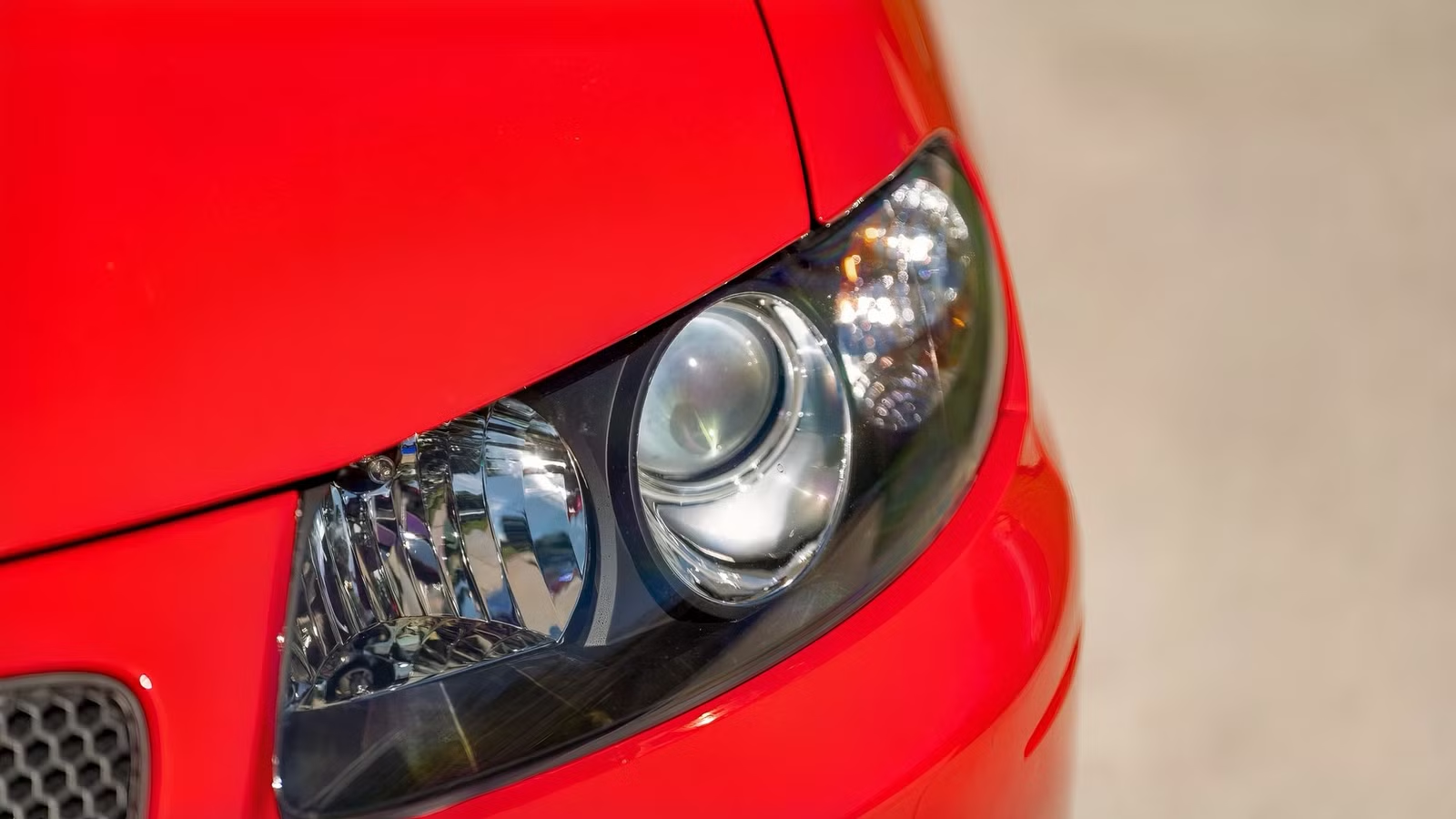
Pontiac brought back its most famous performance badge in 2004, and almost nothing under the sheet metal was homegrown. Buyers wanted a simple continuation of a 1960s legend. What they got was a Corvette-engined grand tourer built on the other side of the world, sitting on a chassis whose family tree started in Germany. And then there is the BMW claim that trails this car through every forum thread, half right and almost never explained properly. The strangest part is that the engineering actually holds up.
Pontiac Lost Its Rear-Wheel-Drive Muscle Car

General Motors killed the F-body platform after the 2002 model year, and with it went the Chevrolet Camaro and the Pontiac Firebird in the same stroke. For a brand marketed entirely around excitement, that created an immediate corporate headache. Pontiac showrooms suddenly had no flagship performance coupe to pull enthusiasts through the doors. Dealers were left selling front-wheel-drive sedans to buyers who specifically wanted eight cylinders sending power to the back tires.

The lineup that remained tells the story on its own. Grand Am, Grand Prix, Bonneville, Aztek. Not one of them sent drive to the rear wheels. The brand identity was rooted in wide-track performance and stoplight drag racing, and none of that survives a showroom full of Grand Ams. Enthusiasts were loud and angry about losing the Firebird. Executives knew the gap was there and the pressure was mounting to close it.
Bob Lutz had arrived at GM in 2001 as vice chairman of product development, and recognized the problem immediately. He knew Pontiac needed a halo car to keep any credibility with driving enthusiasts. The clock was ticking and the brand was losing ground to rivals happily sweeping up disgruntled former Firebird owners. The Ford Mustang was effectively uncontested in the rear-wheel-drive pony car market by then, and a 300-horsepower GT was coming for 2005. Lutz understood that leaving Ford alone in that segment was a terrible business strategy.

Building A New American Muscle Car From Scratch Was Too Expensive

The obvious answer was to gather the engineering teams in Detroit and draw up a new rear-wheel-drive architecture. The financial realities at GM in the early 2000s made that impossible. A clean-sheet platform costs billions and takes years of testing and validation. GM was already spreading its engineering budgets across a sprawling collection of brands, and a bespoke chassis for one niche Pontiac coupe was never going to survive a budget meeting.

Cadillac was where GM was already experimenting with it. The Sigma, launched in 2003 under the CTS program, ran successfully. The kicker? Only Cadillac was getting it, not Pontiac. So the executives went shopping in-house instead, hunting for a division that had already done the heavy lifting. GM ran engineering centers around the world and already leaned hard on sharing platforms between markets. It was around that time, in 2002, that GM poured around $250 million into getting approximately a 42% stake in Daewoo. The requirements were strict. Rear-wheel drive was non-negotiable. It had to swallow a large-displacement V8 and it had to offer a stick shift to satisfy the purists.
It also had to arrive fast, because every year without a performance coupe was another year of lost ground. Nothing in the North American lineup fit. Nothing in GM’s North American lineup offered an obvious affordable rear-drive coupe architecture for Pontiac, which meant the search radius had to expand well beyond the United States.
The 2004 Pontiac GTO Was A Re-Engineered Holden Monaro

The search led Lutz across the Pacific to Australia, where Holden had quietly been building exactly the kind of car Pontiac needed. Holden’s Monaro was a rear-wheel-drive coupe based on the Commodore sedan, and Lutz drove one in Australia and came away convinced an American version could work. Pontiac resurrected the GTO name on the back of it. But calling the 2004 GTO a rebadge ignores how much engineering it took to get the Australian coupe onto American roads.

The whole Pontiac GTO had to be flipped from right-hand drive to left, which meant reworking the firewall and relocating major steering and braking hardware. American crash standards demanded extra structural bracing through the bodyshell. The most invasive change was the fuel system. The Holden design put the tank below the trunk floor, which would not pass American rear-impact testing, so engineers moved all 18 and a half gallons of it up behind the rear seat. The trunk never recovered, and later Australian-market cars inherited the change anyway.
Pontiac fitted its own front and rear fascias, revised the exhaust, and stitched GTO badging into the seats. American emissions certification had to be cleared on top of all of it. According to GM at the time, the entire adaptation took 17 months. The rush shows. The 2004 car launched with a flat hood, and the twin scoops buyers wanted only turned up late in the model year as a dealer-fitted Sport Appearance Package. Under the hood sat the 5.7-liter LS1, from the same V8 family that powered the C5 Corvette, making 350 hp and 365 lb-ft. A Tremec T-56 six-speed manual added $695 to the $32,495 sticker.
So Where Does The GTO’s BMW Reputation Come From?

Car culture runs on rumor, and the most persistent one here is that there is BMW DNA buried somewhere in it. The claim is not nonsense. It is just pointing at the wrong part of the car. The Monaro’s chassis came by way of the Holden VT Commodore, which Holden derived from the European Opel Omega B by widening the body and re-engineering the mechanicals for Australian conditions. That program ran to roughly $600 million, and the finished Commodore shared little with the Opel beyond its starting point.
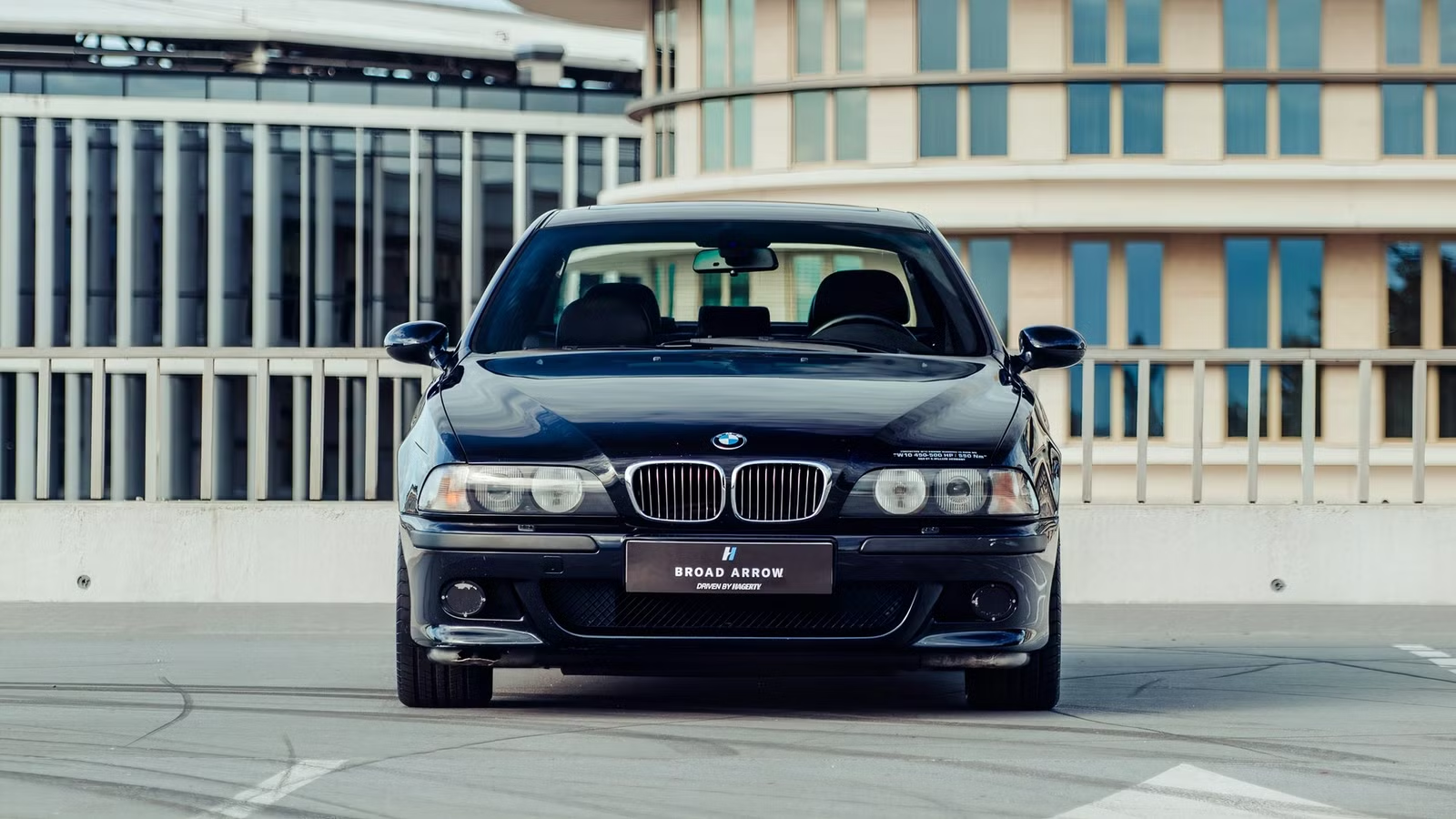
Here is where the record needs to be corrected. Plenty of people still claim the Omega B shared a platform with the E39 BMW 5 Series. It did not. The Omega B sat on GM’s own V platform, and BMW engineered the E39 in house. The BMW crossover was real, but it happened in the parts bin rather than the floorpan. Opel bought BMW’s 2.5-liter M51 inline-six turbodiesel to power the Omega from 1994, later switching to BMW’s M57 for the 2.5 DTI. Traffic went the other way too, with BMW fitting GM’s Strasbourg-built 4L30-E four-speed automatic to 3 Series and 5 Series models.

Then there is the man who signed the GTO off. Bob Lutz. Lutz spent eight years at Opel and reached its board before BMW hired him to Munich, where in May 1972 he founded BMW Motorsport GmbH, the division that eventually became BMW M. So the executive who greenlit an Opel-derived Australian coupe as America’s new GTO had already worked inside both companies the rumor points at. The BMW connection is not a chassis. It is a person.
Classic American muscle was built for straight lines. Live rear axles and vague steering boxes made corners an event nobody particularly enjoyed. The GTO turned up with fully independent suspension at both ends, four-wheel discs, and a limited-slip differential as standard. At 3,725 pounds it was no featherweight, and period testers still griped about body roll, but the shell was stiff enough to run a softer suspension without folding over. The 2005 cars picked up bigger front rotors to keep up with the extra power.
That same architecture had already reached America once, wearing a Cadillac badge. The Catera was an Omega B in a suit and it flopped hard. Nobody at Pontiac was in a rush to mention it. Pontiac turned the heat up for 2005. The LS1 gave way to the 6.0-liter LS2, the same engine powering the C6 Corvette, and output jumped to 400 hp and 400 lb-ft. That bought 0-60 mph in the mid-four-second range and quarter-miles hovering around 13 seconds. A twin-scoop hood arrived alongside it, though the scoops were decoration rather than ram air.
The American Muscle Car From Australia Is Now A Modern Classic

The sales did not follow. Pontiac had planned on roughly 18,000 GTOs a year, but sales fell well short: 13,569 in 2004 and roughly 11,000 in 2005 before recovering to 13,948 in 2006. Around 40,800 cars in total. Styling took most of the blame. Rivals were leaning hard into retro while the GTO looked like a well-resolved rental coupe wearing three sacred letters. Price finished the job. The GTO opened at $32,495, slotting itself well above a Mustang GT, and American buyers took the cheaper badge anyway.

The last Monaro-based coupe rolled off the Australian line on June 14, 2006. By 2005 the Pontiac carried 50 more horsepower and got to 60 mph around half a second sooner. Winning the spec sheet and losing the showroom is a very specific kind of failure. The ending was stranger than the sales sheet suggests. On February 21, 2006, GM told dealers imports would stop in September, blaming new federal airbag deployment standards for 2007 that would have required extensively re-engineering the instrument panel. A dashboard killed it.
Values have not exploded since, whatever the enthusiast chatter suggests. A good-condition car sits around $18,800, up under seven percent in five years, with recorded sales averaging near $21,700. The spread is where it gets interesting. A 2004 car changed hands for $6,599 in March 2026 while a 2006 example hit $70,000 the following July. Four hundred horsepower and a properly sorted European chassis still costs used-commuter money if you buy the right end of that range. The strangest thing about this GTO was never the Corvette engine. It was how many passports the car needed before anyone could bolt a Pontiac badge to it.
Sources: Mecum, Classic.com, Bring A Trailer, Pontiac

Related posts


Latest Post



No Comments