
The Adventure Bike That Owners Keep Longer Than Expected
Today’s tech-led motorcycling world is so fast-paced that model progression year-on-year can not just be quick, but also jump forward substantially. Honda proved as much with a single-generation swap where the 2019 CRF1000L Africa Twin was replaced by the CRF1100L in 2020, which was leaps and bounds forward in tech. It came with a higher 1,084cc displacement, a six-axis IMU, and a touchscreen.

What this does is create a buyer response of wanting the latest and greatest rather than sticking to the older model, which would still serve for years mechanically. But every now and then, a product comes along that challenges established norms, and a BMW flagship adventure bike sets the example of one.
The Itch For A Newer Model Can Get Costly
Switching bikes costs more than money. Romanticizing the love for motorcycles is one thing, but a pragmatic perspective will tell you that a rider who has logged a decent number of miles on one machine has spent ample time with it to have subconsciously calibrated its nuances. And these are details that are now muscle memory. Stuff like how much front brake force the fork takes up before the nose dives aggressively, and exactly where the pegs touch down through a tight corner to have a mental map of the bike’s grip limits. A new bike may be mechanically different, and these nuances take a bit of a learning curve to establish again.


The learning curve is a non-issue, and is what helps you build skills in a motorcycling discipline of choice. It’s the findings that may lead to a mental comparison and the possible regret of getting a new machine that doesn’t live up to the old one. For some riders, especially those who spend a lot of saddle time traversing unforgiving terrains where support or help can be scarce, these factors matter more than the latest tech on offer. The trust and knowledge of a bike well established in the rider’s mind are what prevent one from scratching the itch for a new bike. In the ADV space, there’s only one bike that resonates with this logic.
The BMW R 1250 GS Is The Adventure Bike That Owners Keep Longer Than Expected

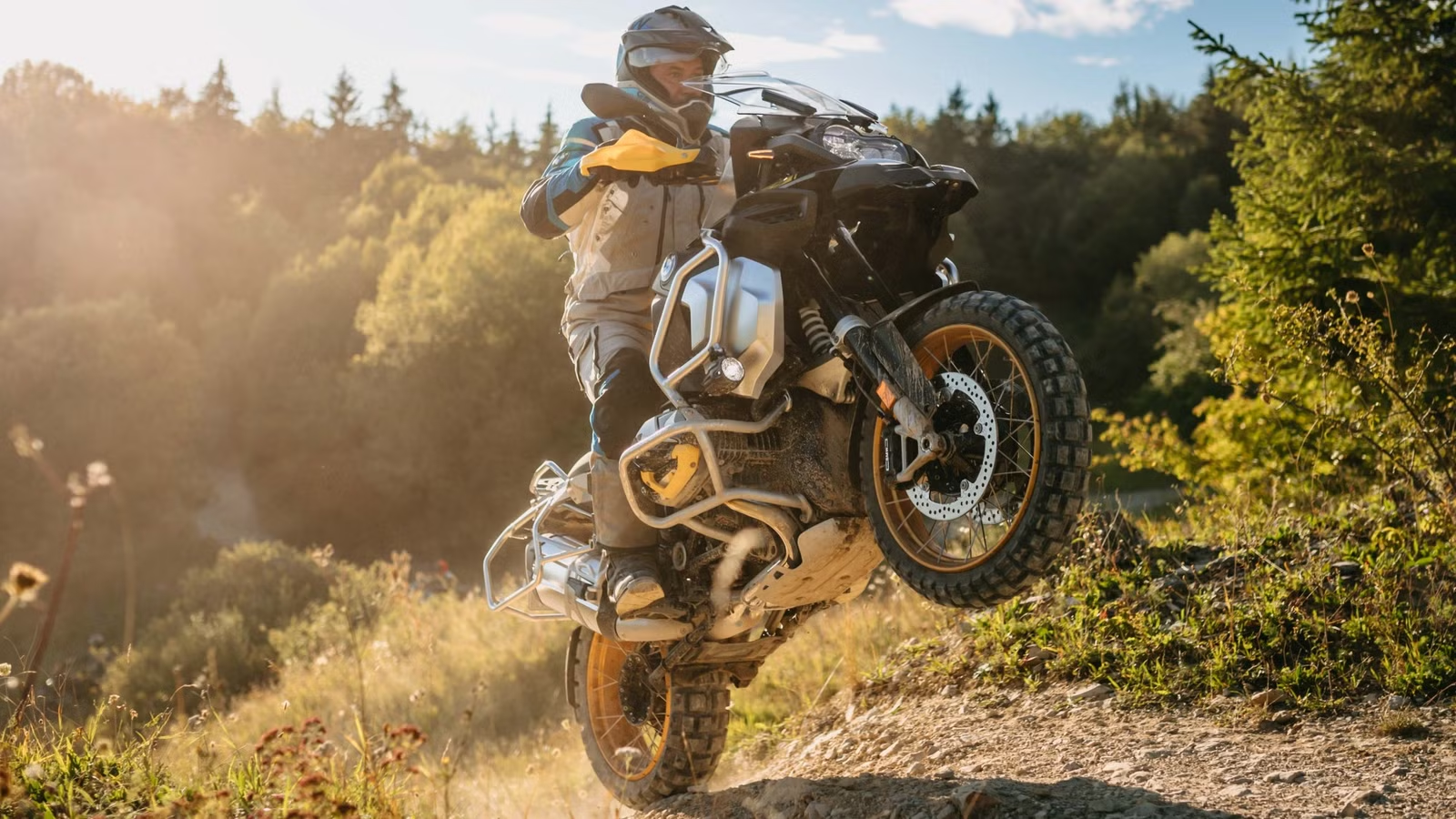
At $17,995 to start, the BMW R 1250 GS wasn’t cheap when BMW sold it new between 2019 and 2023, before the R 1300 GS pushed it out of the current lineup. Used listings today run closer to $13,700 to $16,000, depending on mileage and options. But it’s not the great resale value that makes owners hold onto the bike. Underneath, a 1,254cc boxer twin uses BMW’s ShiftCam variable valve timing that’s good for 136 hp and 105 lb-ft, output that hasn’t aged into irrelevance despite a five-year-old engine. Riders who bought one when it was new are, in plenty of cases, still riding it and there are yet more reasons why.
The Boxer Twin Has A Reputation For Outliving Its Ownership Cycle

BMW’s ShiftCam variable valve timing is what makes that output possible, switching cam profiles depending on specific load and rpm. But the ownership costs are what make the R 1250 GS all the more appealing. Valve clearance rarely needs correcting even after 100,000 kilometers on this engine, and mechanics who’ve opened one up at that mileage report pistons, cylinders, and the crankshaft all still looking relatively factory-fresh.

BMW calls for an inspection of the shaft drive at 12,500 miles and swaps it out preventively around 37,000, even footing that replacement bill itself for as long as the owner keeps the bike. That’s a huge plus in itself. A boxer engine and a drivetrain that both hold up that well simply don’t give an owner a reason to trade in the bike on mechanical grounds alone.
Electronics And Chassis Hardware That Haven’t Aged Out

BMW’s unique telelever front end, something you’ll often hear GS owners brag about, soaks up 7.5 inches of travel through a design BMW has refined since the 1990s. It trades the dive of a conventional fork for a setup that stays composed under hard braking no matter the model year. Chassis composure aside, the electronics are still current.

Standard equipment included a 6.5-inch TFT display, a full LED headlight, and Hill Start Control, along with two riding modes, Rain and Road. An optional Riding Modes Pro package added Dynamic, Dynamic Pro, Enduro, and Enduro Pro, offering six settings in total. It’s no wonder then that the R 1250 GS is still highly regarded as the ultimate ADV.
A Platform That Grows With The Rider Instead Of Being Outgrown

Another reason that the R 1250 GS is preferred as a used buy is that BMW never sold the R 1250 GS as a single, fixed setup. Seat height ranges from a standard 33.5 to 34.3 inches down to 31.5 to 32.3 inches with the factory low-suspension option, and BMW offered a wider spread of factory seat heights on top of that. So a younger rider who has the flexibility to tolerate a taller seat may only have to switch saddles and/or suspension 10 or 15 years down the line, instead of switching bikes altogether.

At 476 pounds, the weight is still manageable with room for a passenger, a full set of panniers, and a top case. BMW has even gone ahead and thought of making things easier for the rider with the optional Dynamic ESA electronic suspension. It adjusts on the fly, softening up for a loaded touring run and firming back up for a solo commute. And this is what makes the R 1250 GS so versatile for speed, comfort and everyday use if so desired.
The R 1250 GS Against The Triumph Tiger Explorer 1200 And Harley-Davidson Pan America 1250

A 2017 Triumph Tiger Explorer 1200 undercuts the GS on the used market, typically running around $9,540. Its 1,215cc inline-triple makes 137 horsepower and 89 lb-ft, more of both than the boxer twin, and a shaft final drive keeps its own maintenance low the same way the GS’s does. What it can’t match is the GS’s specific legacy and pedigree for round-the-world travel. The GS, after all, defined adventure riding for the modern motorcyclist.

A brand new 2026 Harley-Davidson Pan America 1250 Special is the kind of bike that makes a five-year-old GS feel old on paper. It starts at $19,999, and its 1,252cc Revolution Max V-twin makes 150 horsepower and 94 lb-ft, wrapped in a platform that didn’t exist when the R 1250 GS was already several years into production. That’s exactly the pitch aimed at a GS owner shopping for something newer. The Pan America has only been on sale since 2021, though; it isn’t much time to build the kind of ownership history the GS enjoys.

Both rivals pull in a different direction, with the Tiger on long-distance capability and the Pan America being newer and stronger on paper. But neither can borrow the GS’s sheer globe-trotting legacy, and the long-distance trips that built the name or the high-mileage ownership culture that keeps this generation off the used lots and in their owners’ garages longer than most.
Source: BMW Motorrad, Cycle Trader

Related posts

Latest Post



No Comments