
The Toyota Homologation Special Most Supra Fans Have Never Heard Of
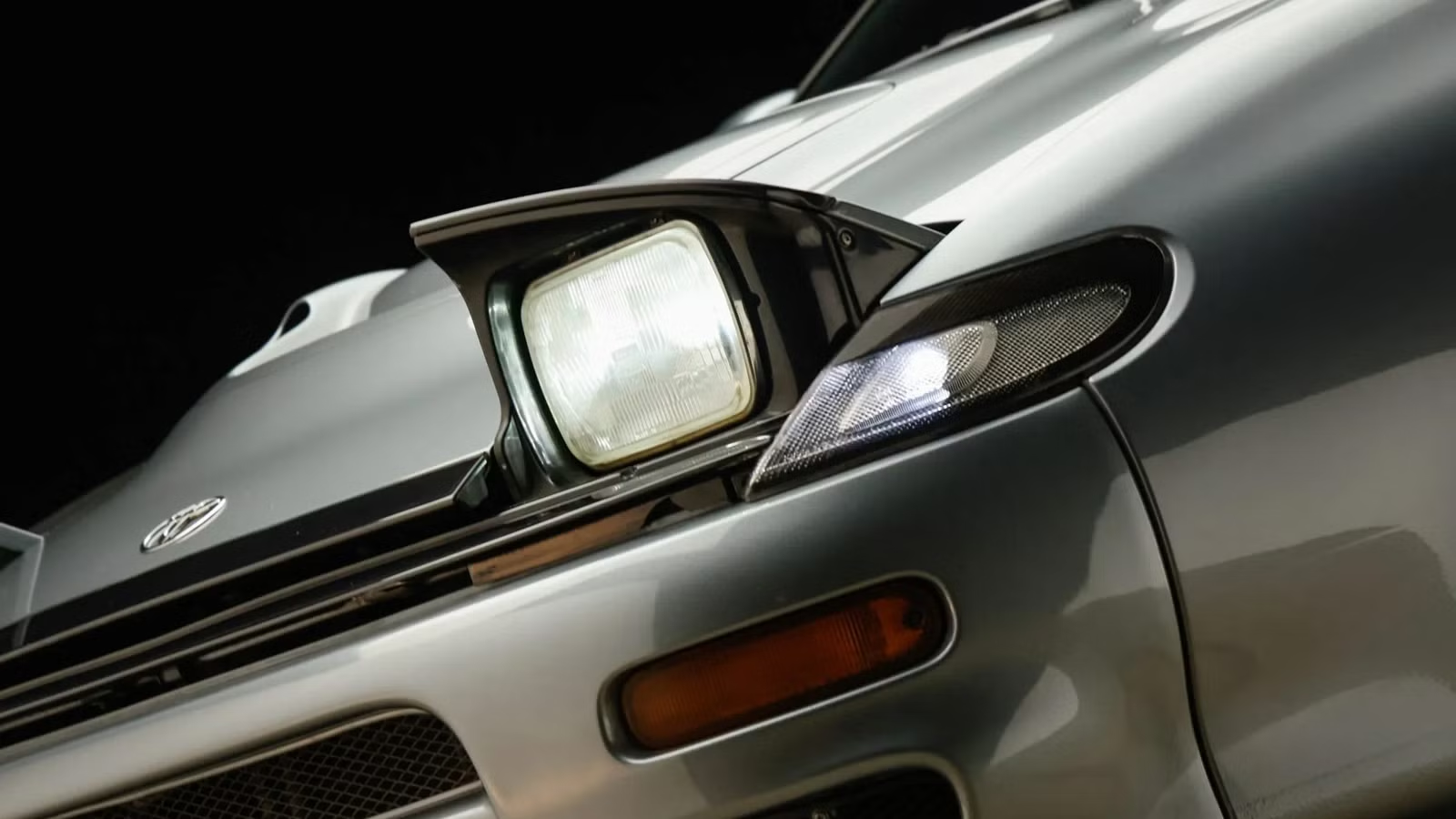
There are few terms more exciting to a motorsport fan than “homologation special”. The phrase refers to cars that exist solely for a team to go racing, and which allow regular enthusiasts the opportunity to get behind something almost as exciting as what the works drivers have, homologation specials have a special place in many fans’ hearts. But for all their history, there’s one Toyota homologation car that barely anyone has heard of today.
How The Supra Became Toyota’s Definitive Performance Icon

Ask anyone what the most well-known Toyota performance car is, and they’ll likely say Supra. They’ll also likely be thinking of the fourth-generation Supra—the one that ran from 1993 to 2002, and was one of the stars of The Fast And The Furious franchise with Brian O’Connor (played by Paul Walker) behind the wheel. It was also featured heavily in the Need For Speed and Gran Turismo games, becoming a symbol of JDM culture worldwide.
While the car’s pop culture performances helped raise it to mythical status, it wasn’t just on the screen that the car did well; it was in motorsport, too. The car won two Teams’ and three Drivers’ championships in the All-Japan GT Championship, and entered (though was ultimately unsuccessful in) the 1995 and 1996 24 Hours of Le Mans. So popular was the Supra that Toyota eventually brought the car back from the dead after 17 years, capitalizing on the accumulated appreciation for the car. But for all the Supra’s undoubted dominance of Toyota’s performance cars, it wasn’t the most outlandish that the marque produced.
Why Homologation Specials Produced Japan’s Most Extreme Performance Cars


A homologation special, for those out of the know, is a road-going car (or bike) that a racing series requires a manufacturer to make in order to compete. They keep the playing field somewhat level, as it ensures that a manufacturer has to at least consider the cost of making a road-legal version of their race car, as much as they might want to just get on track. But as they’re made to satisfy regulations rather than for market demands, manufacturers typically only make as many as they absolutely have to and, when they do, they’re expensive and ludicrous.
From the rally world, there are cars like the Lancia Delta HF Integrale, the Subaru Impreza WRX, and the Mitsubishi Lancer Evolution. Cars that were made not because their manufacturers wanted to make them, but because they had to. And while these cars might be legendary today, there’s another car that deserves to be mentioned alongside them, yet is practically forgotten today.
The Toyota Celica GT-Four RC Is Toyota’s Forgotten Rally Homologation Hero

The Supra is undoubtedly an element of Toyota’s performance lineage, as is its reasonably recent GR line. But tucked between those two eras is the 1991 Celica GT-Four RC. Created as a homologation special to allow the ST185 Celica GT-Four to compete in the World Rally Championship, the GT-Four RC is the lesser-known road-going version of the much-loved rally car.
Being a homologation special, the GT-Four RC wasn’t a completely different car with a familiar badge slapped on the rear; it was a genuine performance vehicle. Powered by Toyota’s turbocharged 2.0-liter 3S-GTE four-cylinder engine and a five-speed manual, it made around 235 hp with a 3,218-pound curb weight. But outright power isn’t what the GT-Four RC was all about. It was a road-going rally car at the end of the day, and copious amounts of power were never the point. It was about being predictable over loose surfaces, maintaining traction over terrain, and surviving the punishment of World Rally Championship stages.
To that end, the RC had a unique aluminum hood with a prominent vent for extra cooling, along with a revised front bumper and a water-to-air chargecooler system instead of the standard air-to-air intercooler. This was done to help manage heat soak and maintain consistent temperatures during hot, humid rally stages, with the RC benefiting by proxy. It also got the suspension and damper tuning you’d expect from a thoroughbred race car, and some special badges to distinguish it as the premium variant; otherwise, differences from the usual GT-Four were relatively slim.

The GT-Four RC was also a departure from Toyota’s usual design philosophy. Where cars like the Supra chased grand touring comfort and outright speed, the RC was singularly focused on one thing: rally. It was never going to be the fastest, or the most comfortable, or the most luxurious, and Toyota didn’t need it to be. It needed to be the foundation of a world champion. And that’s just what it was.
With the required 5,000 examples built to satisfy FIA Group A regulations, Toyota was free to campaign the revised ST185 in the 1992 World Rally Championship. The gamble paid off, with Carlos Sainz Sr. claiming the Drivers’ title after four victories during the season, although Lancia narrowly retained the Manufacturers’ Championship.
Toyota Built The GT-Four RC To Win Championships, Not Sell Sports Cars

While some manufacturers add things to their cars to make them appear fancier, or faster, or more exclusive, that wasn’t the case with the GT-Four RC. Per the homologation rules of the time, Toyota had to make 5,000 within a 12-month period; the competition car had to retain the major characteristics of the production version and, if the manufacturer wanted to make any significant changes, they had to appear on the road-going car first.
This effectively forces manufacturers into either throwing money away, creating a car that can sell well but cannot win, or creating these extraordinary machines that can win on the world stage yet are entirely over-engineered for the road. Toyota decided that the pros outweighed the cons, and the GT-Four RC was created not because Toyota wanted to make it, but because it had to.
Why The GT-Four RC Is Finally Getting The Recognition It Deserves

The Celica GT-Four RC occupies a rather niche spot in motorsport history. Produced in limited numbers over just a single year, it never really had the chance to build the cult following of cars like the R32 Nissan Skyline GT-R, Lancer Evolution, or Impreza WRX.
Of course, Toyota’s 1995 cheating scandal also did nothing for the brand. It may have happened some three years after the GT-Four RC came and went, but as it came at a time when Colin McRae was thrilling fans with his “if in doubt, flat out” mantra behind the wheel of the now-legendary Subaru Impreza, it made for an easy switch of allegiances.
The GT-Four RC remains arguably one of Toyota’s most special cars, and deserves to be talked about in the same breath as the Supra. But it isn’t. Perhaps the car’s inclusion in the recently released Forza Horizon 6 will help it gain a fraction of the attention afforded to the Supra through the Gran Turismo and NFS games but, if not, it can remain one of Toyota’s and rallying’s greatest hidden gems.
Sources: Turbocelica.nl, Toyota

Related posts


Latest Post


No Comments