
Only 96 Buyers Got Oldsmobile’s Rarest 4-Speed Ram-Air Drop-Top
Muscle car history is packed with wild claims, inflated performance figures, and legendary street racers. Yet, when you dig into factory build sheets and actual assembly plant records, the real story is often far more fascinating than show-field folklore. High-performance convertibles from the peak of Detroit’s horsepower race represent the true holy grail for serious collectors today. But even among veteran enthusiasts, one specific open-top legend is constantly misunderstood. The widespread myth surrounding its production count has obscured a far more exclusive truth, hiding a true unicorn behind a famous double-digit number that everyone gets wrong.
The Muscle Era’s Most Misunderstood Production Myth

In 1970, General Motors threw out their internal engine displacement limits and let their high-performance engineering divisions go completely unhinged. Massive big-block V8 engines were dropped into mid-size intermediate chassis, creating quarter-mile monsters straight off the dealership floor. But while hardtop coupes accounted for the vast majority of showroom sales, a tiny handful of brave buyers opted for open-air freedom. Combining a high-compression big-block with a folding soft top created a very specific kind of machine, one that sacrificed a little structural rigidity for sheer, unadulterated exhaust roar and wind-in-your-hair speed.
If you spend any time at major classic car auctions or browsing collector forums, you have definitely heard the famous figure attached to this specific 1970 drop-top. Enthusiasts love quoting a double-digit build total, tossing it around as gospel whenever one of these rare beasts pops up for sale. Generic automotive websites recycle the exact same spec sheets, endlessly repeating that fewer than a hundred of these legendary convertibles ever rolled out of the factory gates.

It makes for a neat headline, but it misses the mark entirely. That widely quoted figure isn’t the whole truth. By treating a single transmission option as the entire production run, casual car buffs have accidentally rewritten history for decades. The actual factory ledger tells a completely different story, one that makes the ultimate driver-focused version of this car even harder to find than the popular rumors suggest. When you look back at how dealership order forms worked during the golden age of muscle cars, buyers had total freedom to mix and match performance parts. You could spec heavy-duty suspension, aggressive rear axle ratios, functional ram-air hoods, and specialized engine packages on almost any body style.

However, because open-top models carried a noticeable price premium and added extra curb weight, very few customers checked every single high-performance option box when ordering a convertible. This created ultra-low production numbers across the board, making surviving examples remarkably valuable in today’s collector market.
Why Hardcore Muscle Collectors Keep Getting The Numbers Wrong

The root of this confusion boils down to how factory production data was recorded and categorized back in 1970. Ordering a top-tier performance package on a convertible was a massive financial decision for buyers. Most customers aiming for pure drag-strip dominance chose the stiffer structure, lighter curb weight, and cheaper sticker price of a hardtop coupe. Ragtops were expensive, heavy, and produced in remarkably small batches, making their factory documentation inherently limited right from the moment they rolled off the assembly line.
As the classic car market exploded over the past two decades, casual observers started taking shorthand build figures out of context. Instead of looking at total vehicle output across the entire model line, people began conflating total convertible production with one specific gearbox choice. That single low number eventually became a lazy catch-all phrase for every drop-top wearing the top-flight performance option code, completely ignoring what kind of gear selector sat between the front bucket seats.

This sloppy shorthand erases the crucial distinction between a high-powered cruiser built with an automatic transmission and a raw, pedal-pumping street machine engineered for manual gear-banging. Setting the record straight isn’t just about quibbling over numbers on a spec sheet. It establishes a multi-tiered hierarchy of extreme rarity that separates casual fans from true automotive historians.
Inside an already tiny group of high-end convertibles sits an even tighter circle of driver-spec cars—machines loaded with aggressive factory weight-saving tricks, special cylinder heads, and ultra-rare rear axle options that most car fans don’t even know exist. When automakers offered these ultra-exclusive options, they weren’t building commuter cars, they were engineering track-ready hardware for drag strips and street racing dominance. Understanding how these options were selected reveals just how uncompromising the original buyers were when they ordered their cars.
The Machine That Was A Production Myth, The 1970 Oldsmobile 4-4-2 W-30 Convertible

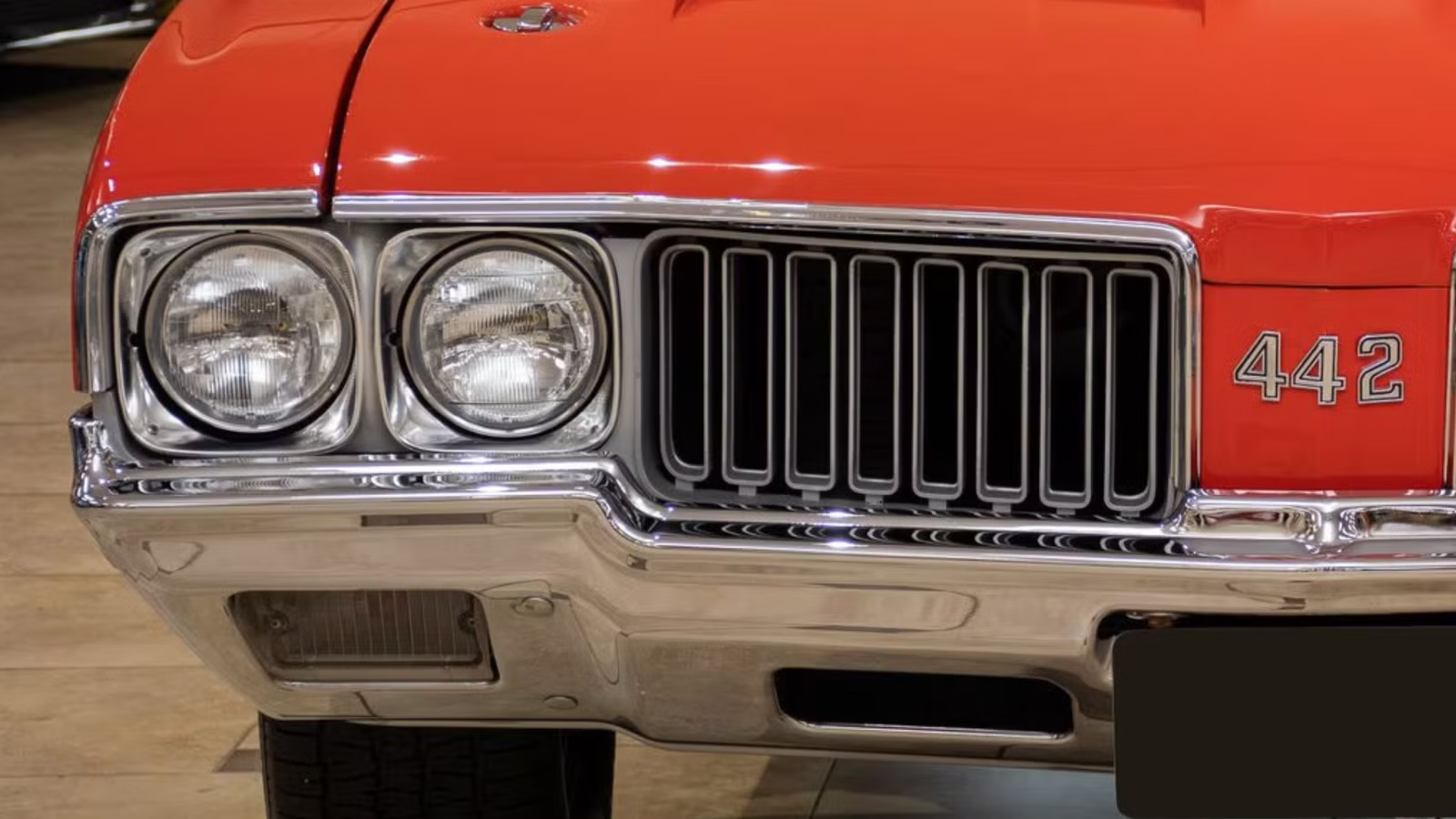
The legendary machine sitting at the center of this production myth is the 1970 Oldsmobile 4-4-2 W-30 convertible. For years, casual muscle car fans have claimed that only 96 of these flagship drop-tops were built for the 1970 model year. That stat confuses transmission data with overall production. Oldsmobile actually built 264 total 4-4-2 W-30 convertibles at its Lansing, Michigan, assembly plant in 1970, with the famous ’96 units’ figure referring strictly to the four-speed manual cars.
The remaining 168 convertibles built that year left the factory equipped with General Motors’ heavy-duty Turbo Hydra-Matic 400 three-speed automatic transmission. While a TH400 automatic W-30 convertible is undeniably a rare beast, the 96 four-speed manual cars are the true crown jewels of the entire model line. Getting that math right changes how you look at the car. Rather than 96 total convertibles existing, 264 buyers took home a W-30 drop-top in 1970, but only 96 of them chose to pair Oldsmobile’s ultimate performance engine package with a clutch pedal and a four-speed stick shift.
By 1970, the 4-4-2 badge had evolved from an option package into its own standalone performance model. The name originally stood for a four-barrel carburetor, four-speed manual transmission, and dual exhausts. Checking the W-30 box on the dealer order sheet turned Oldsmobile’s refined A-body convertible into a legitimate street-clearing terror capable of running head-to-head with the baddest machines coming out of Chevrolet, Pontiac, or Plymouth.
A Ram-Air 455 Big-Block Packed With Lightweight Performance Secrets

Underneath the hood, the heart of the 1970 W-30 package was Oldsmobile’s massive 455-cubic-inch V8 engine, factory rated at 370 horsepower and a monstrous 500 lb-ft of torque. To extract that massive power, Oldsmobile engineers gave the big-block a serious internal overhaul. They loaded the 455 with a performance-profile camshaft, oversized valves housed inside legendary high-flow “F” cylinder heads, and a lightweight aluminum intake manifold topped by a specially calibrated Quadrajet four-barrel carburetor.
Feeding dense cold air to that big-block was the iconic W25 fiberglass hood. Featuring functional dual air scoops, this ram-air setup forced cold outside air directly into a sealed, low-restriction air cleaner assembly. Beyond breathing cold air into the carburetor, the W25 fiberglass hood saved 18 pounds off the nose of the car compared to the standard steel unit. Oldsmobile kept the weight-saving campaign going by installing bright red plastic inner fender liners.

These red liners shaved extra pounds off the front overhang, and Oldsmobile trimmed even more by cutting back on sound-deadening insulation throughout the body structure. Then there is the factory option that true Oldsmobile diehards search for: the legendary W27 aluminum differential package. Offered in 1970, this option replaced the standard cast-iron rear axle housing with a cast-aluminum differential carrier and a finned aluminum cover.
Designed to drop unsprung weight and keep axle fluid cool during severe abuse, the W27 rear end was expensive and earned the reputation for being fragile if launched hard on sticky tires. Today, finding a factory-documented 1970 W-30 four-speed convertible that still retains an authentic W27 aluminum axle represents one of the true holy grails of Oldsmobile collecting.
Quarter-Million-Dollar Holy Grails In Today’s Auction Market

With only 96 four-speed manual W-30 convertibles leaving the Lansing factory in 1970, surviving authentic examples command eye-watering prices whenever they cross the auction block. The collector car market has fully caught up to the extreme rarity and mechanical significance of these open-top muscle cars. Modern buyers demand bulletproof factory documentation, knowing that authentic four-speed W-30 drop-tops represent a genuine high point of GM’s muscle era.
A prime real-world example of this market demand occurred at the RM Sotheby’s Fort Lauderdale auction in March 2022. Lot 2157 featured a stunning 1970 Oldsmobile 4-4-2 W-30 convertible finished in factory-correct Twilight Blue with an Astro Blue vinyl interior and a clean white folding top. Powered by its original numbers-matching 455 V8 paired with the coveted four-speed manual transmission, this specific car had undergone a painstaking restoration by specialists at Thornton Motors.

When the final hammer dropped at the 2022 sale, the price reached an incredible $247,500. That quarter-million-dollar auction result solidifies the four-speed W-30 convertible’s position in the upper echelon of American collector cars. It proves that top-tier collectors are willing to pay massive premiums for verified rarity, correct high-performance hardware, and the visceral thrill of a four-speed manual gearbox connected to 500 lb-ft of big-block torque.
While casual car fans might still quote the wrong total production numbers at weekend car shows, serious collectors know the actual breakdown: 264 total built, just 96 built with three pedals, and every single surviving four-speed manual car stands as a genuine holy grail of muscle history.
Sources: Mecum, Classic.com, RM Sotheby’s, General Motors

Related posts




Latest Post


No Comments