You Don’t Need An Audi A4—This Japanese Sedan Feels Just As Premium
8 minutes reading
Wednesday, 12 Aug 2026 13:00 0 5 autotech
Audi’s decision to discontinue the A4 range last year was part of a strategy based on the restructuring of its vehicle lineup to simplify naming conventions. The German automaker now assigns even numbers to electric vehicles and odd numbers to combustion models.
Replacing its historic sedan is the revised A5, which maintains a Sportback silhouette. While Audi has put the A4 lineage to rest, there’s still a lot of value in opting out of the premium German sedan’s ownership experience in favor of a Japanese alternative that also adopts a fastback design for a more competitive price.
The State Of America’s Premium Sedan Market In 2026
2023 Audi A4 front 3/4 shotAudi
2026 has seen a shift in the U.S. premium automobile market as buyers continue to favor crossovers and SUVs. Premium sedans hold roughly a quarter of overall luxury vehicle sales, trailing behind utility models that dominate luxury volume. Despite declining volume compared to historical peaks, premium sedans maintain strong profitability through higher average selling prices and technological features.
Automakers reposition these models as design and technology flagships, driving steady demand in dense urban areas and executive fleet markets. The target demographic leans toward higher-income corporate executives, affluent professionals, and younger tech-focused buyers who value driving dynamics, brand prestige, and advanced software over extra cargo space. This shift leads legacy brands to streamline their sedan offerings to focus on high-margin electrified models and performance variants. Premium sedans remain relevant by targeting buyers who prioritize distinct styling and high performance over crossover versatility.
Audi Continues To Struggle Competing In The American Premium Market
Front 3/4 action shot of 2026 Audi A5 driving on roadAudi
Audi sales in the U.S. through the first half of 2026 reflect mixed results. The longstanding German marque reports 67,916 vehicle deliveries, reflecting a 17 percent drop compared to the previous year. Internal combustion models are driving the current sales volume as the brand’s EV endeavors fail to hit their projected sales targets.
The Q5 crossover leads this momentum with a 30 percent increase during the second quarter, further highlighting a decline in demand for conventional sedans. The decline in EV demand across the brand lineup is highlighted by an 85 percent sales drop, caused by shifting tax incentives and market dynamics. Traditional luxury crossovers remain essential to maintaining overall corporate brand volume.
Toyota’s Approach To Premium Sedans
Toyota
Over the last decade, Toyota’s sedan catalog has shifted from a diverse range primarily powered by internal-combustion engines toward a streamlined, high-efficiency lineup that prioritizes hybrid technology and modular global platforms. This evolution saw the phase-out of several long-standing nameplates in favor of more aerodynamic, coupe-inspired silhouettes and the introduction of advanced driver-assistance systems as a standard baseline across all segments. Today, the offering is defined by a heavy investment in electrification, with most midsize and full-size options now utilizing dedicated hybrid or plug-in hybrid powertrains that deliver high-output performance alongside significant fuel savings.
The current portfolio spans from accessible compact options to a high-riding flagship that blurs the lines between a traditional executive sedan and a crossover, emphasizing all-wheel-drive capability and tech-forward interiors. To attract buyers who might otherwise look toward dedicated luxury marques, these flagship trims integrate premium materials and features, while maintaining a more competitive MSRP by leveraging the brand’s immense manufacturing scale and shared mechanical components, offering a high-tier executive experience without the traditional luxury price premium.
The Crown Sets The Affordable Luxury Bar High
Front shot of a 2026 Toyota CrownToyota
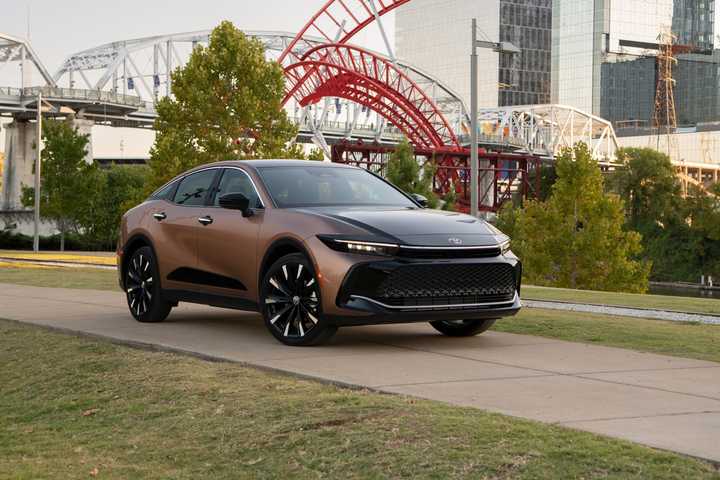
The 2026 Toyota Crown serves as the brand’s sophisticated flagship, merging mainstream practicality with executive-level refinement. Toyota positions this model at the top of its concentrated sedan lineup as the successor to the Avalon, while targeting buyers who want the experience of luxury and prestige with a quiet cabin and a more commanding and elevated road presence.
Like the 2026 Audi A5, it replaces a conventional midsize sedan with a sleeker fastback rear hatch design. Joining this is an elevated ride height and plastic wheel arches to give it the appearance of a conventional SUV. Toyota opts for this design decision to appeal to crossover fans who still want the appeal of a tasteful premium sedan.
Exceptional Reception From The Market
Rear 3/4 action shot of 2026 Toyota CrownToyota
The Toyota Crown‘s reception highlights its impressive execution. J.D. Power gives the Toyota Crown range an 80/100 overall rating, constituting an 82/100 quality and reliability mark and an 81/100 driving experience score. iSeeCars gives the 2026 model year with a 7.8/10 score for retained value and an 8.0/10 score for safety.
The Toyota Crown also currently sits with a 4.3/5 consumer review rating from Edmunds, with existing owners highlighting its fuel efficiency, ride quality, and value as key attributes that you will likely appreciate. Only a few of the 46 reviews mention insufficient interior space.
Unfortunately, Toyota’s strategy with the Crown isn’t exactly paying off. The brand’s sales report for June 2026 reveals that it was only able to sell 656 units of the premium model, reflecting a 31.7 percent year-on-year decline in performance. For the year so far, the report confirms a total of 5,152 units sold. Interestingly, this equates to a 1.9 percent year-on-year performance improvement.
The Crown Gets Luxury Car Interiors Right
Shot of 2026 Toyota Crown interior showing cockpitToyota
Toyota structures the 2026 Crown into four distinct trims, each acting as a defined step towards higher luxury and technological integration to maintain an executive status. Its base MSRP is expensive when compared to other models in the Toyota catalog, but when you pit it against luxury rivals competing in the same segment, this has to be one of the most competitively priced options that you can consider.
The XLE, priced at $41,440, includes leather-trimmed seating with eight-way power-adjustable front seats that are both heated and ventilated. Convenience features include a 12.3-inch digital gauge cluster, a smart key system for all doors, and dual-zone automatic climate control. For entertainment, the cabin boasts a 12.3-inch Toyota Audio Multimedia touchscreen featuring wireless Apple CarPlay and Android Auto, a Qi-compatible wireless charger, and a six-speaker sound system.
The $45,950 Limited adds a fixed panoramic glass roof with a power sunshade, rain-sensing wipers, and quad-LED projector headlights. The entertainment suite receives a major upgrade to an 11-speaker JBL Premium Audio system, including a subwoofer and amplifier, providing the acoustic depth expected of a high-end luxury vehicle.
Appealing Quality From Flagship Trims
2026 Toyota Crown screenToyota
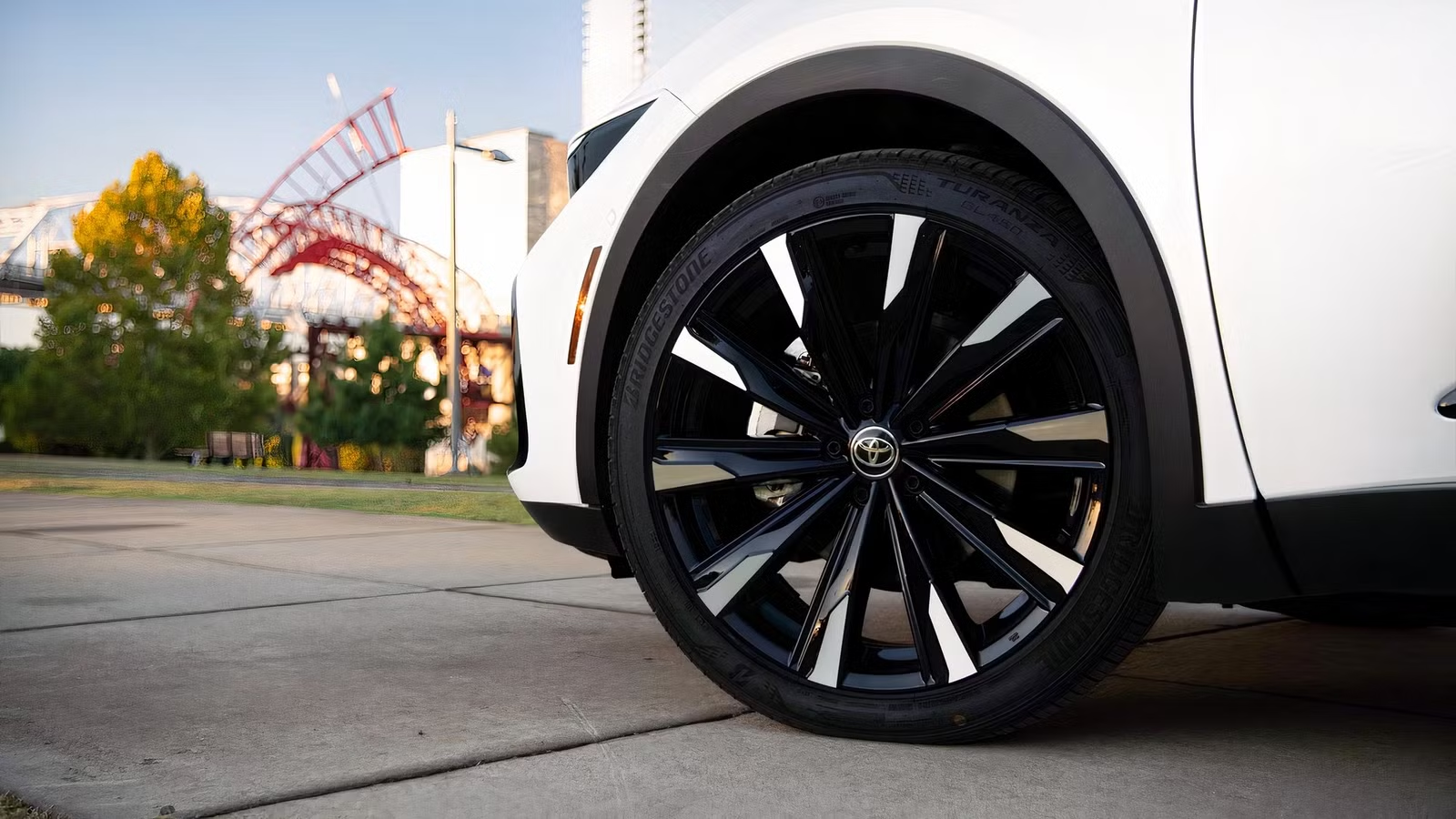
The Nightshade costs $48,765, and builds on the Limited’s offering by adding 21-inch matte-black 10-spoke alloy wheels. It also adds dark-themed exterior accents, such as black mirror caps, door handles, and shark-fin antenna.
For $54,990, you can get the Platinum trim, which adds a 10-inch color head-up display and a panoramic view monitor with a 360-degree overhead view. You also get the Advanced Park self-parking system, a hands-free power trunk with a kick sensor, and digital key capability, together with 21-inch machined-finish alloy wheels with black accents to distinguish it as the top-tier model.
If you want to bridge the gap between trims, Toyota offers a few key additions, including an Advanced Tech Package for the Limited trim. This adds the panoramic view monitor, digital key, and 21-inch 10-spoke dark metallic alloy wheels for $2,900. Bronze Age or Oxygen White paint options increase pricing by $425.
Refined And Potent Powertrain Options
2026 Toyota Crown engineToyota
The XLE and Limited trims feature the 2.5-liter four-cylinder and dual-permanent-magnet motor and eCVT configuration. This produces 236 horsepower and 163 pound-feet to all four wheels, resulting in a claimed 7.6-second 0-60 MPH time and 116 MPH top speed. Independent tests confirm that you can sprint to 60 MPH from a standstill in just 7.2 seconds.
The flagship Platinum model incorporates the turbocharged 2.4-liter four-cylinder and dual-motor configuration. This sends 340 hp and 332 lb-ft to all wheels via a six-speed automatic. Toyota claims this model will sprint from 0 to 60 MPH in 5.7 seconds before hitting a 129 MPH limited top speed.
All models adopt the TNGA-K’s front MacPherson strut and rear multilink suspension, granting the Crown an equally poised and comfortable ride. Only the Platinum benefits from the brand’s Adaptive Variable Suspension system, resulting in superior handling and ride comfort.
Toyota’s World-Class Consumption Estimates
2026 Toyota Crown front driving shotToyota
The Crown benefits from Toyota’s hybrid powertrains, resulting in some impressive EPA-estimated consumption figures. The naturally aspirated models return a 42/41/41 MPG consumption estimate on the city/highway/combined cycle and cover 594 miles on a single tank, with some help from a 0.9-kWh battery pack. The EPA also estimates that this model will save you $2,750 in fuel costs over five years, which means you’ll spend around $1,200 on fuel over the course of the year and $1.98 to drive 25 miles. You can expect to spend $47 to fill up the 14.5-gallon tank.
The turbocharged Platinum model returns a 29/32/30 MPG estimate and covers 435 miles on a single tank, despite featuring a slightly larger 1.2-kWh battery pack. You can expect this model to save you $750 on fuel every five years and cost you $1,600 to refuel every year. A 25-mile trip is likely to cost around $2.70.
Base Trim Engine
2.5L Dynamic Force I4 Hybrid
Base Trim Transmission
CVT
Base Trim Drivetrain
All-Wheel Drive
Base Trim Horsepower
184 HP @6000 RPM
Base Trim Torque
163 lb.-ft. @ 3600 RPM
Base Trim Fuel Economy (city/highway/combined)
42/41/41 MPG
Base Trim Battery Type
Lead acid battery
Make
Toyota
Model
Crown
Sources: The EPA, iSeeCars, Edmunds, CarEdge, and J.D. Power.










No Comments