
The Highest Revving Engine Ever In A Production Car
Few engineering achievements in the automotive world are as viscerally thrilling as a naturally aspirated engine screaming toward a five-digit redline. The shriek of a high-revving motor — whether on a race circuit or a canyon road — is a sound that no forced-induction engine can replicate, and it remains one of the most compelling arguments for keeping the internal combustion engine alive. Engines with high redlines can sustain peak power output across a broader rev range, making them ideal for spirited driving and track use. Generally, high-revving engines are more responsive, feature a shorter stroke, and are built from lightweight materials to achieve the feat. In the V8 era of Formula 1, for example, Ferrari’s engines could rev to a staggering 20,000 rpm.

However, high-revving engines demand advanced engineering, making them expensive to develop and maintain. Additionally, they typically deliver peak performance high in the rev range, which means limited low-end torque — making them largely impractical for everyday driving.
Some hypercars are not generally designed for daily use but rather built for purpose, employing high-revving engines for on-track performance. As automakers chase 0–60 mph times, quarter-mile times, and top speed records for road cars, we set out to find and highlight the highest-revving engine ever used in a production car.
The GMA T.50 V12 Engine Revs To 12,100 RPM
 84 autotech Engine |
Horsepower |
Torque |
0-60 MPH |
|---|---|---|---|
|
3.9-Liter V12 |
654-725 HP |
344-358 LB-FT |
2.9 Seconds |
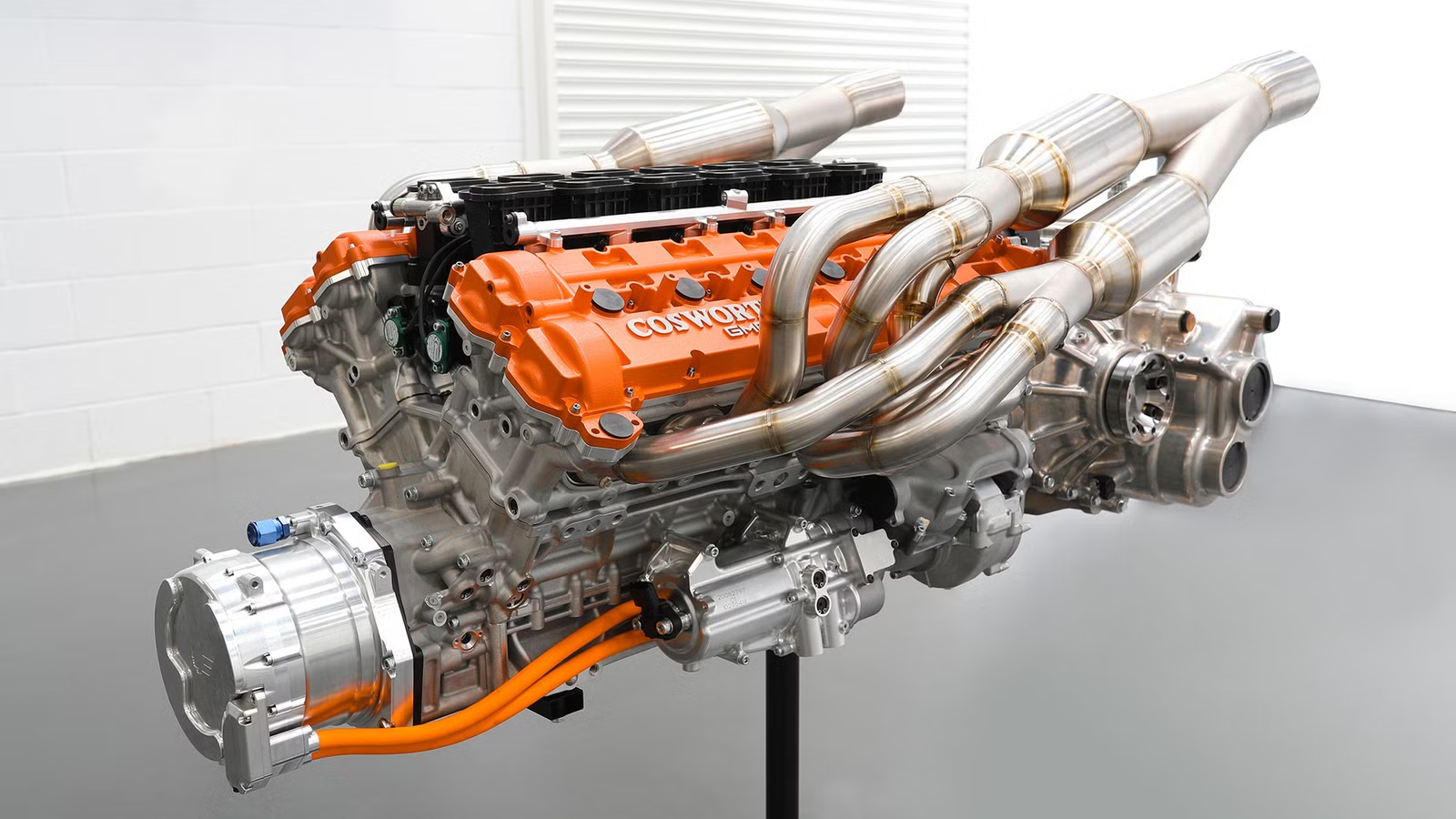
Gordon Murray, the designer of the McLaren F1, revealed the GMA T.50 as a spiritual successor to the fastest naturally aspirated production car ever. Like the F1, the T.50 uses a naturally aspirated V12 engine producing around 654 hp and 344 lb-ft of torque. Its lightweight construction means the engine tips the scales at just 392 lbs. The V12 was developed in collaboration with British engineering firm Cosworth, who also helped develop the V12 for the Aston Martin Valkyrie and the V16 engine for the Bugatti Tourbillon.

This 3.9-liter naturally aspirated V12 engine in the GMA T.50 revs to a staggering 12,100 rpm, making it the highest-revving engine ever fitted to a production car. The engine runs an extremely high 14:1 compression ratio and features individual throttle bodies. A throttle response time of just 28 milliseconds is also claimed to be the fastest of any road car engine in the world.

The V12 is mated to a mechanical 6-speed manual Xtrac gearbox, with gearing tailored for top speed rather than outright acceleration. Despite that, the T.50 is claimed to reach 60 mph in 2.8 seconds and achieve a top speed of 226 mph. GMA also offers a track variant called the T.50s Niki Lauda, which features an aggressive aerodynamic package along with increased engine output — 725 hp and 358 lb-ft of torque. The track-focused T.50s Niki Lauda sheds 295 lbs compared to the standard car, bringing its weight to under 900 kg (1,984 lbs). The enhanced aero package allows the T.50s Niki Lauda to generate up to 2,645–3,306 lbs of downforce.
The Caparo T1’s V10 Engine Revs To 12,000 RPM

|
Engine |
Horsepower |
Torque |
0-60 MPH |
|---|---|---|---|
|
3.5-Liter V8 |
575 HP |
310 LB-FT |
2.5 Seconds |
The Caparo T1 is the car with the second highest-revving engine, after the GMA T.50. The 3.5-liter naturally aspirated V8 engine in the T1 revs to 12,000 rpm. The V8 is derived from Formula 3 engines of the era and was modified for use in a road-legal car. It uses an aluminum block and heads and runs a 12.0:1 compression ratio. Caparo claimed the engine was tuned to produce 575 hp at a remarkable 10,500 rpm and 310 lb-ft of torque at 9,000 rpm.

The T1 weighed just 1,030 lbs dry, resulting in a power-to-weight ratio of over 1,000 hp per ton. Paired with a 6-speed sequential manual transmission also built by Xtrac, the Caparo T1 sprints from 0–60 mph in 2.5 seconds and tops out at 200 mph. Like the GMA T.50, the Caparo featured ultra-quick throttle response, engineered to mimic Formula 1 characteristics.

The Caparo T1 was largely designed for track use, though it was also road-legal. Only 20 examples were manufactured between 2007 and 2012, selling for approximately £235,000 at launch. The T1 was an extreme machine that demanded a high level of skill to drive at the limit. It was also prone to reliability issues, particularly around heat management. Regardless, the Caparo T1 remains an icon for its uncompromising design, delivering a driving experience closer to Formula 1 than almost any other road car.
The Kawasaki Ninja ZX 25R Is The Fastest Revving Motorcycle

|
Engine |
Horsepower |
Torque |
Top Speed |
|---|---|---|---|
|
249cc Inline-Four |
50 HP |
16.9 LB-FT |
118 MPH |
When it comes to truly high-revving engines, motorcycles tend to push the limits even further. The 599cc engine in the Yamaha R6 revs to a commendable 16,000 rpm, but the Kawasaki Ninja ZX-25R goes higher still. The Ninja ZX-25R holds the title of the highest-revving production motorcycle engine in the world, with a redline at 17,000 rpm and a peak rev limit of 17,500 rpm.

The 249cc engine in the Ninja ZX-25R is a liquid-cooled, 4-stroke, DOHC inline-four with individual throttle bodies and electronic fuel injection. The ZX-25R also uses a high-performance exhaust system for smooth airflow and optimized power delivery. The result is 50 hp at 15,500 rpm with a RAM air intake and 16.9 lb-ft of torque at 14,500 rpm, running an 11.5:1 compression ratio.

The Ninja ZX-25R boasts a top speed of 118 mph and weighs just 401 lbs. The four-cylinder engine is mated to a 6-speed manual gearbox with an assist and slipper clutch, and a quick shifter comes as standard. The motorcycle uses a lightweight trellis frame for agility and cornering precision on road and track alike. Suspension consists of 37mm USD Showa SFF-BP forks up front and a horizontal backlink mono-shock at the rear. For stopping power, the ZX-25R uses a single 310mm disc with a radial-mount 4-piston caliper at the front and a 220mm disc with a single-piston caliper at the rear. From the factory, the Ninja rolls on sport-focused Dunlop GPR-300 tires and is equipped with traction control, ride modes, and ABS as standard.
Most motorcycles with 250cc engines are single-cylinder or parallel-twin by design, which makes the Kawasaki Ninja ZX-25R genuinely unusual with its inline-four configuration. The model was introduced in 2020, with a primary focus on Asian and Middle Eastern markets. While the Ninja ZX-25R is designed to be approachable for newer riders, it is equally capable on track.
Sources: Gordon Murray Automotive, Caparo Vehicle Technologies, Kawasaki

Related posts

Latest Post


No Comments