
440 Six-Pack vs 428 Cobra Jet: The Timing Slips That End The Debate
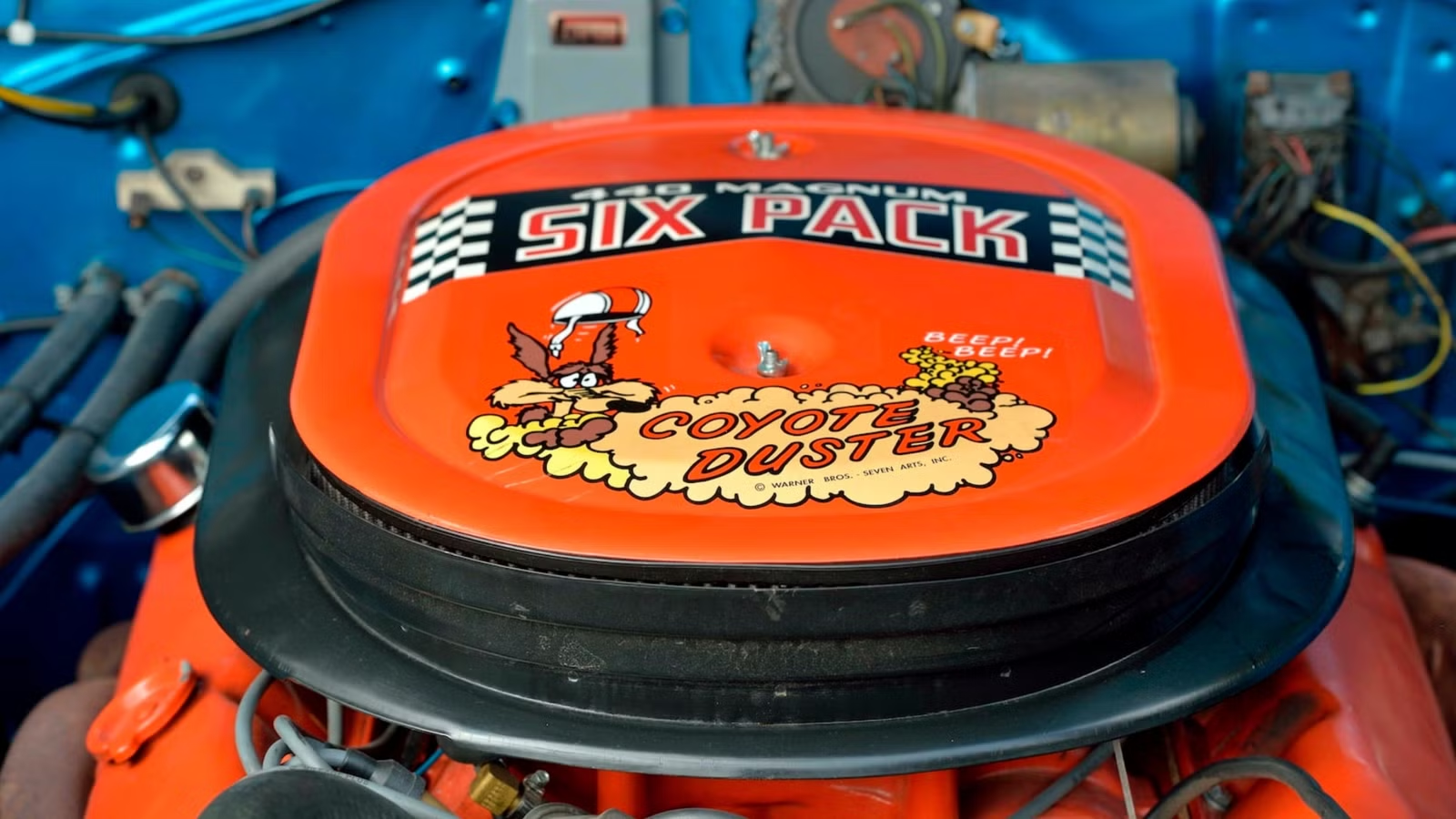
Few arguments in muscle car circles have survived as long, or gotten as personal, as the one between Mopar’s 440 Six-Pack and Ford’s 428 Cobra Jet. Decades of bench racing, forum threads, and swap meet shouting matches have settled nothing, because both sides tend to argue from memory and loyalty rather than an actual stopwatch. The real answer has been sitting in period magazine archives the whole time, in timing slips nobody bothered to line up side by side. It is time to actually do that.
The Debate That Refuses To Die

The 440 Six-Pack and the 428 Cobra Jet represent two genuinely different engineering philosophies aimed at the exact same goal: winning at the drag strip and on the street without the cost or complexity of an exotic hemi-head engine. Chrysler built its case around massive low-rpm torque, betting that raw twisting force off the line would beat almost anything on the first sixty feet. Ford built its case around a high-revving, free-breathing big-block that made its real power higher in the rev range, betting that sustained pull through the traps would matter more than a quick launch. Both approaches worked. Both approaches also produced passionate, permanent partisans who have spent more than fifty years insisting the other side’s engine was overrated.
That argument usually gets settled with opinion, brand loyalty, or whichever car somebody’s father owned in 1969. It rarely gets settled with the actual period timing data, the magazine tests where both engines were strapped into comparable cars and sent down a quarter-mile strip under professional supervision. That data exists, it has existed for decades, and it tells a more interesting story than either side’s mythology usually allows. Some of it favors Chrysler. Some of it favors Ford. And one specific run, largely forgotten outside serious Mopar circles, arguably ends the argument outright. Getting to that answer means looking at what each engine was actually built to do, and then checking the receipts.
Mopar’s Case For Torque Over Everything


Chrysler’s 440 Six-Pack, officially the 440 Six-Barrel on Plymouths and Six-Pack on Dodges, paired the big 440-cubic-inch wedge with three two-barrel Holley carburetors on an aluminum intake manifold, an arrangement in which the center carburetor handled normal driving and the two outer carburetors opened under hard throttle. Chrysler rated the combination at 390 horsepower at 4,700 rpm and, more importantly, 490 lb-ft of torque at 3,200 rpm, a genuinely massive figure that arrived low in the rev range, where a driver could actually use it off the line. The engine first appeared in the limited-production 1969 A12 Road Runner and Super Bee before becoming a wider option across the Road Runner and Super Bee lineup for 1970 and beyond.
How Early Torque Changed The Launch

That low-rpm torque advantage translated directly into how these cars actually launched. A driver could load the 440 Six-Pack against the transmission at a relatively low engine speed and let that 490 lb-ft do the work of getting nearly two tons of Detroit steel moving without needing to hold the engine at a specific, narrow rpm window to make it work. That forgiveness mattered enormously at a stoplight or a drag strip staging lane, where most drivers were not professional racers and could not consistently nail a perfect high-rpm launch. The Six-Pack’s torque curve gave an average driver a genuine shot at a strong first sixty feet, the single most important part of any quarter-mile run, without demanding the kind of practiced clutch work a peakier engine required.
Ford’s Case For Revving Its Way To The Win

Ford took a different approach entirely with the 428 Cobra Jet. Built around a Police Interceptor block fitted with cylinder heads borrowed from the 427, the Cobra Jet used a single 735 CFM Holley four-barrel and a camshaft tuned to keep making power higher in the rev range than the torque-first 440. Ford’s case was straightforward: a high-performance engine that pulled hard through the middle and top of the rev range would post a stronger trap speed and a stronger overall elapsed time, even if it needed a driver willing to keep the engine spinning to get there. The Cobra Jet debuted mid-1968 and quickly became the engine most associated with Ford’s serious quarter-mile ambitions, powering the Mustang, Torino, Cyclone, and Cougar.
The Horsepower Figure Nobody Believed

Ford officially rated the Cobra Jet at 335 horsepower at 5,200 rpm and 440 lb-ft of torque at 3,400 rpm, a figure that confused people from the moment it was announced. That 335 hp rating placed the Cobra Jet just 10 hp above the milder 325 hp 390 GT four-barrel, an almost comical gap for an engine built around 427-style cylinder heads and a genuinely serious camshaft. The industry consensus, backed by decades of independent dyno testing, puts the Cobra Jet’s real output closer to 400 to 410 horsepower, a gap of roughly 65 to 75 horsepower between what Ford printed in its brochures and what the engine actually made.
That underrating was deliberate: a calculated move to keep the Cobra Jet in a favorable NHRA class and away from insurance underwriters who were already circling the muscle car segment by 1968. The NHRA saw through the strategy almost immediately, reclassifying the engine into a higher competition bracket anyway, but Ford never revised the printed number, and the 335 hp rating stuck on paper all the way through 1970.
What The Timing Slips Actually Show

Period magazine testing gives the clearest apples-to-apples comparison available. In March 1968, Hot Rod magazine ran a 428 Cobra Jet Mustang GT through the quarter-mile in 13.56 seconds at 106.64 mph, a genuinely strong number for a bone-stock, big-block pony car straight off the showroom floor. A year later, Super Stock magazine put a bone-stock 1969 A12 Road Runner with the 440 Six-Barrel through its own quarter-mile testing and recorded a documented 13.24-second run at 110.70 mph before any modifications, a result that beat the Cobra Jet Mustang by roughly three tenths of a second in comparable, factory-stock trim.
That gap is not enormous, and gearing, tire compound, driver skill, and even the specific example tested could easily account for a few hundredths of a second either way. But it is real, it is documented, and it points in Mopar’s direction when both engines are measured in the trim customers actually drove off the lot. A 1969 Mach 1 Mustang with the same 428 Cobra Jet, tested separately by Popular Hot Rodding, ran a slightly slower 13.69 seconds at 103.4 mph, adding a second data point that reinforces rather than contradicts the Road Runner’s advantage in stock configuration.
The Run That Changes The Conversation

If the stock-trim comparison already favors Mopar by a few tenths, one specific run erases any remaining doubt entirely. Chrysler enlisted professional drag racer Ronnie Sox of the Sox and Martin racing team to demonstrate what the 1969 A12 Road Runner could actually do in the hands of someone who knew how to extract every last hundredth from a clutch and a shifter. With nothing more than the air cleaner element removed, a legal and easily reversible change any owner could make in a parking lot, Sox ran a sequence of passes that bottomed out at 12.91 seconds at 111.80 mph, a result documented in the original June 1969 road test.
That 12.91-second pass is widely regarded as the fastest quarter-mile time posted by any standard, factory-equipped muscle car of the entire era, Hemi included. It is worth being precise about what that means. This was not a fantasy dyno number or an internet legend with no paper trail behind it, as so many muscle car claims tend to be. It was a documented, magazine-witnessed run, in a car anyone could have ordered from a Dodge or Plymouth dealership, driven by a professional who simply removed a single bolt-on air cleaner.
Sox himself later revealed one more detail behind the number, telling interviewers years afterward that he never used the clutch during those launches, relying instead on the transmission and that torque curve to do the work. When the 440 Six-Pack’s ceiling gets discussed honestly, that run belongs at the center of the conversation, not a footnote at the bottom of it.
The Verdict After Decades Of Arguing

Add it all up, and the picture is clearer than fifty years of parking lot arguments would suggest. In factory-stock trim, the 440 Six-Barrel Road Runner beat the 428 Cobra Jet Mustang by roughly three tenths of a second in period magazine testing, a real and repeatable advantage rather than a rounding error. Ford’s Cobra Jet was a genuinely serious engine, dramatically underrated on paper and capable of real speed once a driver kept it spinning where it wanted to live, but the documented timing data does not actually back up the reputation Ford’s engine has among casual enthusiasts as the outright quicker package. The torque-first approach measurably won the stock-trim comparison.
Factor in Ronnie Sox’s 12.91-second pass, a result no factory-stock 428 Cobra Jet ever got remotely close to matching, and the case closes almost entirely. The 440 Six-Pack was not just competitive with the Cobra Jet, it was demonstrably quicker in the trim that actually mattered, the one customers could buy. Ford enthusiasts can keep the horsepower-fiction story, and it is a genuinely great one. Mopar gets the timing slips. On the only measure that actually settles an argument like this one, a stopwatch at the far end of a quarter-mile strip, the 440 Six-Pack wins.
Sources: Automotive History Preservation Society, Mecum, Bring a Trailer, Dodge, Ford

Related posts

Latest Post


No Comments