
Cadillac’s 318-HP CTS Sport Wagon Is Now A Rising, Yet Cheap Collector Car
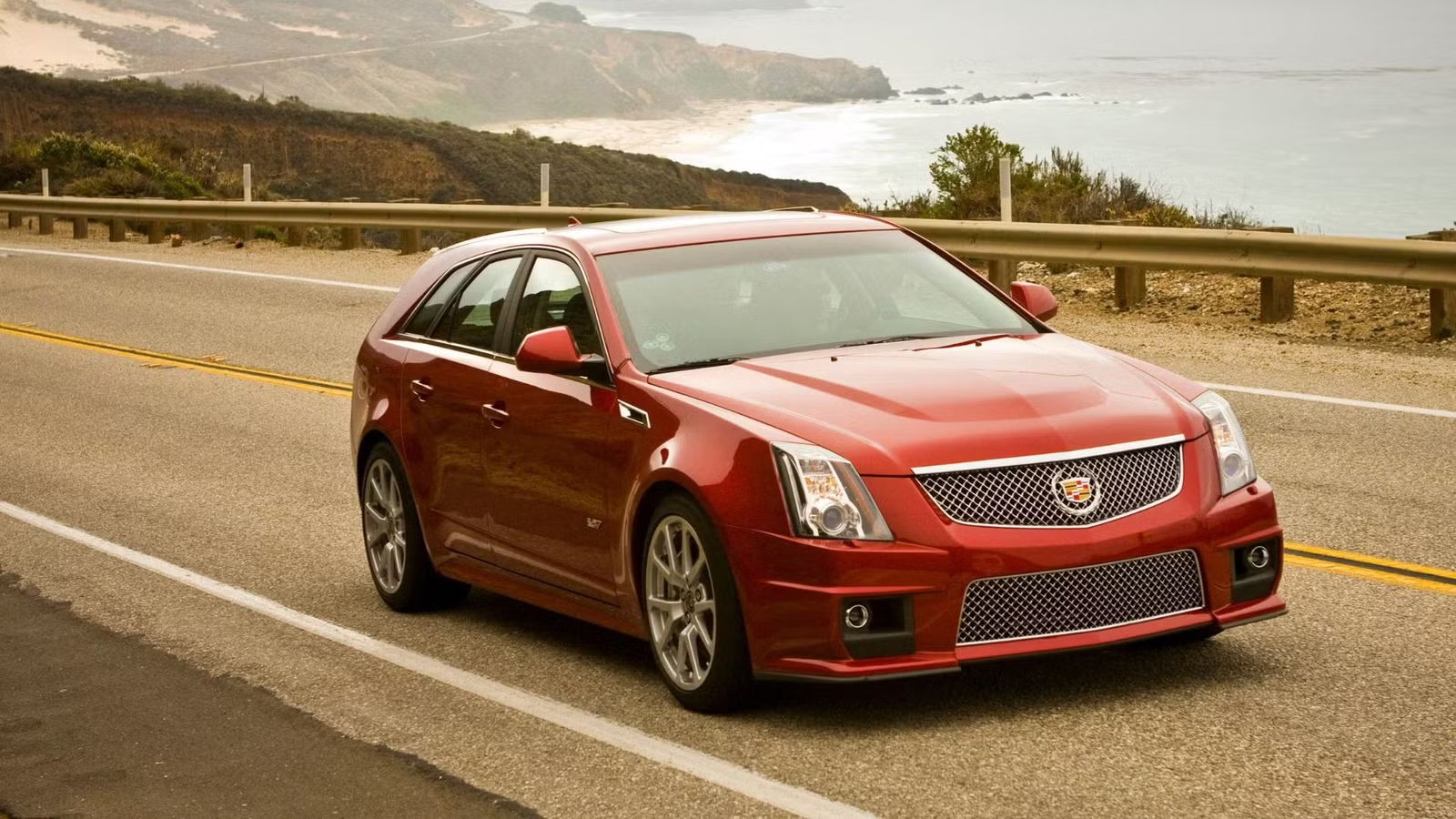
The Cadillac CTS Sport Wagon never got the headlines it deserved when it was new. Overshadowed by the supercharged, manual-transmission CTS-V and dismissed by badge-conscious buyers who defaulted to European alternatives, the 318-hp naturally aspirated wagon quietly delivered more power than a contemporary BMW 328i Sport Wagon or Audi A4 Avant — at a lower sticker price. Now, as CarBuzz‘s recent deep-dive confirms, clean examples are climbing in value on enthusiast auction platforms, and collectors are finally catching on to what period testers already knew.

The non-V CTS Sport Wagon ran from 2010 through 2014 on the same rear-wheel-drive platform as the CTS sedan, with independent suspension at all four corners and available FE3 sport tuning that one outlet said could “rival Europe’s best.” It was never a barn-find secret — Cadillac sold it openly — but most buyers walked past it. That oversight is now looking like an opportunity.
More Power Than Europe, At A Lower Price Point
The horsepower comparison alone makes the case. When the CTS Sport Wagon launched in 2010, its optional 3.6-liter direct-injected V6 produced 304 hp and 273 lb-ft of torque. The BMW 328i Sport Wagon of the same era used a naturally aspirated 3.0-liter inline-six good for 230 hp. The Audi A4 Avant relied on a turbocharged 2.0-liter four-cylinder rated at 211 hp. Cadillac’s early advantage was already substantial — and it widened in 2012 when the updated 3.6-liter LFX engine arrived, pushing output to 318 hp and 275 lb-ft thanks to integrated exhaust manifolds and a composite intake manifold that shed weight while adding power.

The base 3.0-liter V6 (270 hp, 223 lb-ft) was available on lower trims, but reviewers consistently recommended skipping it. Car and Driver singled out the 3.6-liter for its “crisp steering, a satisfying ride, and great handling,” and the fuel economy penalty for stepping up was minimal — the 3.6-liter RWD wagon returned 18/26 mpg city/highway versus 18/27 for the smaller engine. The performance math pointed one direction.

A Chassis That Could Hold Its Own Against the Europeans

Raw output is one thing; what the CTS Sport Wagon did with it is another. The second-generation CTS platform used short- and long-arm front geometry with a multi-link rear suspension — proper sport-sedan architecture, not a softened wagon derivative. Cadillac offered three suspension calibrations: FE1 for comfort, FE2 for sport, and the FE3 setup that came bundled with 19-inch wheels, performance tires, upgraded brakes, performance cooling, and steering-wheel-mounted shift controls as part of a dedicated Performance Package.
With FE3 fitted, period testers found the wagon genuinely competitive. MotorWeek called it “another step towards Cadillac emulating the best luxury sport brands from Europe,” while Edmunds noted it “offers an excellent ride and handling balance that gives the Europeans a run for their money, especially when equipped with the sport-tuned suspension.” Some reviewers acknowledged the BMW felt more delicate on tight roads and that the Audi’s all-wheel-drive traction gave the A4 Avant an edge in certain conditions — but the CTS wasn’t being humored. It was being compared directly, and it held up. The RWD 3.6-liter wagon hit 60 mph in the high-six-second range, which put it squarely in the conversation.
Design Trade-Offs That Read As Character Now

Cadillac’s Art and Science design language gave the Sport Wagon a profile that was only about an inch taller than the CTS sedan and essentially the same overall length at 191.3 inches. Towering vertical taillights, a deeply sloped rear glass, and integrated roof rails made it look purposeful rather than utilitarian — closer to a shooting brake than a traditional wagon. The interior matched the exterior’s ambition: stitched dashboard covering, available Sapele wood trim, ambient lighting, and a navigation screen that rose from the top of the center stack.
The aggressive roofline did come with trade-offs. The small rear window and thick D-pillars made reversing awkward — Cadillac offered a rearview camera as an option to compensate — and the sharply angled tail reduced the maximum height for bulky cargo. But the numbers behind the rear seat were still practical: 25 cubic feet with seats up, and 58 cubic feet with them folded. Configurable tie-down points, underfloor storage, and a 60/40 split rear seat rounded out a genuinely usable cargo setup.
Values Are Moving — But The Window Is Still Open

The CTS Sport Wagon was never going to command CTS-V money, and it still doesn’t. But the auction data is starting to tell a story. A 53,000-mile 2010 Premium with the 3.6-liter engine sold for $13,250 in March 2025. A low-mileage 2010 AWD example — fitted with the smaller 3.0-liter, notably — brought $22,000 in April 2026. Clean, low-mileage cars with the right engine, unusual colors, or RWD configuration are beginning to command meaningful premiums over ordinary high-mileage examples, though the market hasn’t entered a rapid appreciation phase yet.
The sleeper credentials are real. No manual gearbox — that option was reserved for the CTS-V — and no supercharged V8 means the Sport Wagon will never have the CTS-V’s established auction status. But it carries the same fundamental chassis character, the same angular body shape, and most of the same visual drama at a fraction of the price. Maintenance costs run lower too: RepairPal pegs average annual repair costs for the CTS at $663, versus $739 for the Audi A4 and $773 for the BMW 328i. As clean examples get harder to find, that value proposition only gets more compelling. Gearheads who want a genuinely distinctive American luxury wagon — one that could embarrass European rivals on a straight horsepower comparison — should be looking now, before the rest of the market catches up.

Related posts



Latest Post


No Comments