
10 Reasons We’d Pick The Honda Gold Wing Over The Harley-Davidson Road Glide
The Harley-Davidson Road Glide has had a cult following since its inception back in the late 90s. The fairing, V-twin thump, quality features, and regular updates have all only made the popularity stronger over the years. However, in these years, other brands have built some really capable Road Glide rivals. One of these is the Honda Gold Wing, and it’s arguably been the biggest headache for Harley. Is that the case in 2026 as well, you ask? Well, it is. Here’s us telling you how the Gold Wing Tour trumps the Road Glide Limited.
A Contemporary Design That’s More Mass-Appealing

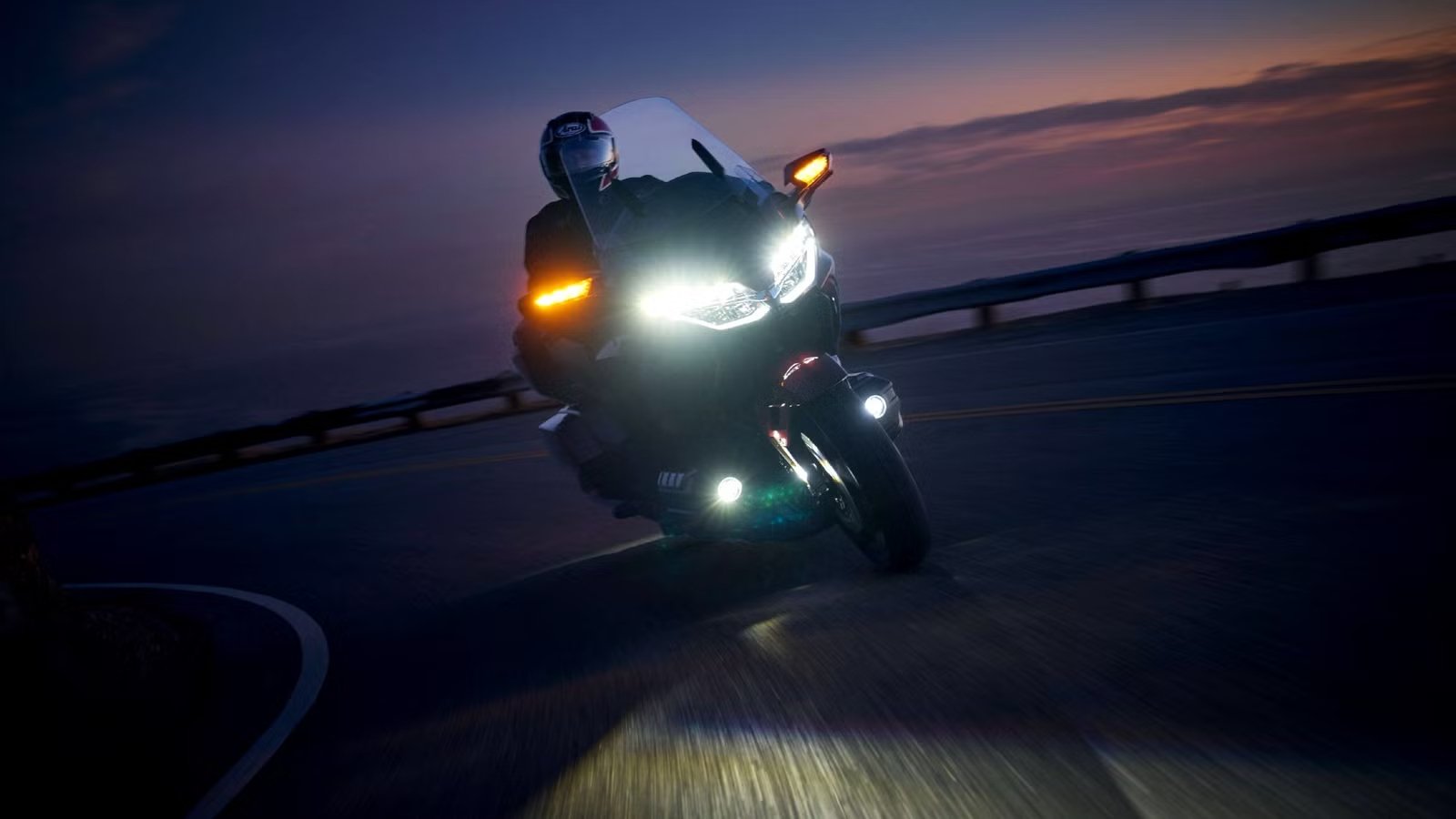
We have to start with a subjective take: the design. Between the two, the Gold Wing Tour feels more pleasing to the eyes than the Road Glide Limited. This is down to its sleeker headlight and bodywork, along with the overall blend of blacked-out and aluminum finishes. Everything is also seamless and well integrated with barely any panel gaps or visible nuts/bolts. Bonus points go to the larger fairing. The Road Glide has a not-so-seamless bagger-like front fairing followed by fairing lowers instead.
A Unique Flat-Six Engine

The Gold Wing is Honda’s flagship touring machine. So the brand has made sure it comes armed with a flagship engine. You get a distinct horizontally opposed six-cylinder powerhouse, displacing 1,833cc, while featuring 24 valves and Honda’s Unicam cylinder heads. This also has full liquid cooling and follows a square construction with a 73 mm bore X 73 mm stroke. In contrast, the Road Glide Limited has the usual air-cooled Milwaukee-Eight 117. You do get variable valve timing here to boost overall tractability, though.

More Power On Tap Than The H-D

‘No replacement for displacement’ is a common saying, but it’s not always true. And the Gold Wing is proof. Although its displacement is less than the Road Glide, you get way more power here. We’re talking 124 hp, which is considerably more than the Road Glide’s 106 hp. The Harley does edge out the Gold Wing in terms of torque (131 lb-ft vs 125 lb-ft). Interestingly, the claimed efficiencies are comparable (43 mpg for the Honda and 45 mpg for the Harley), despite the massive difference in the number of cylinders.
Convenience Of A Shaft Drive And Automatic Transmission

As standard, the Gold Wing has a six-speed manual transmission that sends power through a shaft drive. That is already more convenient than the Road Glide’s belt-driven setup. But there’s also an automatic transmission from the factory for just $1,000 over the base price. This isn’t Honda’s regular six-speed DCT, either.
It’s the motorcycle world’s only seven-speed DCT, which has two clutches: one for start-up and 1st, 3rd, 5th and 7th, the other for 2nd, 4th and 6th. The gearshift pattern changes according to the ride mode, varying between soft shifts that you wouldn’t feel and fast shifts when you’re chasing apexes in twisty sections. You can also put it in manual mode and take full control via paddle switches.
Distinct Aluminum Chassis With Electronic Suspension

To house the unique engine, the Gold Wing has a unique chassis. While the Road Glide has a simple double-cradle frame, you get a diecast aluminium twin-beam frame on the Honda. Its structural thickness is said to be optimized in each area to deliver a smooth and stable ride. Joining hands with this is a distinct suspension.
The front has a double wishbone setup while the rear has a Pro-arm setup, both with single shock absorbers. These have electronic damping control depending on the ride modes. Separate from this, there are four preload settings for the rear: single rider; rider with luggage; rider with pillion, and rider with pillion fully loaded with luggage. The Road Glide has no such option. Heck, you don’t even get front suspension adjustability.
Six-Piston Calipers Bring The Braking Power

The brakes are again superior on the Gold Wing. You get two six-piston calipers up front (with 320 mm discs), compared to the Harley’s four-piston calipers (with 320 mm discs). Similarly, the rear has a three-piston caliper with a 316 mm disc, larger than the RG’s 300 mm rear disc. Considering the Honda is lighter, it should have considerably superior braking power here. As for wheels, both have cast alloy wheels. But the sizes are different (18/16-inch for the Honda and 19/18-inch for the Harley).
Lower Weight And A Crawling Gear Boosts Real-World Usability

With all that use of aluminum, the Gold Wing comes out as the more usable bike between the two. A big credit for that goes to its 847-pound curb weight–a sizable 72 pounds down on the Road Glide Limited. This is despite the Honda having a longer wheelbase and comparable length to the Harley.
Added ease is via clever technologies with the DCT. It adds a ‘Walking Mode’ and ‘Reverse Assist’. Both of these work via ‘+’ and ‘-’ buttons to make slow-speed maneuvers effortless. There’s no such option on the Road Glide, and you’ll simply have to muscle the over-900-pound behemoth yourself.
Loaded To The Teeth With Top-Drawer Features

Speaking of technologies, both bikes are thoroughly loaded. Both have a six-axis IMU and ride-by-wire to offer several rider aids, along with bits like full hard luggage, heated grips, heated seats, speakers, and phone connectivity via a TFT. But dive deeper, and you’ll realize the Gold Wing Tour offers a more complete package than the Road Glide Limited. The Honda’s windscreen has electronic adjustment, and the suspension has electronic control at each end. You also get a Dual Combined Braking System that tweaks modulation of brake pressures depending on the ride mode.
Long-Term Proven Reliability Of Components

This is where the Gold Wing’s age works in its favor. What you get here is essentially the same Gold Wing from 2018, whereas the engine and underpinnings trace back to the early 2000s. Over the years, Honda has worked consistently to iron out all the potential failure points and improve the package with nitty-gritty changes. All that is evident in the Gold Wing’s reliability records, as several six-digit examples are present on ownership portals, running perfectly with just basic maintenance.

The same can’t be said for the new Road Glide Limited. Its technological package and Milwaukee-Eight 117 VVT engine are both fresh off the over (debuted in the last couple of years), so the long-term reliability is still unclear. We’re not saying they won’t survive the test of time; we’re just saying the Gold Wing is a safer bet.
The Gold Wing Tour Is Considerably Cheaper Than The Road Glide Limited

The pricing seals the deal. The Gold Wing Tour sells for $29,500 in 2026, which is $3,399 cheaper than the Road Glide Limited in the base colorway. You could also pick the MY25 Gold Wing and save up to $800 further. So the value proposition with the Honda is simply off the charts.

Things get worse for the HD if you delve into the colors. Choose any other color than Dark Billiard Gray, and the price difference only grows larger between the two. Things get worse if you want the Road Glide’s blacked-out finish (costs an extra $1,400). In comparison, there is no color-based change in price for the Gold Wing, although you do get only three colors compared to the HD’s seven.
Source: Honda, Harley-Davidson

Related posts




Latest Post


No Comments