
5 Analog Sports Cars Collectors Are Quietly Buying
While we are all still intensely debating whether the upcoming electric Ferrari is worthy of its prancing horse badge, one thing is certain: we are now further from pure, analog driving experiences than we have ever been before. As sports cars get heavier and more electrified with each passing year, enthusiasts and collectors who are looking for naturally aspirated sports cars paired with manual transmissions tend to look back. Aside from the usual collectors’ favorites, some less obvious machines are quietly attracting audiences. From American to French, these five analog sports cars are gaining appreciation among collectors who look beyond the hype.
5
Chevrolet Corvette C5 Z06
Average price: $27,696

The Chevrolet Corvette C5 Z06 offers a great driver’s car formula: a relatively light curb weight of about 3,118 pounds, and a naturally aspirated V8 paired with a six-speed manual transmission. Chevrolet debuted the C5 Z06 in 2001 and unlike typically heavy and supercharged muscle cars coming out of the United States, the Z06 focuses purely on the driving experience without feeling overly complex.
The Z06 shaves close to 130 pounds over the standard C5, giving it more agility. Its 53/47 weight distribution also makes it a balanced sports car thanks to its front-mid-engine configuration and rear-mounted transaxle. The Z06’s fixed roof design increases structural rigidity, and its close gear ratios and responsive steering make it all the more engaging to drive. As an added bonus, the Z06’s factory titanium exhaust gives it an aggressive, signature V8 soundtrack. Because collectors tend to flock to European or Japanese sports cars, the Corvette C5 Z06 remains underappreciated.
4
Honda S2000
Average price: $34,000


The JDM world is dominated by icons such as the Skyline GT-R, the Mk4 Supra, and the RX-7, with prices that have skyrocketed over the past few years. Yet while many collectors and enthusiasts focus on the obvious JDMs, other models are quietly earning their recognition.
The Honda S2000 is still relatively overlooked because it hasn’t gotten the same exposure as the aforementioned JDMs, but it is one of the Japanese sports cars that capture one of the purest driving experiences of its era. With the S2000, you’ll be looking at two engines: the F20C and the F22C1.
The original F20C engine is a 2.0-liter, naturally aspirated inline-four that famously redlines at 9,000 rpm. The F22C1 was introduced with the AP2 generation for North American and Japanese markets (first introduced in America in 2004, and later to Japan in 2006), with a slightly larger 2.2-liter displacement. Trading its 9,000-rpm redline for more torque, the AP2 gives you more low-end power but a lower 8,200-rpm redline. The Honda S2000 is the perfect affordable driver’s JDM worth quietly collecting before low-mileage models and special variants go up in price.
3
Lotus Elise
Average price: $42,257

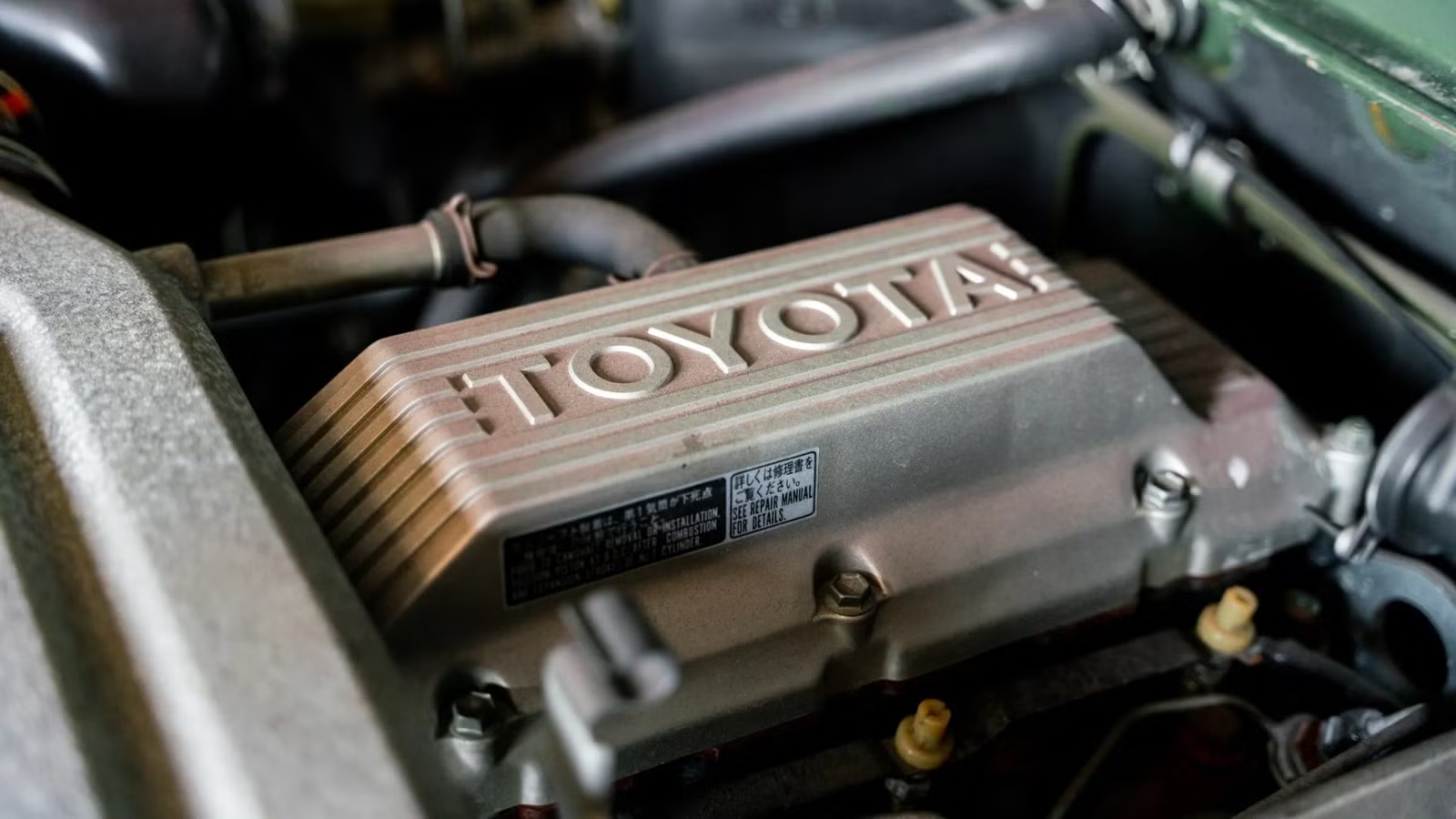
With its new trinity of electric cars, namely the Eletre, Emeya and Evija, the Lotus brand isn’t what it used to be. But there was a time when Lotus very much lived up to its “for the drivers” motto, and it is perhaps the Lotus Elise that embodied it best. As one of the purest expressions of the analog sports car, the tiny Elise abided by Colin Chapman’s rule: “simplify, then add lightness.” The Lotus Elise weighs between 1,521 and 1,984 pounds depending on the Series, making it an agile little rocket. Though earlier Elise models were fitted with the 1.8-liter Rover K-series inline-four, later models received a more reliable 1.8-liter inline-four from Toyota, available either naturally aspirated or supercharged.
As you’d expect, there is no assisted steering in the Elise, but you do get great mid-engine balance, and a satisfying, mechanical feel when shifting gears. With a low power output, there is a certain level of predictability when driving the Elise, but the raw driving experience requires driver skill and precision, which makes it one of the most engaging, analog driver’s cars out there. The Elise has long been respected among enthusiasts and at an average price of $42,257, it maintains its value relatively well. Low-mileage models and Final Edition models are great additions for collectors who seek purity and driver engagement, as the Elise now represents a bygone Lotus era.
2
Alfa Romeo 4C
Average price: $55,593

Designed by Alfa Romeo but manufactured at the Maserati plant in Modena, the Alfa Romeo 4C is anything but your average sports car. The Italian two-seater features a carbon-fiber monocoque, a mid-mounted turbocharged 1.75-liter inline-four sending power to the rear wheels, and comes with a six-speed dual clutch transmission. Though the engine “only” produces 240 hp, the 4C’s curb weight of 2,070 pounds more than makes up for it, and despite the lack of a manual transmission, the 4C offers a raw and engaging driving experience.
The ride feels firm (perhaps too firm for some) and there is no power steering, but it is precisely what makes the 4C so communicative. There is some noticeable turbo lag, but the turbo spool that accompanies the sharp exhaust notes makes the 4C’s soundtrack quite appealing. The Alfa Romeo 4C is a car full of contrasts, and despite some flaws, it is a unique sports car with surprising features, like its carbon-fiber monocoque, that you would usually only find in supercars.
1
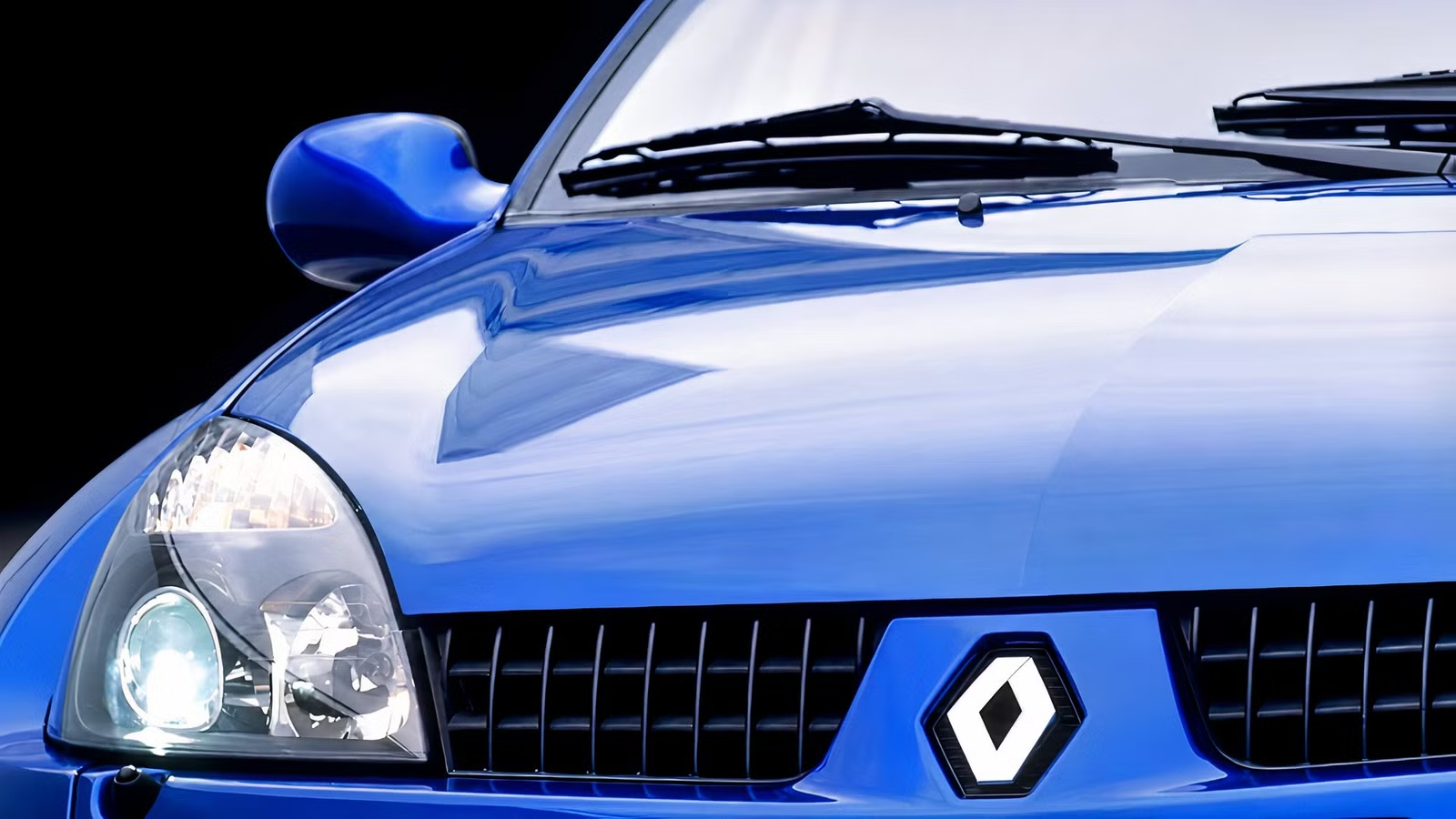
Renault Clio V6
Average price: $56,241

As the spiritual successor to the Renault 5 Turbo, the Renault Clio V6 is one of the most unconventional sports cars to come out of France. Renault completely transformed its adorable, big-eyed Clio into a punchy hot hatch. Rear seats from the standard Clio were removed to relocate the engine behind the front seats, and the Clio V6 received a naturally aspirated 3.0-liter V6 engine paired with a six-speed manual transmission. The drivetrain was converted from front-wheel drive to rear-wheel drive, bespoke suspension and chassis components were added, and finally, Renault widened the body by nearly 7 inches to give it its signature look.
Two versions of the Clio V6 were made. The earlier Phase 1 produced 226 hp and was developed with input from Tom Walkinshaw Racing (TWR) and assembled by TWR in Sweden. The later Phase 2 saw its power output upgraded to 255 hp and production was brought back to the Renault Sport plant in Dieppe. On top of an increase in power, Phase 2 models received significant suspension, transmission, and chassis upgrades, a new aggressive look, and an improved build quality, with production moved back to France. With a total of 2,822 units ever produced—1,513 for Phase 1 and 1,309 for Phase 2—the Clio V6 is the rarest analog sports car on this list, yet commands a conservative average price of $56,241. Though the Clio V6 has already earned a strong reputation among Renault enthusiasts, it remains a niche sports car that only seasoned collectors quietly keep buying.
Sources: Classic.com, Chevrolet, Honda, Renault, Lotus, Alfa Romeo

Related posts

Latest Post


No Comments