
The BMW Six That Powered a Sedan, a Coupe, and Alpina’s Fastest Car
Article Summary
- The M30 ran from 1968 to 1995 across the E3, E9, E12, E23, E24, E28, E32, and E34, BMW’s longest production engine.
- Displacement spans 2.5 to 3.4 liters over seven core variants, with an iron block known for tolerating 250,000-plus miles.
- BMW turbocharged it for the 745i, and Alpina built a 355-hp twin-turbo version for the B10 Biturbo, briefly the fastest sedan in the world.
The M30 doesn’t get the reverence people reserve for the S38 or the S54, but it’s the reason those engines exist in the form they do. A six-cylinder that started life as a bored-out version of BMW’s four-cylinder M10, it went on to outlast three generations of 5 Series, power a Formula 1-adjacent supercar’s spiritual predecessor, and become the block ALPINA turned into the fastest sedan in the world.
This is the definitive guide to the BMW M30: where it came from, the variants BMW built over 27 years, what actually goes wrong on a high-mileage example, and what the block can do with some encouragement.
Origins: Six cylinders For The New Class Era

BMW put the M30 into production in 1968 for the E3 2500 and 2800 sedans and the E9 2800 CS coupe, developing it from the M10 four-cylinder that powered the New Class sedans earlier in the decade. Like the M10, it carries a 30-degree slant to the right, a crossflow cylinder head, and a chain-driven single overhead camshaft actuating the valves through rocker arms. The block is cast iron, the head is aluminum, and the crankshaft is forged, a combination that would define BMW straight-sixes for the next two decades.
The engine went by “M06” and “M68” internally before BMW standardized the “M30” prefix across all variants in 1981. Once the smaller M20 six arrived in the late 1970s, enthusiasts and BMW itself started calling the M30 the “Big Six” or “Senior Six.” It held the title of BMW’s largest and most powerful regular-production engine until the M70 V12 arrived in 1987, and Ward’s later named it one of the top engines of the 20th century.

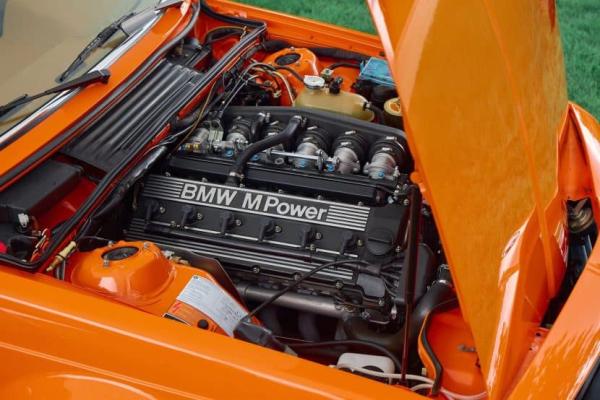
The M30 also has a direct line to BMW Motorsport’s greatest hits. In the late 1970s, engineers took the M30 block and developed a four-valve DOHC head for it, creating the M88 that powered the BMW M1. That lineage runs straight through to the S38 that later powered the E28 M5 and M635CSi. There’s also a stranger sibling: the M30B35LE, also called the M90, which combined the M88’s block with the M30’s own SOHC head and was used in a handful of applications between 1979 and 1982.
Technical Specifications
The M30 grew from 2.5 liters to 3.4 liters over its life, moving from carburetors to Bosch L-Jetronic to Motronic digital fuel injection along the way. Here are the core production variants.
M30B25
- Displacement: 2,494 cc
- Configuration: Inline-6, SOHC, 2 valves per cylinder
- Bore x stroke: 86.0 mm x 71.6 mm
- Compression ratio: 9.0:1
- Power output: 148 hp (110 kW) at 6,000 rpm (carbureted, 1968); unchanged once L-Jetronic injection was added in 1981
- Torque: 156 lb-ft (211 Nm) at 3,700 rpm, rising to 159 lb-ft (215 Nm) with injection
- Fuel system: Dual Solex Zenith 35/40 carburetors, later Bosch L-Jetronic
- Applications: E3 2500, later E12 and E28 5 Series applications
M30B28
- Displacement: 2,788 cc
- Configuration: Inline-6, SOHC, 2 valves per cylinder
- Bore x stroke: 86.0 mm x 80.0 mm
- Compression ratio: 9.0:1
- Power output: 168 hp (125 kW) carbureted; 181 hp (135 kW) once L-Jetronic injection arrived in 1977
- Torque: 173 lb-ft (235 Nm), rising to 177 lb-ft (240 Nm) injected
- Fuel system: Dual Solex Zenith 35/40 carburetors, later Bosch L-Jetronic
- Applications: E3 2800, E9 2800 CS, E12 528, E23 728
M30B30
- Displacement: 2,986 cc
- Configuration: Inline-6, SOHC, 2 valves per cylinder
- Bore x stroke: 89.0 mm x 80.0 mm
- Compression ratio: 9.0:1 carbureted, 9.2:1 injected (9.0:1 with catalytic converter)
- Power output: up to 197 hp (147 kW) injected; 178 hp (132 kW) in carbureted form
- Torque: up to 200 lb-ft (272 Nm)
- Fuel system: Carbureted version used dual Zenith 35/40s; injected version debuted with Bosch D-Jetronic mechanical injection in 1971, upgraded to L-Jetronic in 1976
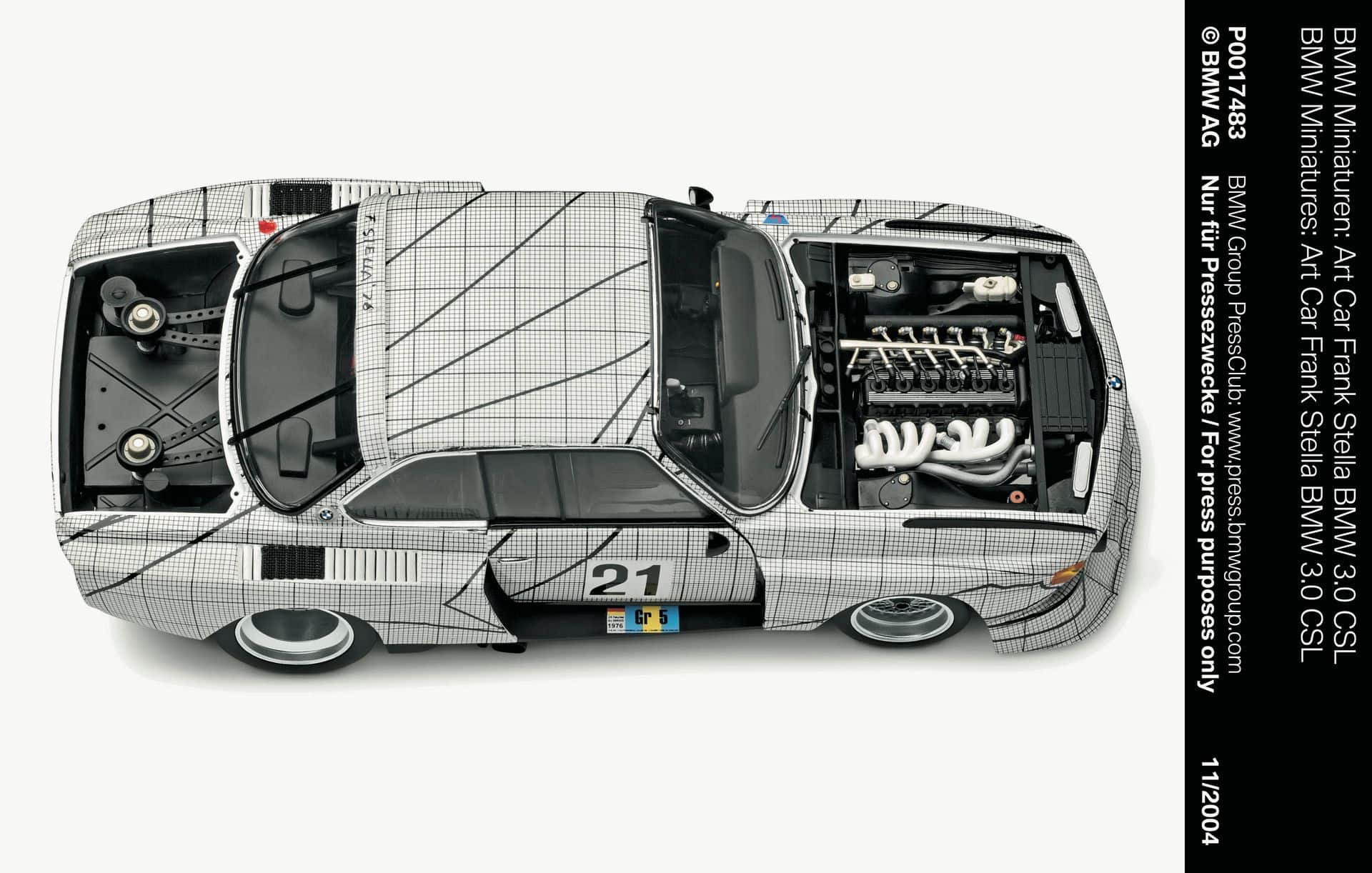
- Applications: E9 3.0 CSi, E9 3.0 CSL, E3 3.0 Si, E12 530i, E24 630CSi, E32 730i, E34 530i
M30B32
- Displacement: 3,210 cc
- Configuration: Inline-6, SOHC, 2 valves per cylinder
- Bore x stroke: 89.0 mm x 86.0 mm
- Compression ratio: 8.8:1
- Power output: up to 200 hp (147 kW) at 5,500 rpm in European trim, 172-194 hp in US spec depending on model and year
- Torque: up to 210 lb-ft (285 Nm) at 4,300 rpm
- Fuel system: Bosch L-Jetronic through mid-1981, then Bosch Motronic
- Applications: E24 633CSi, E23 733i and 732i, E12 533i, E28 533i, E3 3.3 Li; badged as “3.3” in several markets despite the 3.2-liter displacement
M30B34
- Displacement: 3,430 cc
- Configuration: Inline-6, SOHC, 2 valves per cylinder
- Bore x stroke: 92.0 mm x 86.0 mm
- Compression ratio: 10.0:1 in European spec, 8.0:1 in North American and Japanese emissions trim
- Power output: 215 hp (160 kW) at 5,800 rpm in Europe; 182 hp (136 kW) in North America and Japan
- Torque: 229 lb-ft (310 Nm) at 4,200 rpm
- Fuel system: Bosch Motronic digital fuel injection in all markets
M30B35
- Displacement: 3,430 cc
- Configuration: Inline-6, SOHC, 2 valves per cylinder
- Compression ratio: 9.0:1
- Power output: 208 hp (155 kW) at 5,700 rpm; a version without a catalytic converter produced 217 hp (162 kW)
- Torque: 225 lb-ft (305 Nm) at 4,000 rpm
- Fuel system: Bosch Motronic 1.3
Engine variants
M30B25 — The entry-level six from day one. Carbureted through the 1970s and into the early 1980s, it picked up Bosch L-Jetronic injection in 1981 with torque gaining slightly while peak power held steady. It spent most of its life in mid-range 5 Series applications rather than the flagship coupes and sedans.
M30B28 — The original 2.8-liter, launched alongside the B25 in 1968 for the E3 sedan and E9 coupe. Injection arrived in 1977 and bumped output from 168 hp to 181 hp without any displacement change.
M30B30 — The engine that put the M30 on the map, debuting in 1971 in the E9 3.0 CSi with Bosch’s early D-Jetronic mechanical injection system. It carried the 3.0 CSL through European Touring Car Championship competition and stuck around in production long enough to end up in the E34 530i almost two decades later.
M30B32 — Despite a real displacement of 3,210 cc, BMW badged cars fitted with this engine as “3.3,” a naming quirk that shows up on the 633CSi, 733i, and 3.3 Li. It switched from L-Jetronic to Motronic digital injection partway through its run, starting with the 1979 732i, which was BMW’s first production application of Motronic.
M30B34 — Introduced in 1982 with a genuine bump to 3,430 cc, the B34 is the version most associated with the later, more powerful M30-equipped cars, though North American emissions requirements cut its compression ratio nearly in half compared with the European spec and cost it over 30 horsepower in the process.
M30B35 — A further refinement of the 3,430 cc architecture running Bosch Motronic 1.3, generally regarded by specialists as the most reliable and easiest to maintain of the later variants, and the version most likely to turn up under the hood of a late E32 7 Series.
M30B35LE / M90 — The oddball. Built between 1979 and 1982 by combining the motorsport M88’s block with the M30’s own SOHC head, it’s a parts-bin engine that exists because BMW Motorsport had M88 production capacity and the standard M30 head was a known quantity. It’s rare enough that most M30 owners will never encounter one.
The Cars It Powered
- E3 (1968-1977) — The M30’s first home, in 2500, 2800, 3.0S, 3.0Si, and 3.3Li form. The E3 sedan is where BMW’s “big six” identity started.
- E9 (1968-1975) — The 2800 CS, 3.0 CSi, and the legendary 3.0 CSL. This is the coupe body that carried the M30 into European Touring Car Championship racing and gave the engine its motorsport credibility.
- E12 (1974-1981) — 528, 530i, and 533i variants brought the M30 into BMW’s first-generation 5 Series, including the rare 530 MLE built for South African racing homologation.
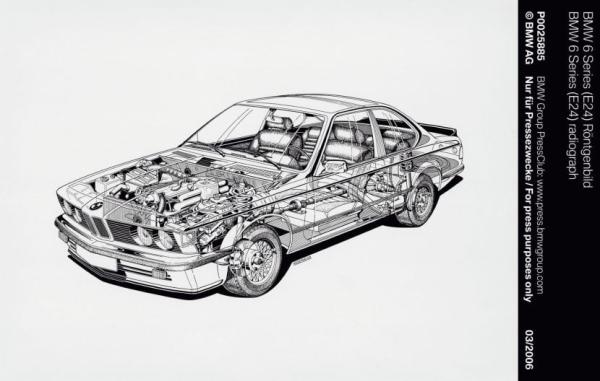
- E24 (1976-1989) — 630CS through 635CSi, plus the turbocharged 745i built on the E24-derived body. The 633CSi and 635CSi are widely considered the best-looking home the M30 ever had.
- E23 (1977-1986) — 728 through 735i, plus the factory-turbocharged 745i, BMW’s first production turbo six.
- E28 (1981-1988) — 533i, 535i, and M535i carried the M30 into BMW’s second-generation 5 Series, running alongside the smaller M20 in the lineup.
- E32 (1986-1994) — The 730i kept the M30 in production well into the era of the E34 M5’s S38.
- E34 (1988-1991) — The 530i was the M30’s last regular assignment before the M50 took over.
- E30 (1984-1986) — A footnote worth knowing: 210 examples of the 333i were built for South Africa’s Group 1 homologation, using an ALPINA-tuned intake and exhaust on the M30B32.
Reliability and Common Issues
The M30’s reputation for durability is earned. The iron block and forged crank tolerate high mileage well, and 250,000 to 300,000 miles on original internals is not unusual for a well-maintained example. That said, it isn’t maintenance-free, and a handful of items separate a good M30 from a problem one.
Timing chain: The M30 uses a single-row timing chain, and it can stretch over time, along with wear in the guide rails. A rattle at cold start is the early warning sign. Left unaddressed, chain wear turns into a much bigger repair.
Cooling system and head integrity: The aluminum head is the M30’s most vulnerable component, and overheating is what actually damages it. Neglected cooling systems, aging thermostat housings, and brittle plastic components on 30-to-50-year-old cars are the real risk, not the engine’s basic design.
Valve stem seals: These harden and leak with age, showing up as blue smoke on startup that clears after a few seconds. It’s a common and relatively affordable fix, not a sign of a bad engine.
Vacuum lines: Original rubber vacuum hoses have had decades to degrade. Perished lines cause rough idle and inconsistent throttle response, and a full refresh is inexpensive insurance on any car this age.
None of this makes the M30 fragile. It makes it an engine where deferred maintenance compounds rather than forgives, which describes almost every classic BMW straight-six.
Maintenance tips
- Cooling system service is the single most important thing an M30 owner can stay ahead of. Replace the thermostat, hoses, and radiator preventively on any car with unknown history, since overheating is what actually damages the head.
- Listen for timing chain rattle at cold start on any car you’re evaluating, and budget for chain and guide rail replacement if the history is undocumented.
- A pre-purchase inspection should include a compression test and a close look at the valve cover, oil pan, and front and rear main seals, since oil leaks are close to universal on high-mileage examples.
- Find a specialist familiar with carbureted or early L-Jetronic M30s if you’re buying a pre-1981 car — tuning and diagnosing these systems is a different skill set from working on the later Motronic cars.
- Keep documentation. A car with a paper trail on cooling system work and timing chain service is worth more than an undocumented one, even at similar mileage.
Tuning Potential
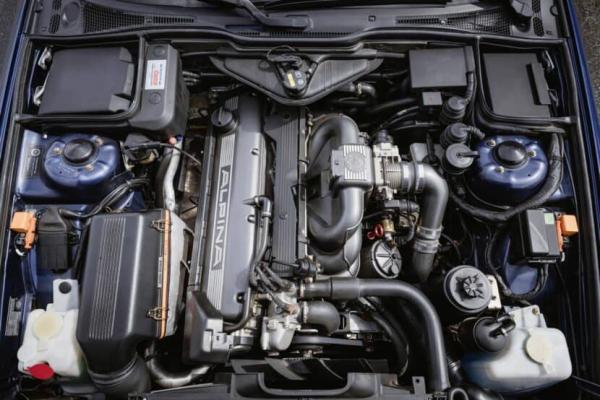
BMW itself proved the block could take boost. The E23 745i ran a turbocharged M30, first as the M102 from 1980 to 1982, producing 252 hp on 9 psi through a KKK K27 turbo and intercooler with the compression ratio dropped to 7.0:1, then as the M106 from 1982 to 1986, which added Motronic management and a larger 3,430 cc displacement while making similar power on reduced boost. ALPINA went further still, building a twin-turbo M30 with forged pistons for the B10 Biturbo that made 355 hp and 384 lb-ft, briefly making it the fastest production sedan in the world. When ALPINA wound the project down, BMW shipped the final 50 M30 blocks straight to them.
That factory and ALPINA precedent is part of why the M30 still has a following among engine builders and vintage racers today. Naturally aspirated builds respond well to ported heads, performance camshafts, and free-flowing exhaust work, and specialist shops that focus on these engines, Metric Mechanic being the best known in the vintage racing world, build stroked, high-compression race motors for CSL and Bavaria applications. Aftermarket forced-induction conversions exist too, built by specialist shops rather than off a shelf, and they can exceed what the factory turbo cars made.
None of it is bolt-on. Every serious M30 build, naturally aspirated or turbocharged, is a machine-shop project rather than a parts-counter purchase, and that’s true whether you’re chasing a mild 10 to 15 percent gain or building something closer to what Alpina put in the B10.
Legacy
The M30 doesn’t get discussed with the same reverence as the M88 or S38, but both of those engines exist because BMW Motorsport had an M30 block to build a four-valve head for in the first place. It ran in a Bavaria sedan and, in derivative form, a Formula 1-adjacent supercar’s road-going successor, survived three separate emissions eras without losing its basic character, and stayed in production long enough to outlive the E12, E23, and E24 chassis it originally powered.
As the cars it came in climb in collector value, particularly the E9 CSL and CSi, the engine itself has picked up more appreciation along with them. It isn’t efficient, and by the time you’re chasing real power out of one, you’re paying a machine shop rather than a catalog. But for something that started as a bored-out four-cylinder in 1968, 27 years in production is a hard number to argue with.

Related posts



Latest Post


No Comments