The Used Flagship Mercedes That Out-Luxuries A New Lexus ES At The Same Price
8 minutes reading
Monday, 10 Aug 2026 13:00 0 6 autotech
Picture the moment. You walk onto a dealer lot with a fixed budget, call it fifty grand, and you have two very different ways to spend it. One is a sensible new luxury sedan: badge intact, warranty fresh, and nothing to worry about. The other wears a three-pointed star, stickered for six figures when it was new, and now sits at the same money because someone else has already absorbed the depreciation. Same check. Wildly different cars. The math that makes this possible is no longer a gray area, and it points to somewhere most buyers never think to look.
The full-size luxury sedan is the worst financial bet in the new-car market, and it is not close. The average new vehicle sheds 41.8 percent of its value over five years, according to iSeeCars. Flagship sedans blow straight past that, dragged down by fast-aging technology, punishing out-of-warranty repair bills, and the flood of off-lease cars that hit the used market on a three-year cycle.
Flagship Depreciation Runs Far Past The Market Average
A front, left hand-side, quarter shot of a 2023 BMW 7 Series travelling down a roadBMW
The scale of the drop is hard to overstate. The BMW 7 Series is one of the fastest-depreciating cars on sale, losing 61.8 percent of its value over five years, an average hit of $72,444, per Motor1. The Audi A8 gives up at least half its value across the same window, according to HotCars. Even a mid-tier player like the Genesis G80 slides about 14.2 percent every year, per RideKick data, which stacks up fast. These are cars that cost as much as a house deposit when new and change hands for mainstream sedan money before their second owner ever sees them.
New Mid-Size Luxury Sedan Money Buys Less Than It Used To
Front 3/4 shot of 2026 Lexus ES 350h parkedLexus
Here is the other half of the equation. The benchmark for a new, sensible luxury sedan just got more expensive. Lexus fully redesigned the ES for 2026, and the gas V6 is gone; the lineup is now the ES 350h hybrid alongside the electric 350e and 500e. The 350h hybrid, the version most cross-shoppers will land on, starts around $51,000 and climbs past $60,000 fully loaded. For that, you get a 2.5-liter four-cylinder hybrid making 244 horsepower, a 14-inch touchscreen, and genuinely impressive rear-seat space. It is a lovely car. It is also, at roughly $51,000, parked in exactly the same price bracket as something far grander.
The Mercedes-Benz S-Class Is The Flagship To Buy Used
2021 Mercedes-Benz S-Class front 3/4 shotMercedes-Benz
That something is the Mercedes-Benz S-Class, the car that has defined the luxury-sedan benchmark for decades. A five-year-old example now trades for the price of a new ES 350h, and that single fact reframes the entire buying decision.
S-Class Depreciation Drops A Six-Figure Sedan To ES Money
A side-view shot of a Mercedes-Benz S-ClassMercedes-Benz
The 2026 S-Class opens at $120,600, per KBB. Track what happens next, and the numbers turn dramatic. iSeeCars, measuring cars that are five years old right now, pegs S-Class five-year depreciation at 55.4 percent and a resale value of $53,305. That is the figure that matters most, because it is roughly what a used one actually costs today. HotCars puts the five-year drop closer to 46 percent. And the pattern is not slowing: KBB projects a new 2026 S-Class will shed $76,941 over five years to a residual of $43,659.
The sources disagree on the exact percentage, but they agree on the direction. A car that cost six figures new sells for somewhere between $44,000 and $53,000 with five years behind it. A used S-Class at $53,000 and a new ES 350h at $51,000 are, for practical purposes, the same purchase price.
Within the range, the S 580 is the one to chase. It pairs a 4.0-liter twin-turbo V8 with a 48-volt mild-hybrid system for 496 horsepower, adds 4MATIC all-wheel drive, and delivers the effortless, long-legged character that defines the breed. It is the version that hands you the full flagship experience without stepping into rarefied Maybach or AMG money, and at five years old it is the one that lands most cleanly on the new-ES price point. The spec sheet comparison isn’t even close — but the S-Class has a catch that can turn a brilliant deal into a five-figure mistake.
A Five-Year-Old S-Class Still Out-Luxuries A New Lexus ES
Price parity would be a curiosity if the used car felt its age. It does not. Half a decade on, the S-Class still operates on a different plane than anything new at this price point, the ES very much included. Credit where it is due: the redesigned 2026 ES leans heavily into rear-seat comfort, with a longer wheelbase, more legroom, and an available executive package that borrows features from cars above it. It is the plushest ES yet.
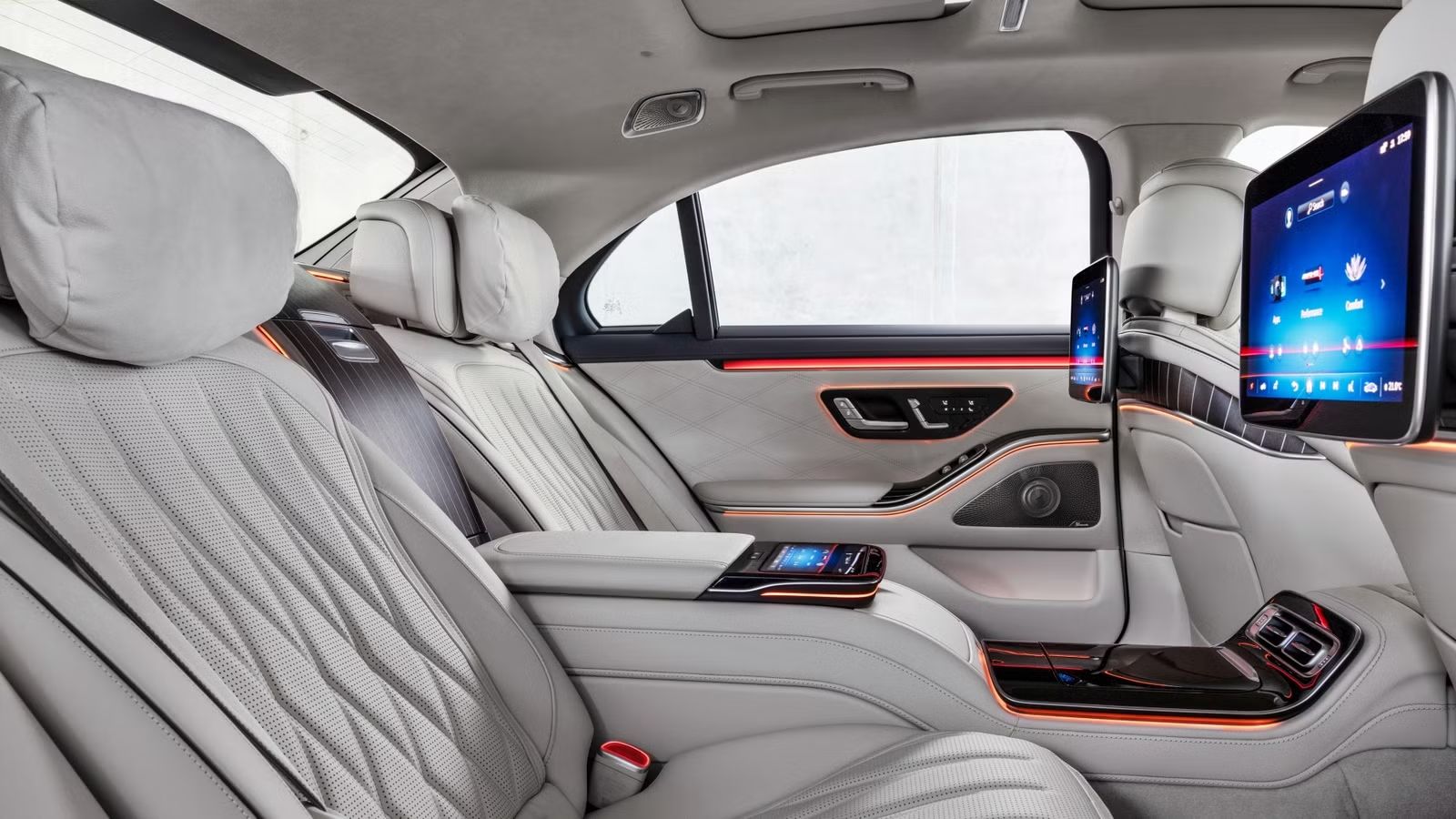
But the S-Class plays a different game entirely. Its cabin runs on nappa leather, real metal trim, layered ambient lighting, and a rear compartment scaled for a genuinely large luxury sedan. The materials, the sound insulation, the sense of occasion when the door closes: these are flagship qualities the ES was never engineered to deliver, and five years does not erase them. On presence alone, the S-Class arrives; the ES merely shows up.
V8 Power Versus A Four-Cylinder Hybrid
A shot of the engine bay in a Mercedes-Benz S-ClassMercedes-Benz
The powertrain gap is just as stark. The S 580’s twin-turbo V8 makes 496 horsepower and moves a large sedan with the quiet authority of a car that never feels like it is trying. The ES 350h answers with 244 horsepower from its hybrid four-cylinder, which is smooth, efficient, and entirely adequate, but adequate is the ceiling. One car is built to carry more than two tons of luxury down a highway without breaking a sweat. The other is built to sip fuel. Both are valid missions. Only one of them feels like a flagship.
The Catch Is Out-Of-Warranty S-Class Ownership
A front 3/4 action shot of a Mercedes-Benz S-ClassMercedes-Benz
This is where the fantasy meets the invoice. A used S-Class is a spectacular amount of car for the money, right up until something breaks outside of warranty, and on a complex German flagship, something eventually does.
Repair And Maintenance Costs After The Warranty Ends
A rear 3/4 studio shot of a Mercedes-Benz S-ClassMercedes-Benz
The routine numbers are already high. RepairPal puts average annual Mercedes-Benz repair and maintenance at $908 against a $652 industry average, and KBB’s cost-to-own data for the S-Class specifically runs closer to $1,921 a year, or about $9,606 over five years. The frightening line items live in the suspension.
The S-Class rides on air springs, and when one fails, RepairPal’s estimate for a single strut or shock absorber replacement runs from roughly $5,600 to over $6,000, with the active-suspension air compressor adding another $1,361 to $1,441. Aftermarket parts and a good independent specialist can reduce those figures significantly, but the dealer worst-case scenario is real, and it can erase a full year of depreciation savings in a single visit.
Reliability And Warranty: New-ES Peace Of Mind Versus Used Risk
2021 Mercedes-Benz S-ClassMercedes-Benz
This is the ES’s trump card. RepairPal rates Mercedes-Benz reliability at 3.0 out of 5.0 and ranks the brand 27th out of 32, with a 13 percent chance of any given repair being severe. Lexus, by contrast, is a perennial reliability leader, and a new ES arrives with a full factory warranty and years of worry-free motoring baked into the price. Buying the S-Class means trading that certainty for grandeur. Whether that is a smart trade comes down to one thing.
The Used S-Class Is The Move If You Budget For The Upkeep
There is no honest way to call a used S-Class the safe choice. It is not. The maintenance is expensive, the warranty is gone, and a bad month can hand you a five-figure suspension bill that a new ES owner will never see. Pretend otherwise and the whole value argument falls apart. But for the right buyer — the one who walks in clear-eyed, sets aside a repair fund or buys a solid extended warranty, and wants the absolute most luxury a $50,000 budget can provide — the math is not close.
A five-year-old S 580 out-classes a new ES 350h on materials, space, power, and presence — at the same price — because someone else already paid the steepest part of the bill. Budget for the upkeep and the used flagship is the smartest luxury buy on the lot. Skip that step, and it is the most expensive mistake you will make all year.











No Comments