
The Short-Lived Muscle Car That Should Have Replaced The Camaro
Chevrolet built its last Camaro in January 2024, and the company insisted the nameplate’s story wasn’t finished. Two years later, that promise appears to be coming true, though not in the shape anyone expected.

The next Chevrolet muscle car is reportedly a four-door sedan on a shared rear-wheel-drive platform, due before the decade ends. Chevrolet has built that exact car before. It sold for four model years, earned glowing reviews, found few buyers, and vanished.
Before the Camaro badge lands on a sedan, that forgotten four-door deserves another look.
Chevrolet’s Next Muscle Car Will Ditch The Coupe Body

General Motors has reportedly approved a Camaro successor, with production scheduled to begin in late 2027 at the Lansing Grand River plant in Michigan, according to GM Authority, whose reporting has been corroborated by Automotive News. The car is expected to arrive as a 2028 model on an evolution of GM’s rear-wheel-drive Alpha platform. The bigger surprise is the body style, because the same reporting points to a four-door layout with a footprint shared with the next Cadillac CT5.
The move away from a coupe follows years of shrinking demand for two-door muscle. Camaro sales fell from 72,705 cars in 2016 to 21,893 in 2021, then recovered only slightly to 24,652 in 2022 before GM ended production. A four-door body answers the practicality complaints that followed the sixth-generation car through its entire run.

The new body style also creates a naming problem. To generations of enthusiasts, Camaro means a two-door coupe with a long hood and a cramped back seat, not a family sedan. Chevrolet already owns a badge that was created for exactly the kind of car GM is now describing, and it wore that badge for only four model years.
The Chevrolet SS Was The Four-Door Muscle Car Blueprint

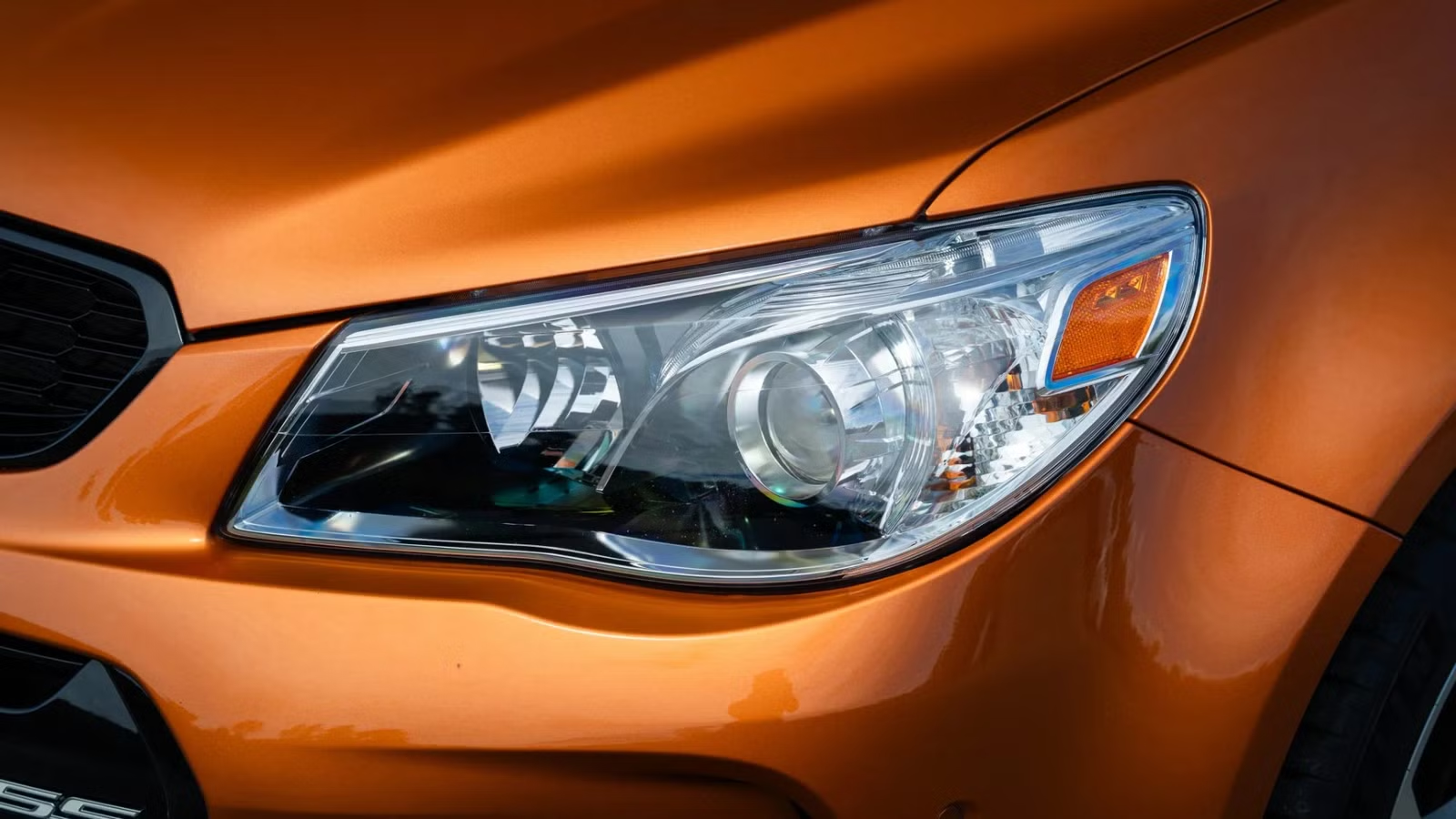
The Chevrolet SS was a four-door muscle sedan sold from the 2014 through 2017 model years. It was Chevrolet’s first rear-wheel-drive performance sedan since 1996, and the company pitched it as a four-door Corvette. Under the skin sat GM’s Zeta platform, the same architecture that carried the fifth-generation Camaro.
Holden engineered and built the SS in Elizabeth, South Australia, as a left-hand-drive version of the Holden Commodore SS, one of the most celebrated performance sedans that country ever produced. American buyers had seen the recipe before in the Pontiac G8 GXP, which died alongside the Pontiac brand, and the SS picked up where that car left off.

Pricing started at $44,470 when US sales began in late 2013. By the final 2017 model year, the base price had climbed to $46,625 before destination charges and a $1,300 gas-guzzler tax. The money bought a long list of standard equipment, including navigation, a head-up display, and sport seats, with a sunroof and a full-size spare tire as the only factory options.
In 2013, Chevrolet placed a muscle sedan on a platform shared with its performance coupes, and in 2027, it reportedly plans to run the same play on Alpha 2. The formula GM is preparing to revive is the one the SS already proved, right down to the shared bones with a Cadillac. Even the sales pitch repeats itself, promising muscle-car pace with room for the whole family.
The LS3 V8 Gave The Chevrolet SS Real Muscle Car Pace

Every SS carried the 6.2-liter LS3 V8, the same small-block family found in the Corvette and Camaro SS of the era. Output stood at 415 hp and 415 lb-ft of torque without forced induction, and top speed reached 160 mph. A 6L80 six-speed automatic was the only transmission at launch, and a Tremec TR-6060 six-speed manual joined the lineup for 2015.
The SS sedan could clear 0-60 mph in 4.5 seconds, a sub-13.0-second quarter-mile at 111 mph, and 0.97 g of grip on the skidpad. Those figures placed the four-door within striking distance of the V8 Camaro sold beside it. Standard Brembo brakes and a mechanical limited-slip differential backed up the straight-line numbers.

Chevrolet kept developing the car even as its future dimmed. Magnetic Ride Control adaptive dampers arrived for 2015, and a 2016 facelift brought functional hood vents and a bi-modal exhaust. Both changes arrived after GM had already decided the car’s fate, which makes the effort even more remarkable.
The body style could fit five adults inside, the trunk held 16.4 cubic feet of luggage, and the rear doors opened wide enough for child seats, something the coupe could never deliver. The sixth-generation Camaro’s tight cabin and poor visibility were constant complaints in period reviews, and that usability gap is exactly what the rumored 2028 car is being designed to close.
Holden’s Factory Closure Killed The SS, Not Weak Demand

GM announced in December 2013 that it would end vehicle manufacturing in Australia, only weeks after the first SS sedans reached American showrooms. The decision condemned the car before most buyers knew it existed, because every SS depended on Holden’s Elizabeth factory. When the plant shut down in 2017, the SS died with it, along with the Commodore, the Ute, the Caprice, and the entire Zeta platform.
Just 12,860 examples were built across four model years. Annual volume never came close to what the Camaro managed, even in the coupe’s weakest years. Chevrolet sold the car only in the United States, skipping Canada and Mexico entirely, and initially restricted allocation to dealers that also carried the Corvette.

Marketing was minimal, the styling read as anonymous beside a Camaro or a Charger, and the price sat within reach of a well-equipped V8 Camaro that offered more visual drama for the money. It was, in essence, the definition of a sleeper. But buyers who wanted a fast Chevrolet walked past the sedan without knowing what it was, and GM did little to change that.
None of those headwinds amounted to a verdict on the four-door muscle formula. The SS never failed a real market test, because GM never gave it one, and the factory closure settled the question before the car could build an audience.
Why The SS Badge Fits The 2028 Muscle Car Better Than Camaro

The argument for reviving the SS badge instead of stretching the Camaro name comes down to what each one promises. Camaro promises a coupe, and putting the badge on a sedan spends decades of brand equity on a car it doesn’t describe. The SS name was created for a four-door muscle sedan, carried that mission for four years, and retired with its reputation intact.
Classic.com now places the model’s benchmark near $40,000, and clean manual cars regularly trade at or above their original sticker prices. A 2017 example showing around 2,000 miles was bid to $45,500 on Bring a Trailer in August 2026 and still failed to meet its reserve.

Enthusiasts now pay near-MSRP for a decade-old sedan GM struggled to sell new, which says more about the car than any period review could. GM is reportedly preparing to build the same formula again, with four doors, rear-wheel drive, and a shared platform. The badge that pioneered the recipe is sitting unused, and the 2028 reveal is the right moment to bring it back while the Camaro name rests where it belongs: on a coupe.
Sources: General Motors, FastestLaps, Classic, Bring A Trailer

Related posts




Latest Post


No Comments