
The Most Underrated Mid-Engined Supercar Ever Produced
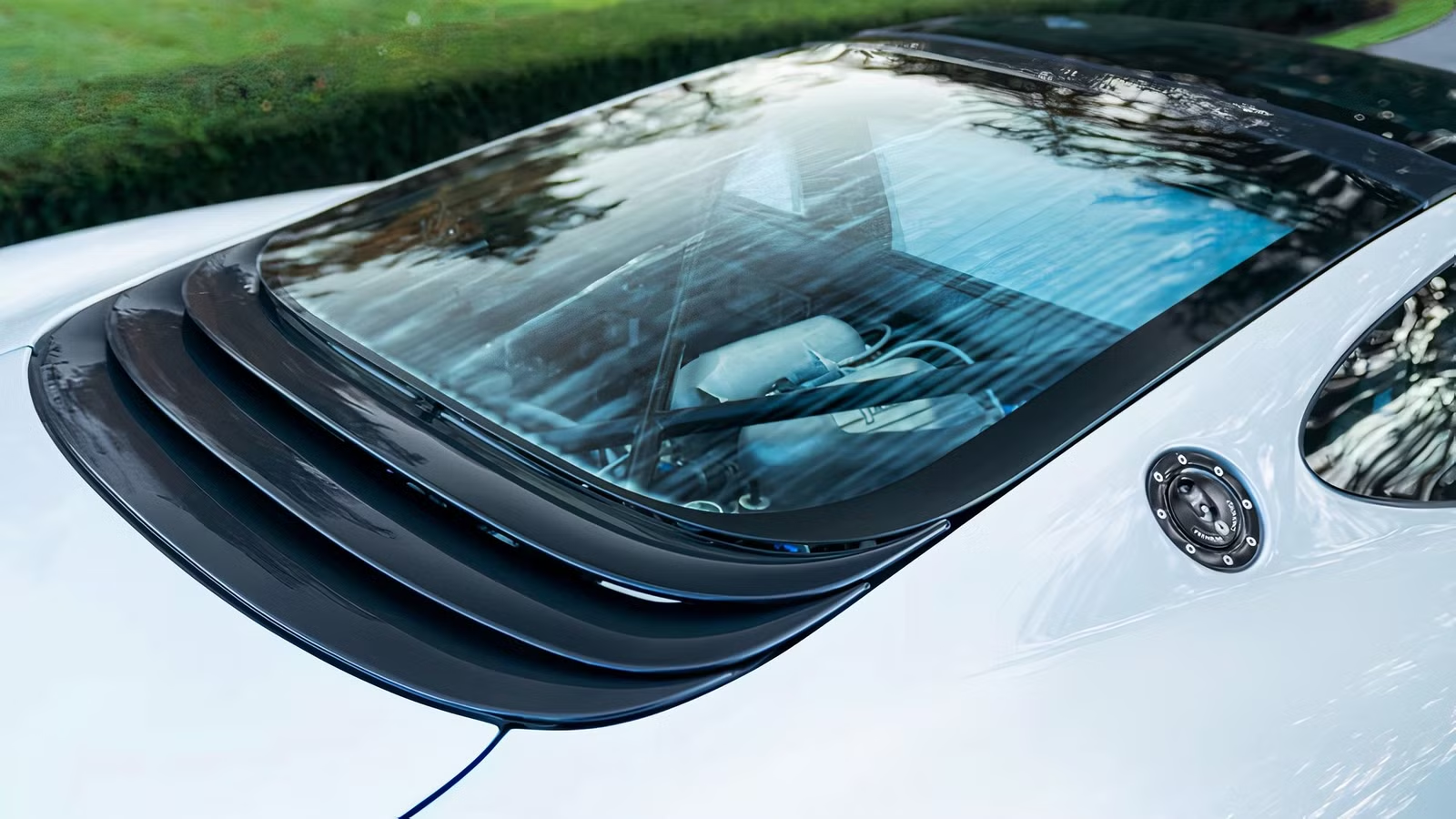
Supercars and hypercars are built to make a statement. In a world where every new hypercar announcement seems to top the last — more cylinders, more turbos, more downforce — it’s easy to forget that some of the greatest performance machines ever made never got the recognition they deserved. From ridiculous engines with endless cylinders and turbos to mind-blowing quarter-mile times, these cars are engineered with a certain one-upmanship baked in alongside the carbon panels and screaming rev limiters. That relentless pursuit of extremes is what gives them longevity and notoriety. Even cars that needed a periscope to see out of them have become legendary — to paraphrase President John F. Kennedy, we don’t buy supercars because they are easy to drive; we buy them because they are hardcore.

Which makes it all the more remarkable that one supercar has spent decades flying almost completely under the radar. This is a car that was underrated before it launched, underrated after it launched, and remains underrated today. It comes from a brand that, some say, nobody really lusts after — and yet it represented the absolute pinnacle of automotive engineering when it was new. The company struggled to sell them, some buyers demanded their money back, and compared to its peers, it remains the bargain of the century on today’s market.
HotCars used manufacturer data and secondhand prices and statistics from industry experts such as Hagerty and Hemmings to reach our conclusion of what is the most underrated supercar of all time.
The Jaguar XJ220 Is The World’s Most Underrated Mid-Engined Supercar

Imagine for a second you just won the lottery, or just offloaded a tech startup onto a Silicon Valley giant, and you are an overnight multi-millionaire. You can buy any supercar you want — what would it be? There are probably a few that would feature on most people’s lists, such as the very special Ferrari F40, Porsche 959, McLaren F1, or Lamborghini Countach. These are the groundbreaking cars of their era, quicker than almost everything else on the road. Completely outrageous and often uncompromising, they are engineering marvels that stopped the world in its tracks with their performance figures. But there is one missing.
The XJ220 Was Supposed To Change Jag’s Image, But It Was Quickly Forgotten
The Jaguar XJ220 is a Jaguar. That means it’s not a car brand people under the age of 70 generally lust after. But in the mid-’80s, the company’s director of engineering, Jim Randle, started work on a supercar that would serve as a halo model for the brand, which had become a little too synonymous with the golf club. The idea was to take a 6.0-liter V12 and create an all-wheel-drive supercar that would be a technological masterpiece.
Jaguar Changed The Plan
It didn’t quite work out like that. The concept was developed with Tom Walkinshaw Racing, and Tom later said, according to Hemmings, that the original drivetrain and engine were too heavy and unnecessary. In the end, a lighter Metro 6R4 V6 was chosen, fed by two water-cooled Garrett T3 turbos running one bar of boost pressure. Tom was right — the Jag didn’t need a V12 to go fast (more on that shortly) — but the finished car was perhaps a touch too refined at everyday speeds. Prospective owners wanted something unhinged that they could climb out of in front of the casino looking like they’d been wrestling a bear, not something idling fuss-free with the powerplant of a Mini Metro thrumming away in the background.
The XJ220 Was Underappreciated Before It Even Went On Sale
What happened next was the first blow to the XJ220 — and it hadn’t even hit the streets. Jaguar had, says Hemmings, taken numerous reservations from excited buyers to the tune of £50,000 each, with the car due to be produced in 1989. Originally 220 cars were planned, with up to 350 if demand warranted it. Prospective buyers, apparently disgruntled with how much the car had changed from the concept shown at the Birmingham Motor Show the year before, launched a lawsuit to get their money back, says Hemmings — the XJ220 was already disliked, and it hadn’t even left the factory.
Here’s Why The Jaguar XJ220 Is So Underrated
>
Jaguar XJ220 Specs
|
Engine |
Twin-turbocharged 3.5-liter V6 |
|
Power |
542 hp |
|
Torque |
475 lb-ft |
|
0-60 mph |
3.6 seconds |
|
Top Speed |
212 mph |
Source: Jaguar
When you consider it now, the XJ220’s downsized, turbocharged powerplant was genuinely ahead of its time — even Ferrari followed the same philosophy decades later. According to specialist Don Law, it was relatively easy to drive and could cruise at high speeds all day without complaint. But that was only one side of the XJ220. What some people forget is that the XJ220 was briefly the fastest production car in the world.
Formula 1 driver Martin Brundle took an XJ220 to 217 mph at the Nardo test track in Italy in June 1992 — a top speed that very few hypercars can match even now, more than three decades on. It wasn’t just about straight-line speed, either. The XJ220 was also the fastest production car around the Nürburgring, completing a lap in 7:46.36 in 1991.
The Jaguar XJ220 Is The World’s Fastest Car That Not Many People Want
So the Jaguar XJ220 answered its critics. Tom Walkinshaw was right — it didn’t need 12 cylinders or four-wheel drive at all. It was a masterclass in simplicity. Yet today, few are scrambling to pay a premium for one. Official Jaguar figures show that just 282 XJ220s were produced between 1992 and 1994, making it rare even by supercar standards. And despite having once been the fastest car on the planet, it has never achieved the iconic status of the Ferrari F40, McLaren F1, or Porsche 959.
No matter what year you choose, an F40 will cost around $2,400,000 in good condition, says Hagerty, and Ferrari made 1,311 of those. A Porsche 959 starts from around $1,500,000. And that other British record-holder, the McLaren F1? You’ll need upward of $20,000,000 to get the keys to one. Meanwhile, a Jaguar XJ220 in good condition can be found for a fraction of those figures — making it, by any measure, the supercar bargain of its generation.
Experts Agree The XJ220 Is Underrated
Jeremy Clarkson is a fan of Jaguar’s unloved supercar, saying it was underrated when new and comparing it to the similarly talented yet forgotten Bugatti EB 110. Clarkson said in another video about the big Jag that the XJ220 is ‘made from stuff that was dug out of the ground by men in checked shirts and hard hats. It’s as sophisticated and as advanced as a telegraph pole.’ Then he drag-raced it against a 12-years-younger Pagani Zonda with a 7.3-liter V12 engine. The Jaguar won.
One of the Jaguar XJ220’s problems could have been the first half of its name. The car company Jaguar just doesn’t excite people the way it once did — not since the E-Type, argues Doug DeMuro, who adds that it could shut down tomorrow and few would lose sleep over it. ‘This is the the worst of the worst car company,’ he says, noting that the brand’s recent dramatic rebranding is the first time anyone has talked about Jaguar in a long time.
If that’s true, it goes a long way toward explaining why you never hear anyone gazing wistfully into the distance and saying, ‘one day, a Jaguar XJ220 will be mine.’ Look at one today, however, and the beauty of the XJ220’s design is undeniable — flowing lines and more than a nod to that timeless classic, the E-Type. Clever aerodynamics meant it stuck to the road without resorting to excessive wings. The XJ220 was more Eric Clapton than Sid Vicious: relaxed and classy on the outside, with a wicked rock-and-roll streak tucked away beneath.
Jaguar Made Another Underrated Supercar In The ’90s Which Most People Forgot

Jaguar XJR-15 Specs
|
Engine |
6.0-liter V12 |
|
Power |
450 hp |
|
Torque |
420 lb-ft |
Source: Jaguar
Think the XJ220 dropped off the radar? Jaguar built another supercar at the same time that most people wouldn’t even recognize, let alone be lucky enough to see in the wild. Jaguar Sport — created in partnership with Tom Walkinshaw Racing — enlisted British automotive designer Peter Stevens, who would later pen the legendary McLaren F1, to create the XJR-15. This machine was essentially a race car made road-legal, featuring a V12 engine and a price tag approaching $1 million. It is even rarer than the XJ220: of the 53 built, just 27 left the factory in road-going specification.
Sources: Jaguar, Hagerty.com; Hemmings.com

Related posts


Latest Post


No Comments