The Kia Sport Sedan That Delivers F80 M3 Pace Without The Rebuild Anxiety
8 minutes reading
Saturday, 8 Aug 2026 15:00 0 31 autotech
Every former 3 Series owner knows the feeling of scrolling listings for a used F80 M3, doing the math on a car that’s finally within reach, then reading the forum threads about rod bearings and wondering if the dream is worth the risk. The S55’s reputation for engine problems has turned M3 ownership into a gamble dressed up as a sports car bargain. But there’s another car—one most cross-shoppers overlook—that delivers startlingly similar pace, a similarly engaging rear-drive chassis, and none of the anxiety. It’s not German, it’s not new, and it comes with a warranty that actually means something.
There’s a particular kind of buyer’s remorse that hits ex-3 Series owners a few years after they’ve sold the car. They remember the steering feel, the balance, the way a well-sorted rear-drive sedan made a commute feel like an occasion. Then they start looking at what replaced that feeling in their driveway, a crossover, a front-drive sedan, something sensible, and the itch comes back.
For a lot of these drivers, the natural next step is chasing the high. A used F80-generation M3—it’s the obvious move. Big power, a potent twin-turbo inline-six, a chassis tuned by people who understand what made the old 3 Series special in the first place. The badge alone does most of the selling.
Rear 3/4 shot of 2016 BMW M3 in blue parkedBMW
But the F80 M3 comes with baggage that doesn’t show up in the listing photos. The S55 engine has a well-documented history of rod bearing wear, and the fix isn’t cheap: independent shops routinely quote four figures, and dealer-level repairs can climb well past that once labor and parts are factored in. For a car already sitting outside its factory warranty window, that’s not a hypothetical. It’s a question of when, not if, for a meaningful percentage of the used fleet.
So the fantasy of F80 ownership runs headlong into a spreadsheet problem. What if there were a car that delivered comparable real-world thrust, a similar rear-drive character, and genuine daily usability without the rebuild roulette? There is. It’s just not wearing a roundel.
The Kia Stinger GT2 Delivers Twin-Turbo V6 Performance That Lands In F80 M3 Territory
Front 3/4 action shot of a red 2021 Kia Stinger GT2 speeding around a cornerKia
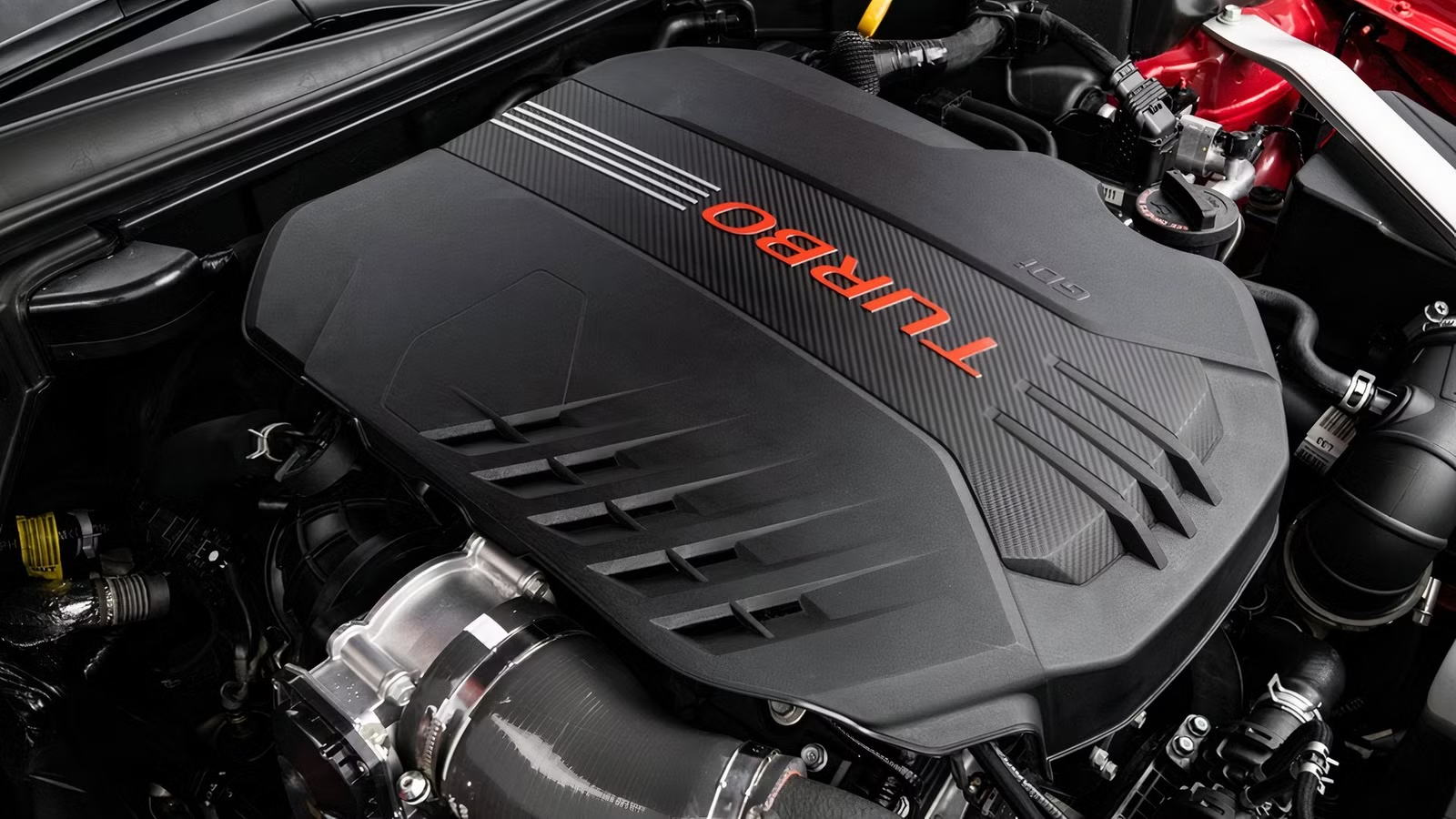
The car in question is the Kia Stinger GT2, and the numbers are the reason it belongs in this conversation at all. The Stinger’s twin-turbo 3.3-liter V6 made 365 horsepower and 376 pound-feet of torque in its 2018-2021 form, with a mid-cycle bump to 368 horsepower for 2022 and later model years. That’s enough to send the GT2 from 0-60 mph in roughly 4.4 seconds depending on drivetrain and testing conditions—numbers that put it firmly in hot-hatch-meets-sport-sedan territory, and close enough to F80 M3 acceleration figures that the gap stops mattering in daily driving.
This isn’t a case of a value brand playing catch-up on paper only. When outlets tested the Stinger against German rivals like the BMW 4 Series Gran Coupe and Audi S5 Sportback, the Kia held its own on both pace and drama, with a soundtrack and thrust curve that felt genuinely engineered rather than borrowed. It’s the kind of engine that rewards the same right-foot commitment an M3 owner is chasing, just wrapped in different sheet metal and a different badge on the trunk lid.
Rear 3/4 action shot of 2023 Kia StingerKia
For a driver mourning their old 3 Series and eyeing an M3 as the cure, the Stinger GT2 offers something the spec sheet doesn’t fully capture: it scratches the same itch. The turbocharged shove, the way the car gathers speed without drama until you check the speedometer, the sense that there’s real performance underneath a comparatively unassuming shape—all of it lands in a similar emotional zone to the M-car experience, minus the intimidation factor of a car people whisper about in mechanic waiting rooms.
A Rear-Drive Chassis, Limited-Slip Differential, And Hatchback Practicality
Front action shot of 2023 Kia Stinger GT2 in red being drivenKia
Straight-line pace is only half of what makes the BMW F80 M3 desirable. The rest is chassis feel, the sense that the car is happy to rotate, that power gets to the road in a way that feels alive rather than merely fast. This is where the Kia Stinger GT2 keeps making its case.
In its rear-wheel-drive configuration, the GT2 comes standard with a limited-slip differential, giving it the kind of controlled, playful balance that a straight rear-drive sedan needs to feel special rather than just quick. Reviewers who put it back-to-back with BMW’s own 4 Series Gran Coupe found the Stinger’s dynamics genuinely competitive, even if the steering and suspension tuning fell just short of BMW’s traditional polish. That’s a fair trade-off for a car built to a different price point, and for a buyer whose alternative is gambling on a decade-old M3, “just short of BMW polish” is still miles ahead of anything else in the conversation.
The Stinger Pulls Ahead Of The F80 In Terms Of Practicality
Trunk space of a 2023 Kia Stinger GT2Kia
The Stinger’s liftback body style gives it genuine hatchback cargo capacity that a traditional three-box sedan, M3 included, simply can’t match. For an owner who wants weekend track-adjacent thrills without sacrificing the ability to haul luggage, a bike, or a week’s worth of groceries, that flexibility matters. It’s a rear-drive, LSD-equipped performance sedan that also does the boring parts of car ownership without complaint, which is precisely the kind of unglamorous virtue that never shows up in an M3 daydream but matters enormously in year three of ownership.
Why A CPO Stinger GT2 Makes More Financial Sense Than Rolling The Dice On A Used F80 M3
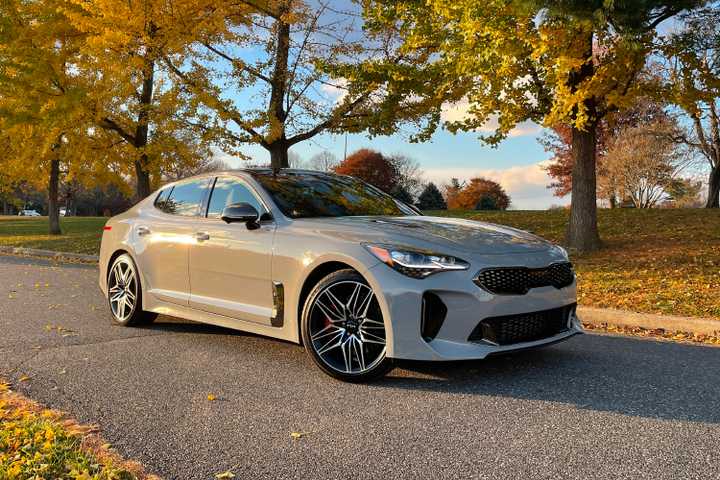
Side shot of a 2023 Kia Stinger GT2Kia
Here’s where the comparison stops being about feelings and starts being about math. Kia ended Stinger production after the 2023 model year, which means every Stinger on the market today—like every F80 M3—is a used or certified pre-owned proposition. That fact alone levels the playing field in a way it wouldn’t have five years ago: neither car comes with a fresh factory warranty as standard equipment. The difference is what happens next.
A well-optioned Stinger GT1 originally stickered around $48,350, while a comparably equipped, but less powerful, BMW 430i Gran Coupe pushed past $54,000, and a loaded GT2 AWD tested closer to $56,000 new. On the used and CPO market today, that original gap has only widened, with Stinger GT2 values sitting meaningfully below comparable used 4 Series and M3 pricing for a car offering similar or better real-world acceleration.
A shot of the cabin in a KIA Stinger Tribute EditionKIA
Now overlay the ownership risk. A used F80 M3 outside its original warranty period is, statistically, a car that may need rod bearing service at some point in its life, a repair that independent estimates place well into four figures once labor is included, and higher still at a dealership. That’s not a maintenance item; it’s a standing liability that a buyer has to price into every used M3 purchase, whether they budget for it or simply hope it doesn’t happen on their watch.
The Stinger GT2, by contrast, comes backed by Kia’s 10-year/100,000-mile powertrain warranty in the US, coverage that, on a CPO example, can still have years or tens of thousands of miles remaining. That’s not a marketing footnote; it’s a genuine financial backstop on the exact component—the engine—that represents the single biggest risk in F80 M3 ownership.
Run the numbers over a realistic five-year ownership window: a CPO Stinger GT2 purchased below M3 money, with a powertrain safety net still active, against a used M3 purchased at a premium with an unbudgeted four-figure repair bill lurking somewhere in its future. The Stinger isn’t just the cheaper car to buy. It’s the cheaper car to own, and the only one of the two where the seller, Kia, still has skin in the game on engine reliability.
One Of The Smartest Used Performance Sedans
The Stinger’s cancellation after 2023 could have been the end of its relevance to performance-minded shoppers. Instead, it’s arguably sharpened the car’s appeal. With no new units being built, the used and CPO market is now the only way to buy one, and that market is exactly where the Stinger’s warranty advantage does its best work, offsetting the usual anxieties that come with buying a used performance car from any brand.
For the former BMW owner who still feels the pull of a manual or a really good twin-turbo, rear-drive sedan, the Stinger GT2 isn’t a consolation prize. It’s a car that delivers F80-adjacent thrills, genuine daily usability, and a manufacturer-backed safety net on the part of the car most likely to break their heart and their bank account. In a used market where both cars are gambles to some degree, the Stinger is simply the smarter bet.









No Comments