
The Used German Flagship That Now Auctions For Toyota Camry Money
Wholesale auto market dynamics from Cox Automotive show a significant shift in the luxury car segment as mid-August 2026 data reveals nationwide price corrections. Softening values across secondary markets stem directly from rising fuel costs and shifting buyer priorities. Commuter vehicles retain strong demand while high-end executive transport experiences steep value drops.

This widening split creates unprecedented secondary market parity between mass-market daily drivers and flagship prestige vehicles. Shoppers now have access to high-end engineering, advanced comfort, and executive styling for mainstream money. Current inventory trends confirm that changing market conditions offer value-conscious enthusiasts an ideal entry point into premium transportation.
Why Buying Used Luxury Cars Has Always Been The Smarter Choice
Buying a five-year-old luxury vehicle offers superior value by leveraging peak depreciation. New luxury cars lose roughly 50 percent or more of their original sticker price within the first five years. Secondhand buyers secure high-end engineering, advanced safety features, premium interior materials, and good cabin acoustic insulation for mainstream family sedan money. You avoid the initial financial hit, letting the first owner absorb the steep value drop.

However, five-year-old luxury models present distinct ownership risks. Out-of-warranty mechanical repairs carry substantial overhead. Complex electronics, adaptive air suspension systems, active driver assist systems, and multi-turbo engine layouts require specialized diagnostic tools and costly replacement parts. Component labor rates at dealerships remain exceptionally high, regardless of the vehicle’s current market value.
Additionally, routine maintenance items, including larger performance brake pads, specialized run-flat tires, and specific synthetic fluid flushes, cost significantly more than standard commuter vehicle maintenance. Neglected service records from previous owners escalate future failure risks. Prospective buyers need dedicated repair funds to offset unexpected maintenance demands, ensuring short-term purchase savings do not transform into long-term financial liabilities.
Fuel Price Directly Affects The Market Shift

Wholesale auto market dynamics are shifting rapidly. The Manheim Used Vehicle Value Index registers at 207.4 points in mid-August 2026, marking a 1.2 percent drop from the July 2026 reading of 210 points. That July score itself represents a 1.4 percent month-over-month decline. This persistent summer price erosion stems directly from mounting consumer affordability pressures. A major catalyst behind this market movement is the national fuel price environment. The national gas average sits at $4.06 per gallon as of mid-August 2026. This figure marks a sharp increase from the $3.14 per gallon national average recorded one year prior. High fuel costs actively reshape retail and wholesale demand across vehicle segments.
Fuel efficiency concerns split the market along segment lines. Compact cars show robust resilience, gaining 2.2 percent year-over-year in wholesale value. Drivers prioritize smaller commuter cars to insulate themselves from high gas prices. Conversely, the overall luxury segment experiences minimal growth, rising just 0.7 percent year-over-year. The sharp rise in fuel costs heavily penalizes thirsty, non-hybrid executive cars. Wholesale buyers back away from large-displacement V-8 engines and heavy platforms, accelerating depreciation rates on full-size luxury inventory.
Five-Year-Old Luxury Sedans Are Competing With New Camrys

This wholesale market softening opens a clear arbitrage opportunity for retail car shoppers. The depreciation curves of prestigious three-to-five-year-old flagships intersect directly with the retail prices of brand-new midsize family sedans. A standard 2026 Toyota Camry carries a base MSRP of $29,600, while top-tier trims like the XSE push past $35,000 before dealer fees. Meanwhile, auction values and retail trade-in evaluations for flagship sedans drop into this identical price range. Savvy enthusiasts can now purchase high-end German and Japanese engineering for mainstream money.
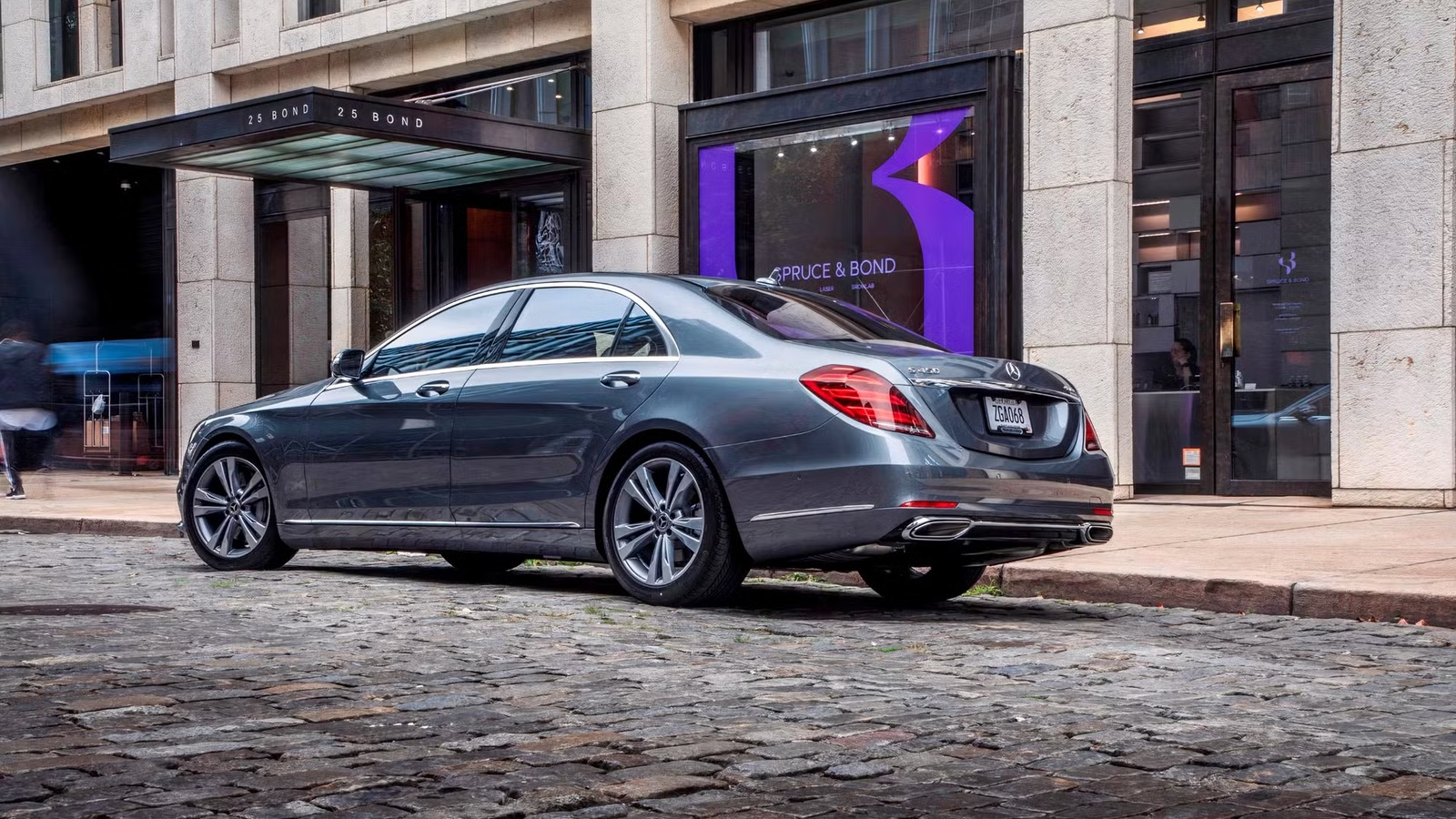
The Mercedes-Benz S-Class leads this depreciation wave. A 2021 Mercedes-Benz S500 or S580 originally commanded six-figure window stickers. Today, wholesale values for three-year-old higher-mileage examples and five-year-old W222-generation models regularly cross into the $30,000 to $35,000 territory. Buyer hesitation around twin-turbo V-8 fuel consumption drives these auction results down. Consumers get air suspension, double-pane glass, and handcrafted leather for the cost of a modern four-cylinder hybrid daily driver.

BMW 7 Series models experience an equally aggressive price adjustment. A 2020 or 2021 BMW 740i or 750i xDrive sedan rapidly depreciates on wholesale lots. The B58 inline-six engine offers respectable efficiency, yet market perception of flagship maintenance costs keeps bidder activity low. Auction values for clean, four-year-old G12 7 Series sedans sit firmly between $28,000 and $34,000. Buyers trade standard feeling of a generic commuter for executive rear seating and active chassis stabilization at exact Camry price parity.

The Audi A8 sedan presents another prime target for value-seeking buyers. The D5-generation Audi A8 L features a sophisticated mild-hybrid V-6 powertrain alongside standard Quattro all-wheel drive. Despite its tech-laden aluminum spaceframe construction, wholesale demand for used A8 models weakens significantly during fuel price spikes. Three-to-five-year-old A8 models regularly cross dealer wholesale lots at values below $32,000. Retail shoppers gain access to flagship executive transport equipped with adaptive air suspension for less than the price of an optioned-out Camry XLE.
The Lexus LS Is Also A Victim Of The Trend

Lexus LS models historically resist steep market drops better than European rivals, yet current market conditions hit them as well. The fifth-generation Lexus LS 500 features a twin-turbocharged 3.4-liter V-6 engine. While reliable, its premium fuel requirement and large footprint push wholesale values down in mid-August 2026. 2019 and 2020 Lexus LS 500 sedans consistently trade through wholesale channels between $31,000 and $36,000. Buyers secure absolute Japanese craftmanship and exceptional long-term build quality for the cost of a mainstream hybrid.

The Jaguar XJ remains a standout bargain for buyers seeking distinct character. Jaguar discontinued the XJ nameplate, which accelerates its standing depreciation curve on secondary markets. Late-model X351 Jaguar XJ sedans, powered by supercharged V-6 or V-8 engines, trade at wholesale figures hovering between $25,000 and $30,000. These low trade values let buyers acquire an all-aluminum luxury flagship for less than the starting sticker price of a base 2026 Camry LE.
Some Buyers Believe The Risk Is Worth It

Current macro trends show no immediate signs of reversal for heavy luxury inventory. High gas prices continue to direct mainstream buyers toward compact hybrids, leaving non-hybrid executive sedans vulnerable to ongoing wholesale corrections. While new sedan buyers accept modest materials to secure factory warranties, used vehicle buyers leverage high gas prices to acquire elite comfort. This mid-August wholesale drop highlights how patient car buyers can easily bypass mass-market options to step directly into full-size luxury flagships.
Luxury Cars Fail To Beat The Camry’s Dependability

While used luxury cars are enticing, they fail to offer the same sense of long-term security that you’d typically get from a Toyota Camry. iSeeCars gives the Camry range an 8.2/10 overall score, including 8.6/10 for reliability, 8.6/10 for retained value, and 8.0/10 for safety. The publication indicates that the model will run for 13.1 years or 171,901 miles without encountering any noteworthy mechanical issues, and has a 31.8 percent probability of hitting 200,000 miles.
J.D. Power gives the 2026 Toyota Camry model year an 82/100 consumer-verified overall score, including 80/100 for quality and reliability, 82/100 for the driving experience, 92/100 for resale, and 76/100 for the dealership experience.
Value Retention Also Plays A Huge Role

Where depreciation is concerned, you can expect the model to lose $10,829 or 37.7 percent of its value over five years or 60,000 miles, which is well under the segment average. CarEdge highlights that the Toyota Camry will cost $36,432 to own over the same period, with $14,274 accounting for depreciation, $10,060 for insurance, $4,530 for fuel, $6,056 for interest, and $1,512 for maintenance.
According to Edmunds’ True Cost To Own calculator, you can expect a new base front-wheel-drive 2025 Toyota Camry LE to cost you $38,952 over the course of five years. This includes $10,795 worth of depreciation, but excludes the $28,700 MSRP. You’ll also find yourself spending $7,631 on insurance, $3,213 on maintenance, and just $773 on repairs. Your taxes and fees will also be incredibly low, with the calculator showing that you’re only likely to spend $3,627. Fuel will cost you $7,226, based on average driving distance in the U.S.
The Camry’s Exceptional Fuel Efficiency Remains Undefeated

As per the EPA’s official fuel consumption estimates for the 2025 Toyota Camry, you’ll find that Edmunds‘ estimates are on par. The front-wheel-drive LE is the most efficient model, returning a 53/50/51 MPG consumption result on the city/highway/combined cycle with a 663-mile range claim from the 13-gallon tank. The agency also indicates that this will save you up to $5,000 in fuel costs every five years and costs $1.59 to drive every 25 miles.
The all-wheel-drive XSE is the least frugal model, but this is only by a fractional amount. The EPA indicates that it returns a 43/43/43 MPG result with a 559-mile range claim and suggests that this will save you up to $3,750 in fuel costs every five years and cost $2.38 to drive every 25 miles. Expect to pay $53 to refill the 13-gallon tank, featured in all trims. The front-wheel-drive LE is the most attractive model, with it set to cost you $1,200 in fuel every year. The flagship all-wheel-drive XSE is just a bit more expensive to run, with its $1,350 annual fuel cost.
Sources: Mercedes-Benz, Toyota, Cox Automotive, iSeeCars, Edmunds, CarEdge, the NHTSA, and J.D. Power.

Related posts


Latest Post




No Comments