
The Rarest 1968 Pontiac GTO Is Defined By What Pontiac Left Off
Walk any big summer car show and you will see the crowd drift past certain cars without a second glance. They look like base models wearing badges they never earned, so most enthusiasts keep moving toward the stripes and the scoops. That instinct is usually right, but in one famous case it is exactly wrong.

During the golden age of American muscle, when rarity was built from what factories added, one automaker created its scarcest variant by taking something away. The plainest, cheapest version of an icon is now the one collectors quietly hunt, and the only real proof of what it is lives on a piece of paper.
Why Some Of The Rarest American Muscle Cars Left The Factory With Less
Detroit’s order sheets of the 1960s were full of boxes that removed equipment rather than added it. Racers deleted radios and heaters to save weight, fleet buyers deleted trim to save money, and dealers rarely stocked such cars because nobody browsing a showroom wanted less. The result is a category of vehicles that were unpopular when new and are fascinating now, precisely because so few buyers ever ticked those boxes.

The value logic here is different from the usual muscle-car math. A big engine announces itself the moment the hood opens, but a delete option is invisible unless you know the production figures and can prove the car left the factory that way. That makes these cars a paperwork game, where scarcity was created at the order desk rather than on the assembly line.
There is an emotional payoff too, because delete cars reward knowledge over spectacle. The collector who spots one is seeing something the rest of the show field dismissed. One 1968 muscle car from Pontiac took this idea to its logical extreme, because the feature its buyers deleted was the very innovation that had just won the model national acclaim.
Pontiac Let Buyers Delete The One Feature That Made The 1968 GTO Famous

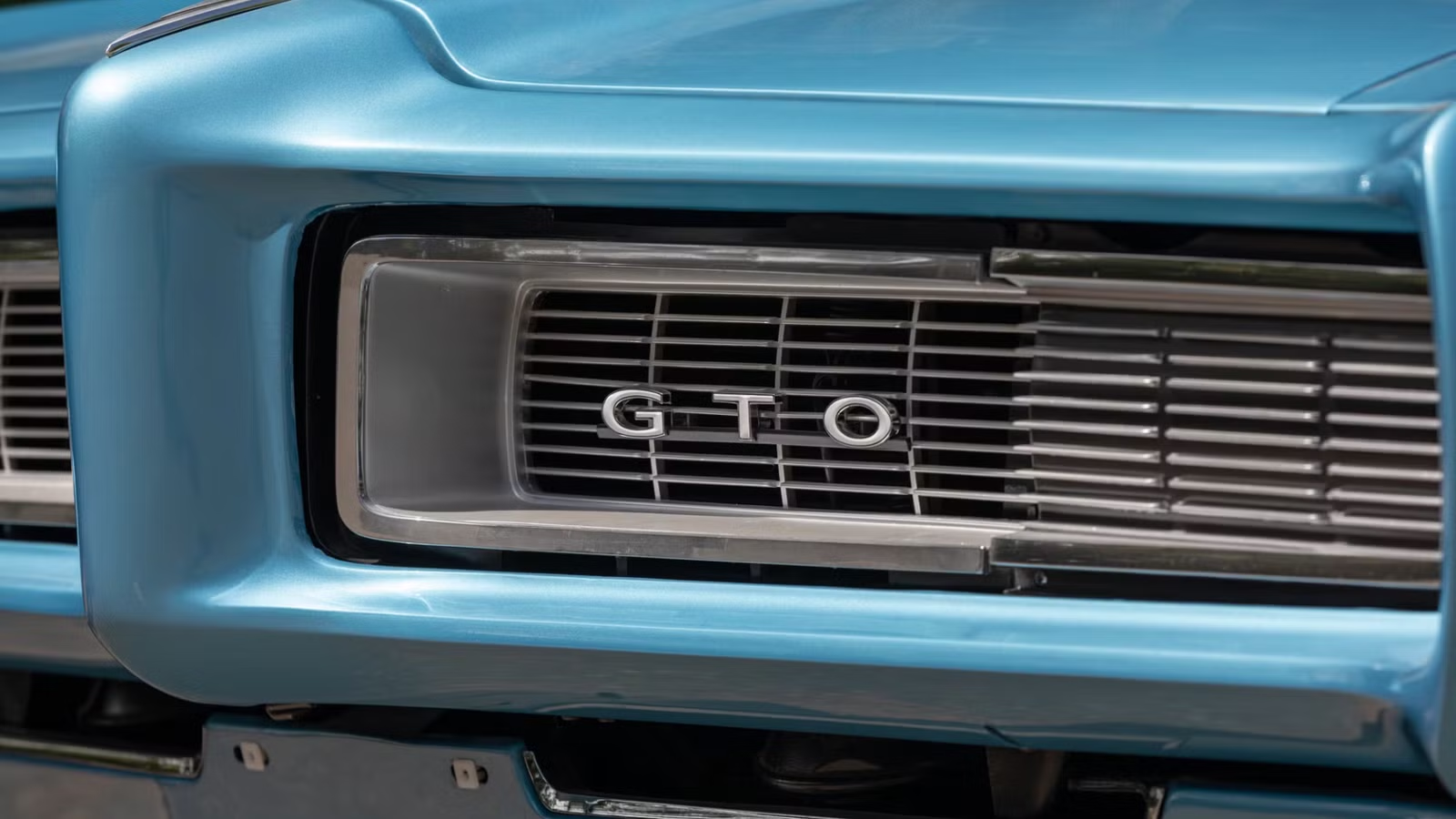
The 1968 Pontiac GTO’s signature was its nose, and option 674 removed it entirely. The redesigned 1968 GTO introduced the Endura front bumper, a color-matched nose that Pontiac advertising showed shrugging off direct blows from crowbars, tire irons, baseball bats, and sledgehammers.
When Motor Trend named the GTO its Car of the Year, the magazine created a second Special Achievement Award just for the bumper. Motor Trend’s test of a 350-hp automatic car recorded 0-60 mph in 7.3 seconds and a 15.93-second quarter mile, but it was the nose that made the GTO the talk of 1968.

The material itself had an unlikely pedigree. It was developed by GM’s Inland division, whose roots trace back to the Dayton Wright Airplane Company, co-founded by GM research chief Charles F. Kettering and Orville Wright.
Then Pontiac offered to take it all away. In December 1967, the division announced Regular Production Option 674, known as the Endura delete option, which substituted a LeMans chrome front bumper, exposed headlamps, and hardware for the Endura nose. Cars ordered with code 674 could not be equipped with the GTO’s hidden headlights, so the delete stripped the front end back to something any Tempest buyer would recognize. The most celebrated face in American muscle became, at a stroke, ordinary.
Why Pontiac Offered A Downgrade On Its Award-Winning Nose

Three explanations circulate for code 674, and they do not all carry the same weight. The best-documented reason involves paint. The Endura manufacturing process supported only 16 exterior colors, and deleting the nose allowed customers to order shades outside that range. For buyers chasing a special-order color, the chrome bumper was not a compromise but the price of admission.
The second reason is nearly as solid, and it targeted the drag strip. The chrome bumper was lighter assembly, and choosing it earned the buyer a $26.33 credit on the invoice. Some accounts describe the swap as a no-cost option, which means Pontiac effectively paid racers to take the faster front end.

The third explanation is the one enthusiasts repeat most and the one with the shakiest paper trail. Early production struggles with getting paint to adhere to the Endura material reportedly delayed the bumper’s full availability, and the delete of the feature has long been framed as Pontiac’s hedge against those problems. However, this piece of GTO lore has never been confirmed. The adhesion troubles were real enough, but treating them as the reason the option existed goes beyond what the record supports.
Only 2,108 Of 87,684 GTOs Left The Factory With A Chrome Front Bumper

The production math explains why so few people have ever seen a genuine example. Pontiac built 87,684 GTOs for 1968, and just 2,108 of them carried option code 674. That works out to roughly 2.4 percent of production in one of the nameplate’s strongest sales years, which means the average 1968 GTO gathering might not contain a single delete car.
The year’s total split into 77,704 hardtops and 9,980 convertibles, so the chrome-nose cars were scattered thinly across a huge and popular model run. The option is obscure enough that its existence gets flatly denied — even veteran mechanics have denied it existed. When the people who fix these cars for a living doubt the option existed, the average show spectator has no chance.
Survivors are believed to be rarer still than the build number suggests. The Endura nose defined the GTO’s identity, and many delete cars are thought to have been converted to the famous front end during restorations over the decades. A factory chrome-nose car that still wears its chrome nose is the rare version of a rare version.
Without PHS Documentation, A Genuine 674 GTO Is Indistinguishable From A Clone

Authentication is where this obscure option becomes a lesson in modern collecting. The delete car’s curse is that it looks like something lesser. Genuine examples get dismissed at shows as LeMans clones wearing GTO badges, or as wrecked GTOs repaired with cheaper LeMans parts, and because the two models shared a body, the eye alone cannot settle the argument. The 242 VIN prefix proves a car began life as a GTO, but it cannot prove the chrome nose came from the factory rather than a body shop.
Only Pontiac Historic Services documentation can do that, which is why the paperwork has become the most valuable component on the car. When a vehicle’s rarity lives in what is absent rather than what is present, authenticity is the entire game, and the 674 GTO is the purest case of it in the muscle-car world. The car everyone walks past is the one worth stopping for, provided the paperwork says so.
Sources: Hagerty, GTO Forum, Pontiac, MotorTrend

Related posts





Latest Post


No Comments