
The Suzuki Dual-Sport That Led An Entire Segment Unchallenged For Two Decades
By their very nature, dual-sport motorcycles aim to strike a fine balance between off-road and street riding. Some do it better than others, but few machines out there are so good that they barely change for well over two decades. The bike we’ll be looking at today most certainly was, though, and it only recently made way for its thoroughly updated successor to continue what it had started. Having stayed at the forefront of the dual-sport segment for so long, the model gained one heck of a reputation for its versatility and reliable nature. But for context, let us first take a look at the dual-sport genre as a whole during the 1990s.
Competition Drives Innovation Unlike Anything Else

By the 1990s, the segment had come a long way from the Yamaha DT-1 of 1968, widely regarded as the world’s first dual-sport. Japanese brands offered some of the very best dual-purpose bikes out there, with heavy-hitters such as the Honda XR650L or Kawasaki’s KLR650 being just a couple of notable examples. Suzuki was at it with the DR650SE, too, and the model is still in production today employing a traditional carburetor as opposed to EFI for serviceability’s sake. But what Suzuki needed back in the nineties was a solid middleweight to challenge highly capable models like the Honda XR400R and Yamaha XT350. And while the DR350 had been in production since 1990, it was getting a bit long in the tooth as the decade was drawing to a close.
Setting A New Benchmark For Mid-Sized Dual-Sports

Wanting to get ahead of the competition, Suzuki went back to the drawing board and got to work creating one of the finest middleweight dual-sports the world has ever seen. Not only would the model stay in production almost unchanged from 1999 until 2024, but it also remained among the leaders of its segment during that time. And even though Suzuki in the late nineties is generally associated with the legendary GSX1300R Hayabusa, the specimen we’re about to look at was arguably just as influential in its own way. The formula was as effective as it was plain, so it didn’t take long for the public to fully embrace Suzuki’s newcomer. What’s more, said machine went on to outlast just about every rival that stood in its way.


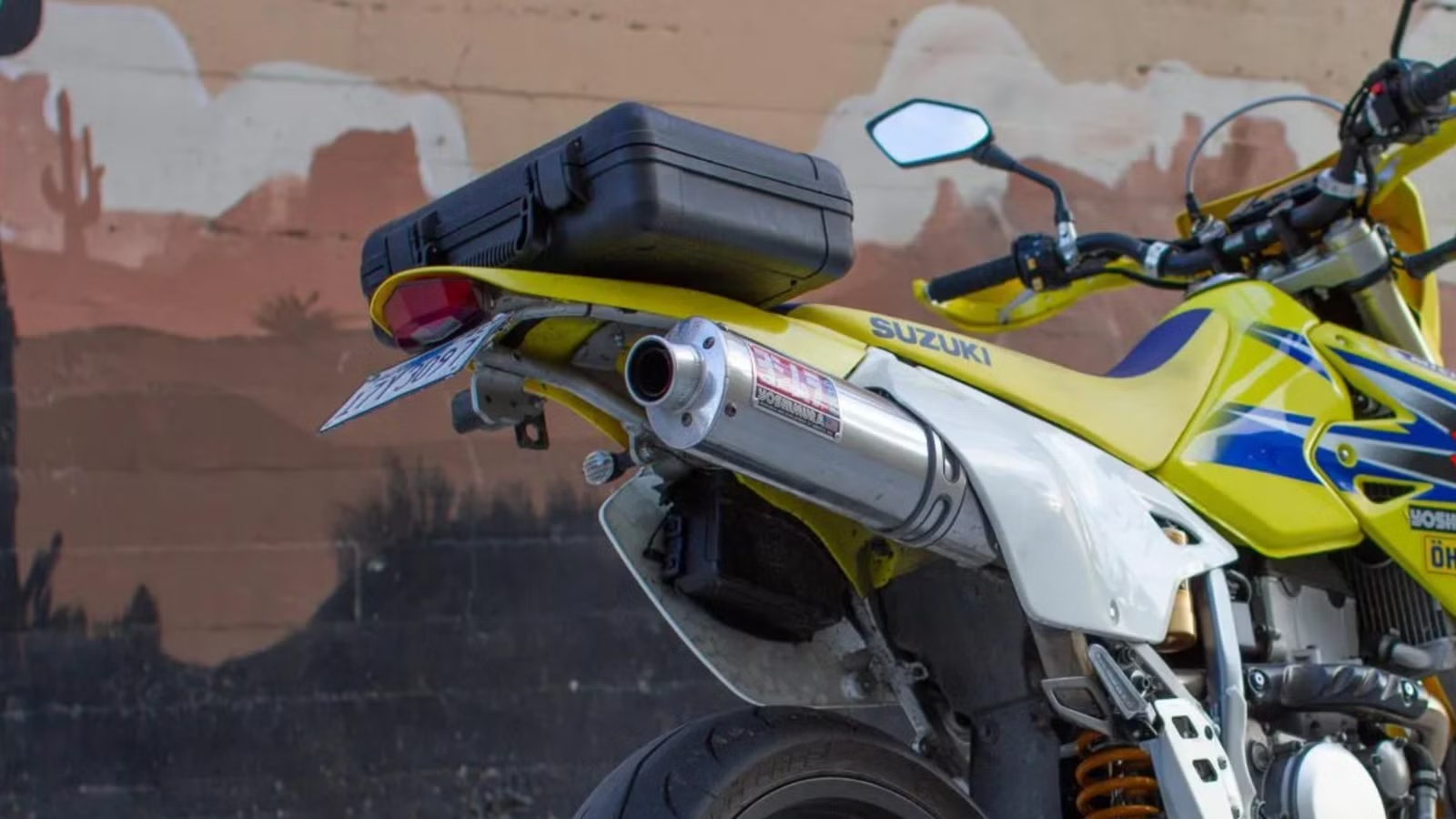
Released in 1999 for the model-year 2000, the DR-Z400 was Suzuki’s way of taking over the middleweight dual-sport scene without trying to completely reinvent the wheel. It wasn’t trying to excel disproportionately in one particular area, but it instead sought to provide the most well-rounded package for city commutes during the week, off-road outings on the weekend, and just about everything else in between. For the most part, this versatility formed the basis of the DR-Z’s success, allowing it to remain relevant in an ever-changing motorcycle landscape. And compared to the earlier DR350, the DR-Z400 was superior in pretty much every way that mattered.
At its core, there was a liquid-cooled 398cc single-cylinder engine with four valves operated by dual overhead cams. The thumper’s power output figures varied a little depending on which DR-Z variant you got, as it was initially available either as a street-legal S version or the off-road-only E featuring an electric start. The former used Mikuni carburetion hardware and was able to muster around 40 horsepower, whereas the DR-Z400E benefited from a bigger Keihin FCR carb, slightly higher compression, and 48 hp on tap. Neither of them chased outright power, though, instead leaning toward a torquey mid-range, sharp throttle response, and exceptional durability. The engine’s oomph was passed on to the rear wheel by way of a five-speed gearbox and a drive chain.

Naturally, Suzuki made sure the chassis was just as sturdy as that single-cylinder powerhouse. A tough steel frame and aluminum swingarm formed its basis, and front-end suspension duties were assigned to a beefy pair of adjustable 49-millimeter (1.93-inch) forks offering a generous amount of wheel travel. On the other hand, the rear end was supported by a fully-adjustable, linkage-type monoshock, while the DR-Z’s dry weight sat between 262 and 291 pounds depending on the iteration. Yet another version of the model was added to Suzuki’s lineup in 2005, namely the DR-Z400SM tailored toward the supermoto crowd. And, of course, there were a few key differences between the SM and its off-roading counterparts.
It came with 17-inch wheels in typical supermoto fashion, as well as upside-down forks and a larger front brake for sportier riding on the street. Just as the DR-Z400S had become the gold standard in the dual-sport category, the SM came to occupy a similar spot in the world of supermotos. A great deal of aftermarket support sprang up around Suzuki’s lineup over the years, only enhancing its appeal further, especially among those who sought to personalize their rides in one or more ways. But no matter how good the DR-Z400 might’ve been, you can only keep selling the same bike for so long before something prompts you to evolve. As such, the legendary dual-sport finally met its end after the model-year 2024, concluding a 26-year production run with no major updates performed throughout it.
The DR-Z Name Lives On, Albeit Extensively Modernized

Remarkably, the final iteration of the DR-Z400 was very similar to the first on a mechanical level. It was still carbureted, still devoid of modern electronics like ride modes or ABS, and still great at getting the job done. However, today’s strict emissions regulations became rather problematic for its carb-equipped powerplant, and this became the biggest reason for the model’s discontinuation. Modern safety standards in many markets played a key role, too, with ABS becoming legally mandatory for new bikes in places like Australia, Japan and the European Union. But from a commercial standpoint, the DR-Z400 continued to perform extremely well throughout its lifespan, so poor sales never had anything to do with its eventual discontinuation.
Suzuki hasn’t killed the DR-Z nameplate altogether, though, instead releasing the updated DR-Z4S and DR-Z4SM in 2025 to carry things forward. They come with fuel injection and a comprehensive electronics suite featuring things like anti-lock braking, traction control and a ride-by-wire throttle. With these, Suzuki addressed the main culprits behind the DR-Z400’s downfall, so we can expect the lineage to be around for many more years. Other notable changes included fresh KYB suspension, better brakes and revised engine internals for smoother power delivery, while MSRPs for both the S and SM variants start at $8,999. On the other hand, prices for used DR-Z400s generally land below five grand on the second-hand market.
Why The DR-Z400’s Legacy Is Such A Big Deal

Just as it had done with the GSX-R1000 K5, Suzuki created a bike so good that it didn’t require any major updates for several years. The DR-Z gave dual-sport riders exactly what they wanted—a no-frills machine that could hit the trails on Sunday and take you to work on Monday, all while costing just a little over $7,000 brand-new. Bulletproof reliability was yet another one of its major strengths, as were factors like ease of maintenance and extensive aftermarket support. Suzuki proved that buyers weren’t necessarily interested in fancy tech or impressive spec sheets. They just wanted a solid two-wheeled companion they could depend on in any environment, which is precisely what the DR-Z was from the very beginning. This explains why its commercial success lasted 26 years while so many of its rivals came and went. And with the new DR-Z4S released in 2025, the nameplate is unlikely to go away anytime soon.
Sources: Suzuki

Related posts


Latest Post


No Comments