The Luxury V8 SUV That Lost 62-Percent Of Its Value In Five Years
13 minutes reading
Friday, 7 Aug 2026 14:00 0 8 autotech
Some SUVs are built to hold their value. Take the likes of the RAV4; it is estimated that it will only lose 28 percent of its value in the first five years of ownership. Luxury SUVs, on the other hand, tend to have a different trend. Thanks to the generally high maintenance costs, huge starting prices, the rate at which tech goes out of date, and a huge number of ex-lease models on the used market, value tends to plummet quickly.
This isn’t great news if you are thinking about buying a new luxury SUV and planning on keeping it for only a few years. However, if you are in the market for a used luxury SUV at a good price, waiting five years for a model to drop in price is a shrewd move.
Front 3/4 shot of 2025 Land Rover Discovery in red parkedLand Rover
We’d suggest reading this bit quicker if you are buying new luxury SUVs, as depreciation is likely to hit your model hard. Of course, not all luxury SUVs depreciate quickly; if you buy something especially collectible or produced by the likes of Lexus, there is a better chance you’ll be able to recoup some money when you sell it. But if you buy something like a Land Rover Discovery, a Jaguar F-Pace, a Range Rover Sport, or a BMW X7, they can be money pits.
According to CarEdge, the F-Pace will lose 65.4 percent of its value in the first five years; the Discovery, 65 percent; the Sport, 64.6 percent; and the X7, 63.7 percent. If you can wait five years for a model you like, you could be looking at huge savings compared to new prices, especially when the likes of the new Discovery has an MSRP of $62,050, and the new Range Rover Sport has an MSRP of $79,450.
The First Owner Already Absorbed The Biggest Financial Hit
Front shot of 2025 Cadillac Escalade in blue parked on drivewayCadillac
The first owner is the one who generally pays the premium for driving a brand-new luxury SUV off the lot, but they’re also the one who takes the biggest financial hit. Take the 2026 BMW X7; it has a starting price of $89,050 and loses 63.7 percent of its value in the first five years. That means that in 2031, if trends continue the way they are, it will only be worth around $32,300; that is before accounting for insurance premiums, gas costs, and maintenance.
For X7 second owners, though, it is where things get interesting. Five years on, you could get heated and ventilated seats, a 375-horsepower turbo-six under the hood, adaptive suspension, a plush cabin, and a 14.9-inch touchscreen for roughly the same price as a new Mazda CX-5 in 2026. The X7 is not the only one either, because this is a pattern that has long emerged in the luxury market; some excellent used luxury SUVs out there have depreciated into bargains.
Why The Smartest Used Buys Usually Aren’t The Cheapest
Front shot of white 2019 Porsche Cayenne E Hybrid parkedPorsche
Compared to the mainstream used market, luxury SUVs follow a very different pattern. If you are looking for a five-year-old RAV4 or CR-V, paying a little more often gets you lower mileage or a higher trim because they both hold their value so well. In the luxury segment, though, steep depreciation means your budget can stretch into an entirely different class of vehicle.
Instead of spending $35,000 on a well-equipped mainstream SUV, you could be looking at something like a 2019 Cayenne E-Hybrid, which originally stickered at around $80,000. Models like this are also why condition matters more than simply chasing the lowest price.
A cheap Cayenne E-Hybrid with a patchy service history might seem like an incredible deal, but expensive parts, air suspension servicing, or overdue maintenance can quickly erase any of those savings. If you spend a few thousand more dollars on a well-maintained example, you’re more likely to get a vehicle that offers genuine luxury, sports car performance, and premium tech for the price of a mainstream crossover.
The Infiniti QX80 Is The Hidden Winner Of The Luxury Depreciation Cliff
Front 3/4 shot of 2024 Infiniti QX80 in silver posing in front of mountainsInfiniti
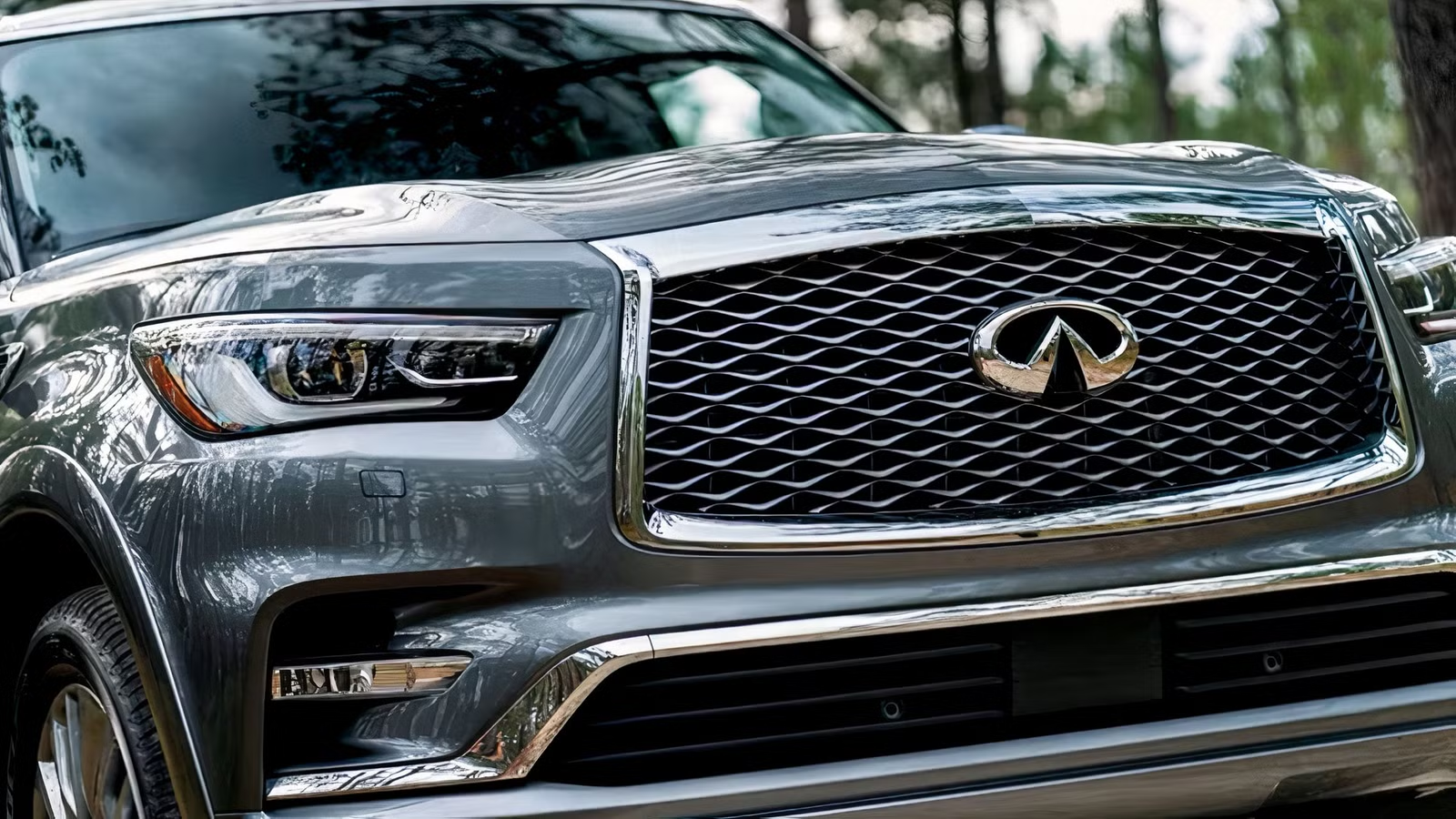
All of the above is why the Infiniti QX80 is such a good deal today. Based on the rock-hard Nissan Armada but with far more finery, a three-row, full-sized 2026 QX80 has a high starting price of $84,950 before any extras or climbing above the base trim. You do get the height of luxury across all three rows and a 450-horsepower bi-turbo V6 under the hood, but there is no doubt it is a lot of money.
The good news for used luxury buyers is that the QX80 is the luxury SUV with one of the highest depreciation rates. CarEdge says it loses 69 percent of its value in five years, while Forbes reports that it loses slightly less value, at 62.8 percent of its value over five years.
Rear 3/4 action shot of 2021 Infiniti QX80 driving on roadInfiniti
Average used prices of the 2021 Infiniti QX80 now sit between $27,500 for the base-trim LUXE and $33,900 for the top-tier SENSORY trim, down from original starting prices of between $73,645 and $84,795. Bearing in mind 2026 average used prices, this makes for a value percentage drop of between 60 percent and 62.7 percent.
Its Naturally Aspirated V8 Is Becoming A Rare Find
Close-up shot of 2020 Infiniti QX80 engine bay showing V8Infiniti
Alongside the appealingly low prices, the 2021 QX80 is equipped with a V8; to be more precise, a 5.6-liter naturally aspirated V8 good for 400 horsepower and 413 pound-feet of torque. Power is routed through a seven-speed automatic transmission to either the rear wheels or all four wheels. The V8, like we are seeing across the market in most models today, was dropped from the QX80 lineup for the 2025 model year, and the last model year equipped with one was 2024.
FuelEconomy.gov estimates that the 2021 QX80 can achieve between 15 and 16 combined mpg, which translates to city mpg ratings between 13 and 14, and a highway mpg rating of between 19 and 20, so not great. However, you do get a smooth and robust feel, and a maximum towing capacity of 8,500 pounds.
You Get Flagship Luxury For Mainstream SUV Money
Shot of 2021 Infiniti QX80 interior showing front cabinInfiniti
Possibly one of the main reasons to buy a used QX80, though, is because of the flagship-level plushness and comfort inside. Owner reviews on Kelley Blue Book rate the ’21 QX80 4.1 out of 5, with performance and reliability at 4.3 out of 5, and comfort and styling at 4.6 out of 5.
There are three rows of seating in the QX80, which offer up 39.6 inches of front legroom, 41 inches of second-row legroom, and 28.8 inches of rear legroom, and you get an exceptional 152.5 cubic feet of passenger volume. Then there is the build quality and materials.
Shot of 2021 Infiniti QX80 interior showing front cabinInfiniti
Shot of 2021 Infiniti QX80 interior showing second row of seatsInfiniti
The eight-inch touchscreen and seven-inch lower touchscreen aren’t what you’d get in a brand-new luxury SUV today, but the 2021 QX80’s cabin still feels every bit flagship. Infiniti focused on traditional luxury, with soft-touch surfaces, genuine wood trim, quilted leather upholstery on higher trims, and solid switchgear throughout. Even by modern standards, it is a cabin that is made for comfort over gimmicks.
The entry-level LUXE gets leather-trimmed seats, heated front seats, a heated leather-wrapped steering wheel, tri-zone climate control, power-folding third-row seats, and a 13-speaker Bose audio system. The PREMIUM SELECT trim adds dark chrome interior accents, open-pore wood trim, upgraded leather seating, and 22-inch wheels.
Shot of 2021 Infiniti QX80 interior showing third row of seatsInfiniti
At the top of the trim range is the SENSORY, which is equipped with two captain’s chairs in the second row, semi-aniline leather upholstery, heated second-row seats, climate-controlled front seats, and a 17-speaker Bose Performance Series audio rig. Combined with good sound deadening, smooth ride quality, and all the space on offer, it still delivers a proper luxury SUV experience, despite its aging tech.
Here’s Where It Leaves Other Depreciation Victims Behind
Front 3/4 action shot of 2021 Infiniti QX80 driving on roadInfiniti
According to Forbes’ study, the QX80 is one of the worst SUVs for value retention, and is only out-depreciated by one model: the Nissan Leaf. It says that the Range Rover Sport, the QX60, the Q5, the Q7, and the X5 all depreciate more slowly than it. iSeeCars rates the QX80 6.7 out of 10 for value retention, and CarEdge says only the Land Rover Range Rover, the Maserati Levante, the Jag I-PACE, and the Maserati Grecale out-depreciate the QX80 over five years.
So why would it make for a good used buy (aside from the low used price and features)? Well, the QX80 is built to be a practical luxury SUV that can be driven every day. Behind the third row, there is 16.6 cubic feet of storage space; behind the second row, 49.6 cubic feet; with all the seats folded down, 95.1 cubic feet.
Lower Ownership Costs Give It An Edge Over Full-Sized Rivals
Profile shot of 2021 Infiniti QX80 parkedInfiniti
Edmunds estimates that the true cost to own a 2021 QX80 over five years is between $75,713 for the RWD LUXE and $91,469 for the AWD SENSORY. This includes costs of between $8,679 and $8,834 for insurance, $9,878 and $10,156 for maintenance, and between $3,579 and $4,097 for repairs.
FuelEconomy.gov also estimates that it will cost you between $4,650 and $4,950 a year for gas, which equates to spending between $12,500 and $14,000 more on gas over five years compared to the average modern vehicle. There is no escaping the fact that these figures are not for the budget-minded. However, it could be worse, and the QX80 actually has lower ownership costs than some of its three-row luxury SUV rivals.
Rear shot of 2021 Infiniti QX80 parkedInfiniti
The 2021 BMW X7 offers up to 90.4 cubic feet of storage space (less than the QX80), and while you get a more powerful engine and the BMW badge, Edmunds says it will cost you $90,378 to own over five years. This is slightly less than the top trim of the QX80, but this is for the base trim; if you want the most sporty ride, you have to opt for the X7 M50i, which will cost up to $106,707 to own over the same time. This five-year cost to own includes insurance costs of up to $10,129, maintenance costs of up to $18,390, and repair costs of up to $10,690.
Then there is the home-grown competition. The 2021 Cadillac Escalade delivers all sorts of finery, and at its most spacious, offers up to 121 cubic feet of cargo space with all the seats folded down, but it is even more expensive than both the X7 and the QX80 to own.
Front 3/4 shot of 2021 Infiniti QX80 parkedInfiniti
Edmunds estimates that it will cost you between $99,918 and $105,216 to own a five-year-old Escalade over five years. Maintenance costs are up to $8,771; insurance premiums are high at $9,488; and repair costs are still expensive at $7,331.
This may look favorable compared to the QX80 at specific trim levels, but because the Escalade was priced significantly higher in 2021 than the QX80 (base trim MSRP of $80,890/$105,290 for the top trim), depreciation costs of up to $33,666 and fuel costs of up to $26,892 feel even more significant.
The QX80’s Truck-Based Platform Makes It A Smarter Long-Term Bet
Front 3/4 action shot of 2021 Infiniti QX80 driving on city streetInfiniti
iSeeCars rates the 2021 QX80 6.7 out of 10 for reliability, which is not the greatest for an SUV, and owners have complained about a faulty electrical system that causes battery drain, while fuel pump failures and rearview camera problems have prompted NHTSA recalls, but it does benefit from one thing: its body-on-frame chassis.
Unlike a lot of modern luxury SUVs that use a unibody, the QX80 shares the F-alpha ladder-frame platform with the Nissan Armada and Patrol. It can withstand heavy towing, rough terrain, and years of hard use, which is why it has developed a strong following despite a lack of badge prestige and steep depreciation costs. The trade-off is extra weight and less athletic road manners than the likes of the X7; the payoff is a chassis that’s proven itself over nearly two decades.
Profile action shot of 2021 Infiniti QX80 driving on roadInfiniti
The suspension is equally old-school, but in the best way. Every QX80 is equipped with an independent double-wishbone suspension at the front and rear, while higher trims get Hydraulic Body Motion Control (HBMC). Rather than relying on air springs or adaptive dampers, HBMC links the dampers hydraulically to reduce body roll in corners while maintaining a smooth ride on holey roads.
It is an elegantly simple solution that delivers much of the composure of more complex systems without introducing expensive components that are likely to cost a significant amount to repair down the road.
The QX80 Proves Depreciation Can Be Your Greatest Advantage
Front 3/4 action shot of 2021 Infiniti QX80 driving on city roadInfiniti
A long lifespan is key to getting full value from a vehicle that is a few years old. While it is unlikely that most of the 2021 QX80 models on the used market have hundreds of thousands of miles on them (given the high running costs in the age of hybrid SUVs), that doesn’t mean it can’t last into high mileage.
iSeeCars predicts the QX80 has an average lifespan of 146,900 miles, and thanks to its relatively new age, truck-like build, and naturally aspirated V8 under the hood, we have already seen a few examples hit around 115,000 miles with little trouble to report.
Shot of 2021 Infiniti QX80 front cabinInfiniti
That longevity completely changes the depreciation story. While the depreciation rate is a painful stat for new buyers, if you are buying used, it’s the loophole that turns a flagship luxury SUV into a real bargain. Instead of spending the same money on a new, well-equipped crossover, you’re stepping into a full-size V8 SUV that was engineered to compete with the Range Rover, the Lexus LX, and the BMW X7.
More importantly, the QX80 doesn’t fall into the same trap as many of the luxury SUVs sitting around it on the depreciation chart. A used X7, Range Rover, or Tesla Model S might also look tempting once the values plummet, but they often bring far more complicated technology to maintain.
Close-up shot of 2021 Infiniti QX80 rear badgeInfiniti
The QX80 strikes a better balance: annual maintenance is estimated at between $716 and $907, its V8 has earned a reputation for durability, the interior is quietly luxurious, and the truck-based underpinnings are built around proven engineering rather than chasing trends. In a lot of ways, the QX80 is the ideal example of why depreciation isn’t always bad news.
As luxury SUVs and EVs continue to bear the brunt of the 2026 depreciation cliff, if you’re looking to buy used, you are set to benefit the most. The QX80 can, on one hand, be seen as one of the worst new-SUV investments on the U.S. market, but after five years, it has quietly become one of the smartest used-SUV purchases. It is proof that sometimes the biggest loser on paper turns into the biggest winner on the driveway.
Base Trim Engine
3.5-liter V6
Base Trim Transmission
9-Speed Automatic
Base Trim Drivetrain
Rear-Wheel Drive
Base Trim Horsepower
450 hp
Base Trim Torque
516 lb-ft
Make
Infiniti
Model
QX80
Segment
Full-Size Luxury SUV
Sources: iSeeCars, CarEdge, RepairPal, Kelley Blue Book, J.D. Power, and Infiniti.









No Comments