
The 2027 Ferrari Amalfi Spider Is Here — Here’s What Dropping The Roof Actually Changes
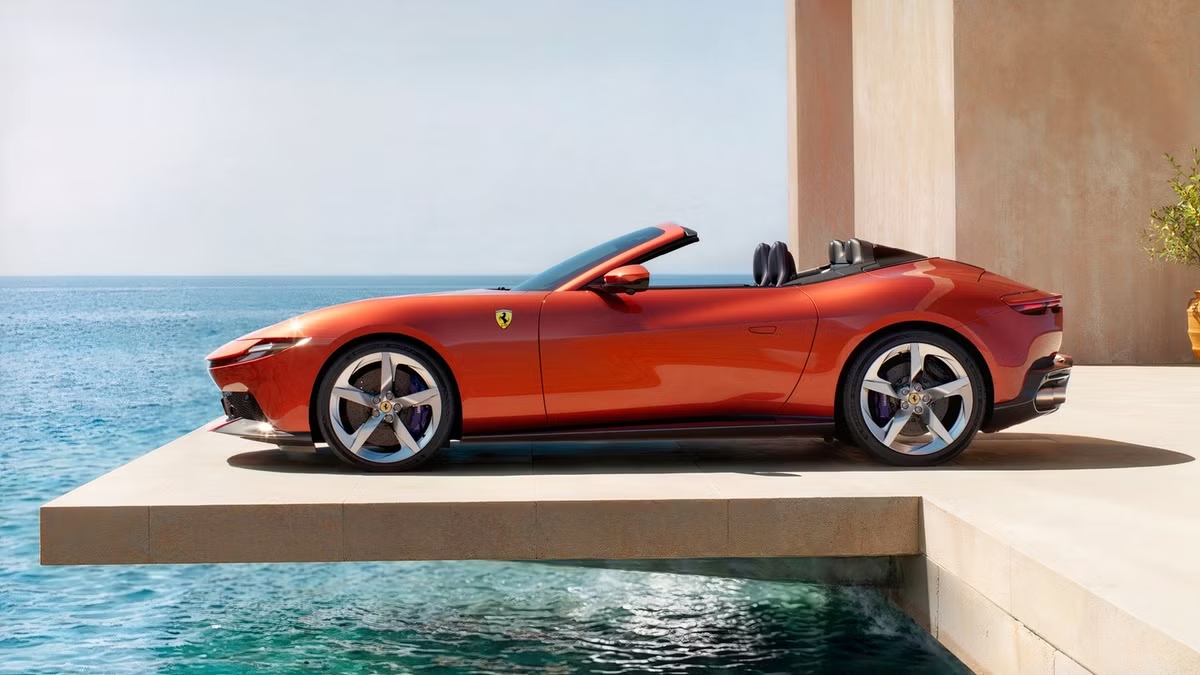
Ferrari’s front-engine V-8 convertible lineage — California, Portofino, Roma Spider — just gained its most complete chapter yet. The 2027 Amalfi Spider arrived with full drive reviews from Road & Track and Car & Driver on August 5, and the verdict is nuanced: dropping the roof genuinely enhances the grand-touring experience in several meaningful ways, but it also introduces one frustrating trade-off that has nothing to do with chassis dynamics.

The Spider replaces the Roma Spider as Ferrari’s most accessible open-top model, carrying the same 631-hp flat-plane-crank 3.9-liter twin-turbo V-8 as the coupe. Ferrari claims 0–60 in just over three seconds and a 199-mph top speed. Those numbers are identical to the hardtop. What changes is everything around the experience of chasing them.
The Structural Story: 190 Pounds and You Won’t Feel Them
Converting any performance car to a convertible means adding structure to compensate for the lost rigidity of a fixed roof. Ferrari addressed this with an extensive reinforcement package throughout the Amalfi Spider’s body — the specifics of which the company hasn’t itemized publicly, but the result is a 190-pound weight penalty over the coupe.

On paper, that’s meaningful. In practice, on the mountain roads above Agioi Theodoroi in southern Greece where both publications conducted their drives, it was nearly imperceptible. Road & Track’s reviewer specifically noted that despite the weight difference, the Spider’s handling felt indistinguishable from the coupe’s. The active dynamic systems — magnetorheological adaptive dampers, electronically controlled limited-slip differential, and a three-position active rear wing — absorb the penalty effectively. The chassis feels balanced, with the convertible’s mass centered in a way that keeps cornering predictable rather than sluggish.
The Roof Itself: A Five-Layer Softtop That Earns Its Keep

Ferrari carried over the retractable fabric roof introduced on the Roma Spider — a five-layer construction with acoustic-deadening material built in. It opens electrically in 13.5 seconds and can be operated on the move. A wind deflector doubles as a rear seatback partition, and with it deployed and the windows raised, cabin turbulence is minimal enough that Road & Track’s driver admitted forgetting, at points, that he was in a convertible at all.
Visually, Ferrari’s designers used what they describe as a “speedform” approach, deliberately shaping the softtop to mirror the coupe’s roofline. The result preserves the Amalfi’s side-profile proportions — something Car & Driver called “achingly beautiful” — rather than compromising them the way some convertible conversions do. The top stows completely under the rear decklid when folded, keeping the Spider’s silhouette clean from every angle.
The Sound Problem: Regulations Mute the Main Event

Here is where the open-top promise runs into a real-world wall. With the roof down, the Amalfi Spider is quiet — too quiet, according to Road & Track. European noise emission regulations have shaped the exhaust tuning to the point where, top down and in motion, very little of the flat-plane V-8’s character reaches the cabin. What fills the cockpit instead is rushing air and, when a rock wall provides a surface to reflect off, only a faint echo of the exhaust note beneath it.
The counterintuitive discovery from both drives: the Amalfi Spider sounds better with the roof up. The intake roar becomes sonorous inside the cabin, and Road & Track’s reviewer found that running top-up with windows down actually delivered more aural engagement than the fully open configuration. Ferrari can’t be entirely blamed — noise regulations are a shared industry constraint — but it’s a meaningful caveat for buyers who picture themselves chasing a mountain pass with a V-8 singing overhead.
Grand Touring Credentials: Where the Spider Genuinely Wins
Strip away the sound question and the Amalfi Spider makes a compelling case as the better grand tourer of the two body styles. Comfort mode keeps the rear end planted and the ride forgiving enough for long highway stretches; Car & Driver noted that the adaptive dampers shield occupants from road imperfections without feeling disconnected. Sport mode introduces controlled slip angle, and Race mode (with stability control active) opens up the car’s dynamic range considerably while keeping a safety net in place.
The interior received meaningful upgrades over the Roma Spider: physical buttons replace touch-capacitive controls on the steering wheel, a 10.3-inch infotainment screen sits lower and better-angled than the Roma’s skyward-facing unit, and the material quality throughout — Alcantara, brushed aluminum, premium leather — matches the car’s price positioning. Ferrari estimates the Spider will start around $300,000, roughly 10 percent above the coupe, placing it directly alongside the Bentley Continental GTC and Aston Martin DB12 Volante. Among that group, both publications agree the Amalfi is the driver’s car — more demanding, more involving, and more rewarding when pushed.
The 2027 Amalfi Spider is a better convertible than the Roma Spider it replaces, and structurally it’s as close to the coupe experience as a softtop Ferrari has come. Whether losing the lid truly enhances the gran turismo depends on how much the exhaust note matters to you — and for a car at this price, that’s a fair thing to weigh carefully before signing.

Related posts




Latest Post


No Comments