
The Muscle Car With Dodge Power And Toyota Durability
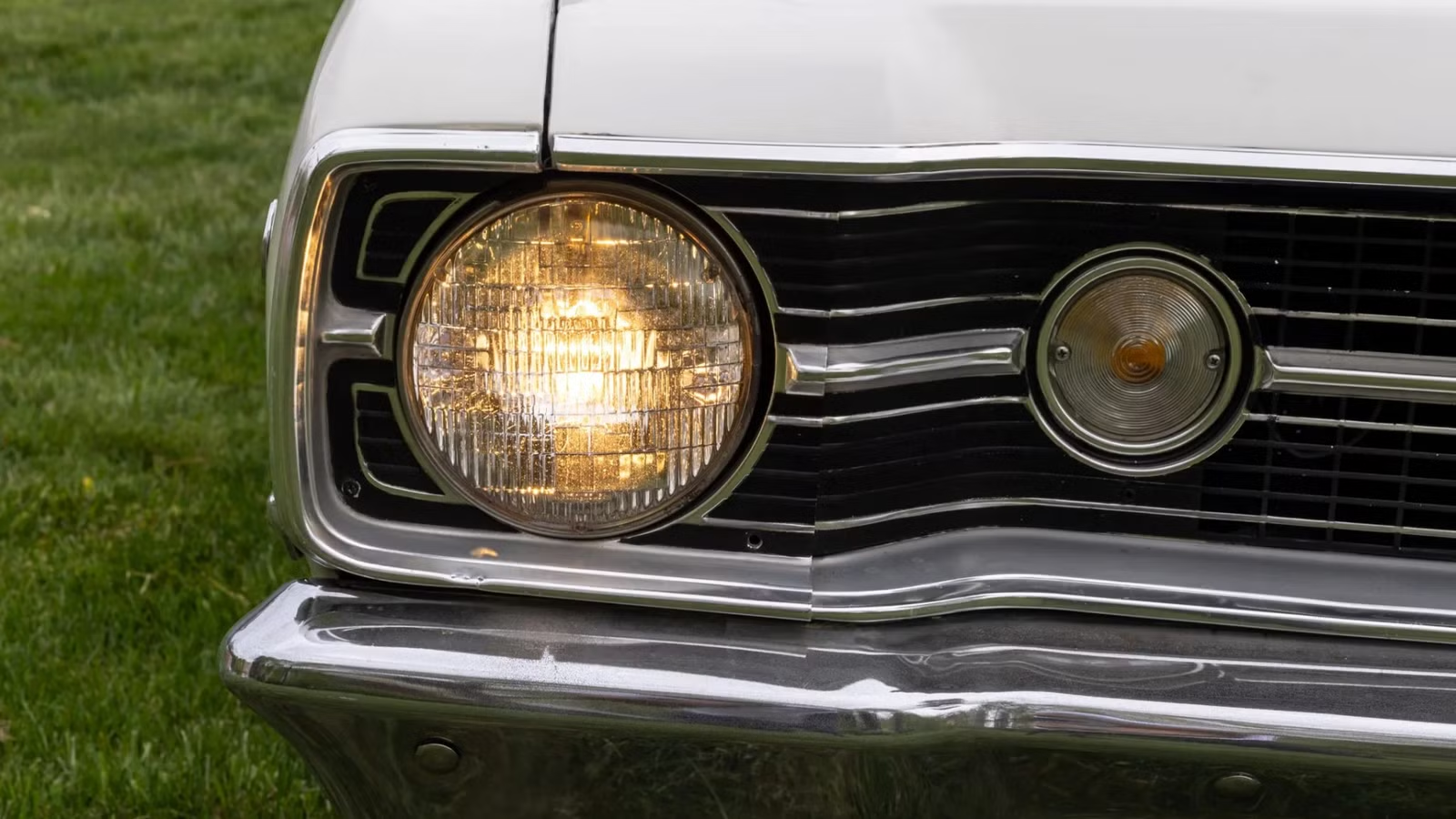
Buying a classic muscle car has always involved a quiet trade. You get the sound, the speed, and the looks, and in return you accept that something expensive will eventually let go. Enthusiasts have treated that fragility as the price of admission for decades.

One Detroit compact never agreed to those terms. It carried a V8 that racked up six-figure mileage in taxi fleets and police duty, then went home and played muscle car on the weekend. It remains cheap to buy, simple to fix, and nearly impossible to kill, and it deserves far more credit than it gets.
Detroit’s Golden Age Had A Secret
The muscle car era produced some of the most exciting engines America has ever built, but excitement was rarely matched by endurance. The headline motors of the late 1960s ran high compression, aggressive cams, and cooling systems that worked hardest on the hottest days. Even Chrysler’s famous Hemi, for all its racing glory, never earned a reputation for being easy to live with.

That gap between performance and dependability shaped how people used these cars. Owners learned to budget for rebuilds, watch their temperature gauges, and treat every long trip as a calculated risk. A weekend warrior could tolerate that arrangement, but anyone who needed a car every single day could not. Most buyers of the period were not drag racers. They needed an engine that started every morning, pulled smoothly under load, and asked for nothing beyond oil changes and basic tune-ups. Detroit built plenty of engines that promised this balance, but very few delivered it over hundreds of thousands of miles.
One engine family quietly did. It proved itself across two decades of production and tens of millions of accumulated miles, hauling taxis through city traffic and serving police fleets without complaint. The same engine also happened to power one of the most likable compacts of the muscle era, and that pairing is where this story begins.
The Dodge Dart 318 Was The Exception That Broke The Rule

The car is the fourth-generation Dodge Dart, built from 1967 to 1976, and the engine is Chrysler’s 5.2-liter LA-series 318 V8. The Dart’s 1967 redesign brought revised steering, a wider front track, and new K-members sized to accept physically larger engines. Those changes turned Dodge’s sensible compact into a proper V8 car.
The LA 318 followed for the 1968 model year as the mid-sized option in Chrysler’s new lightweight small-block family. Thin-wall casting made it roughly 50 pounds lighter than the polyspherical 318 it replaced, with no loss of strength. By 1968, it had also become the base V8 in the sporty Dart GTS.

Early engines were rated at 230 horsepower and 320 lb-ft of torque under the SAE gross system. The switch to net ratings in 1971 restated that as 155 hp and 260 lb-ft, and a compression drop to 8.6:1 brought the figure to 150 hp for 1972. The paperwork changed far more than the engine did.
The best-known home for the 318 was the Dart Swinger. Introduced for 1969 at $2,400, the hardtop came with Rallye suspension, stiffer shocks, a power bulge hood, and dual exhaust. Through the early 1970s, the 318 settled in as the Dart’s mainstay V8, powering everything from Swingers to Custom sedans.
The Engineering That Gave A Dodge Toyota-Grade Durability

The 318’s toughness starts with its materials. Both the block and the cylinder heads are cast iron, and engines built before 1973 used a forged crankshaft backed by unusually robust main bearing caps and thick connecting rods. The cylinder walls are also thicker than small-block norms, which lets the engine absorb wear that would sideline lesser designs.
The supporting systems follow the same overbuilt philosophy. Oil passages run generously throughout the block, and the water jackets are slightly larger than those of comparable small-blocks, so the 318 stays cool and well-lubricated even under sustained hard use. None of this shows up on a spec sheet, but all of it shows up at 150,000 miles.
Just as telling is what the 318 never developed: a signature failure. There was no chronic head gasket problem, no cam-wear epidemic, and no bottom-end weakness that owners learned to dread. Across nearly 25 years of production, the engine simply avoided the generational faults that haunted so many of its contemporaries.
The deeper reason is that the 318 was understressed by design. With a two-barrel carburetor and modest compression, it spent its working life loafing well inside its mechanical limits, which is exactly how an engine earns a bulletproof reputation.

If that formula sounds familiar, it should. Simple architecture, a conservative state of tune, cast-iron construction, and overbuilt cooling and oiling are the same ingredients Toyota used to build its reliability legend a decade later. The 318 followed the identical playbook, just with a V8 soundtrack.
The Dart even proved itself the same way Toyota did, in commercial fleets. Dodge offered a dedicated Dart taxi package for the model’s entire run, complete with heavy-duty brakes, cooling, and suspension, and there is no harsher durability test than a city cab.
Muscle Car Looks Without The Muscle Car Anxiety

The 318 Dart never pretended to be the fastest car in the lineup, and that is precisely its charm. Dodge launched the Dart GTS in late 1967 to fight the Chevrolet Nova SS, and the A-body platform kept the whole car under 3,000 lbs. That low mass means even a two-barrel 318 moves the Dart with genuine enthusiasm.
Chrysler never bothered building a high-performance 318 for the street, because the four-barrel 340 and the big-block options already covered that ground. The happy side effect is that surviving 318 cars tend to be original and unthrashed, having lived gentler lives than their hotter siblings.

The rest of the drivetrain matches the engine’s character. The torsion-bar front suspension is simple and long-lived, and the three-speed TorqueFlite automatic asks for little beyond regular fluid changes, routinely outlasting the sheet metal around it.
The Dart’s modern appeal is easy to sum up: it delivers classic American muscle car style for meaningfully less than the bigger, more famous names command. The 318 versions push that value case the furthest, because they give you the look and the V8 experience without the collector premium that follows the performance badges around the auction circuit.
You Can Still Buy One For Honda Civic Money

Classic.com puts the average sale price of a fourth-generation Dart Swinger at $32,157, but that figure is inflated by 340-powered cars. The 318 versions consistently change hands for less.
Recent dealer sales bear that out. Streetside Classics sold a survivor-grade 1972 Swinger 318 for $28,995 and a 1973 Swinger 318 with air conditioning for $22,995, while ClassicCars.com listings start around $4,000 for projects, with solid drivers available in the teens. Parts support is excellent too, since the LA engine family stayed in production into the 1990s across millions of Chrysler products.
Auction results tell the same story from the other direction. The Darts that cross Bring a Trailer skew heavily toward 340 and 360 cars, which leaves the 318 largely invisible to collectors. For buyers, that invisibility is the entire opportunity: muscle-era looks, a nearly unkillable V8, and an entry price that undercuts a used Honda Civic.
Sources: Stellantis, Hagerty, Classic, Motales, Streetside Classics

Related posts





Latest Post


No Comments