
The Biggest Displacement Ford V8 Engines Ever Produced That Ended Up In WWII Tanks
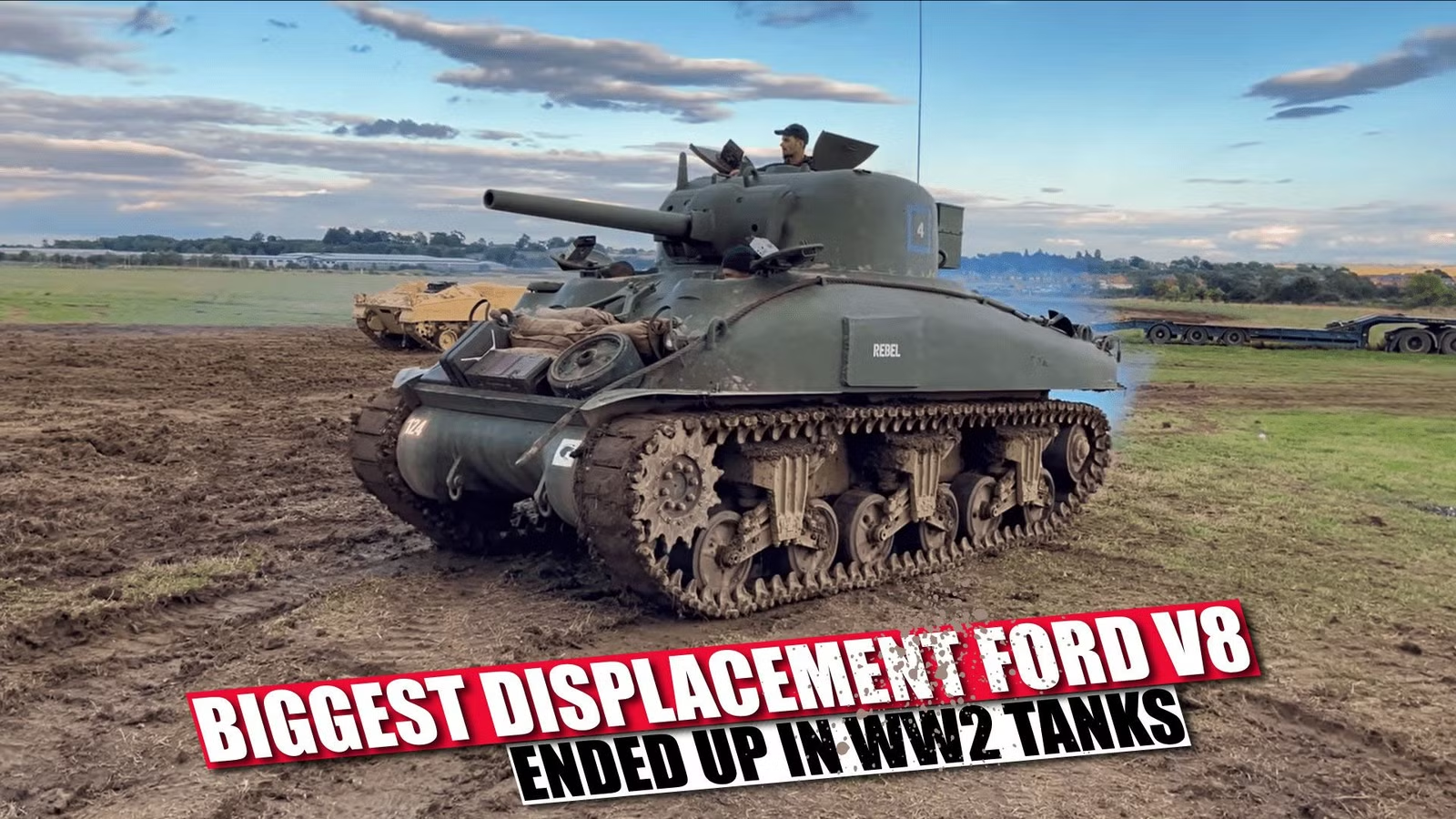
When enthusiasts debate Ford’s greatest V8s, the conversation usually lands on the Coyote, the Voodoo, or the GT40 — but the most extraordinary engine the Blue Oval ever built with eight cylinders never powered a road car. The Ford GAA, an 18-liter behemoth developed during World War II for use in Sherman tanks, remains a staggering piece of engineering that holds up remarkably well against modern benchmarks.

Gearheads will be familiar with the ‘Voodoo’ engine that went into the Ford Shelby Mustang GT350, which shares several design features with the GAA — though the tank engine predates it by decades.
This is one of Ford’s most impressive V8s ever that, unfortunately, never went into a Mustang, as it would have made for the torquiest Mustang ever built. We take a closer look at the design, features, and history of the GAA, as well as its specifications — numbers that would not look out of place in a serious performance or heavy-duty application even today.
The Ford GAA 1,100 CID V8 Was Ford’s Biggest Ever V8
Ford GAA: Basic Specifications
 53 autotech Ford GAA 1,100 CID |
|
|
Engine |
18-liter, NA V8 |
|
Power |
500 hp |
|
Torque |
1,050 lb-ft |
|
Block design |
All-aluminum |
|
Block angle |
60 degree |
|
Valvetrain |
4 valves per cylinder, geared timing, DOHC |
|
Example implementation |
Sherman M4 tank |
Data courtesy of Engine Labs
Ford’s GAA was an 18-liter V8 with a 60-degree bank angle. It featured dual overhead cams, four valves per cylinder, an aluminum block and heads, and a flat-plane crank — details that make it look thoroughly modern even by 21st-century standards, despite being produced in the 1940s. It was innovative for other reasons too: the absence of a cambelt or chain also makes the GAA particularly curious. Rather than a belt or chain, the crankshaft and camshafts were kept in sync via a gear-driven system, eliminating the risk of belt or chain breakage in the field.
The engine produced enormous torque — 1,050 lb-ft — which is where it came into its own as a powerplant for military applications such as the Sherman series of tanks, which required a strong motor to move their considerable mass.
According to Engine Labs, the engine can deliver 90% of its torque from just 1,000 rpm. Weighing in at well over 1,000 lbs, this was never an engine destined for a passenger car. In fact, it is largely rooted in an aviation engine: the Rolls-Royce Merlin.
The Merlin was a V12 produced by Rolls-Royce and used in various fighters and bombers, including the Spitfire, Hurricane, and Lancaster, among others. Its popularity and effectiveness made the Merlin the benchmark for Ford’s own V12 engine program, which would ultimately evolve into the GAA — albeit in a form that was substantially different from its inspiration.
The Ford GAA Was A Scaled-Back Rolls-Royce Merlin Engine At Heart
There are differing versions of the story of how the GAA came to be. Essentially, Ford decided to develop its own V12 aviation engine to capitalize on the growing demand for aircraft powerplants. The famous and successful Rolls-Royce Merlin V12 served as the benchmark, and Ford’s prototype shared a great deal of the Merlin’s architecture.
Interestingly, the project took an unexpected turn. The V12 engine was turned down by the Navy, but in a stroke of luck, the Army needed tank engines — V8s, to be exact.
To protect the investments already poured into the V12 prototype and the tooling that had already been purchased, engineers removed four cylinders from the 12-cylinder engine to produce a V8. The resulting GAA is an eight-cylinder, 18-liter engine.
Ford’s GAA wasn’t the only engine to go into Sherman tanks, nor was it a perfect design. But it served its purpose well, taking up less space than the tall and wide radial engines also still in use, while some other Sherman variants ran diesel powerplants.
What made the GAA a great engine was its relatively compact size, strong output, and battlefield reliability — it could even be repaired in the field in some cases. Today, it remains impressive for its forward-thinking features: four-valve, DOHC architecture, an alloy block and heads, and a flat-plane crank — the same configuration found in the Shelby GT350’s Voodoo V8 and the C8 Chevrolet Corvette Z06’s LT6 V8.
The Ford GAA Was A Scaled-Back Rolls-Royce Merlin Engine At Heart
- Directly inspired by the Merlin, the Ford V12 prototype was designed with aviation in mind
- Due to the Navy’s reliance on radial engines and other contractual limitations, the V12 was surplus to demand
- The Army’s tank corps had a requirement for V8 engines to power tanks and came to Ford
- Ford’s GAA was born – reducing the V12 to a V8 by removing 33% of the cylinders and carrying over the design
- It featured in some variants of the M4 Sherman tank such as the M4A3
A Brief Look At The Sherman M4 Tank

The Sherman was the most widely used American tank of WWII, produced in approximately 50,000 examples. Notably, it saw service not just with the US military but also with Britain, France, Russia, and other Allied nations.
Built from around 1942 and seeing active service from 1943, the Sherman proved reliable and effective thanks to its speed, maneuverability, and adaptability to various roles and environments. It was also relatively straightforward to repair in the field.
Unfortunately for the Sherman, it wasn’t the dominant force on the battlefield — stronger, better-armored tanks would eventually outclass it, such as the Tiger and Panther — but its overall qualities made it a vital asset throughout the war. Various models ran a wide variety of engines, including the GAA, radial engines, and a GM diesel unit. Thanks to the Ford GAA, the Sherman got the V8 it needed, and Ford found a productive use for its Merlin-inspired V12 prototype — channeling it into the most remarkable V8 the company has ever produced.
US Army Sherman M4 Tank: Basic Specifications
|
Sherman M4A3 |
|
|
Engine |
18-liter, NA V8 (Ford GAA) |
|
Power/Torque |
500 hp / 1,050 lb-ft |
|
Weight |
68,000 lbs |
|
Top Speed |
26 mph |
|
Crew |
5 |
|
Main armament |
75 mm main gun |
Data courtesy of National WWII Museum
Sources: Engine Labs, War History Online, National WWII Museum

Related posts



Latest Post


No Comments