
The Practical Sedan That Secretly Ruled The Streets
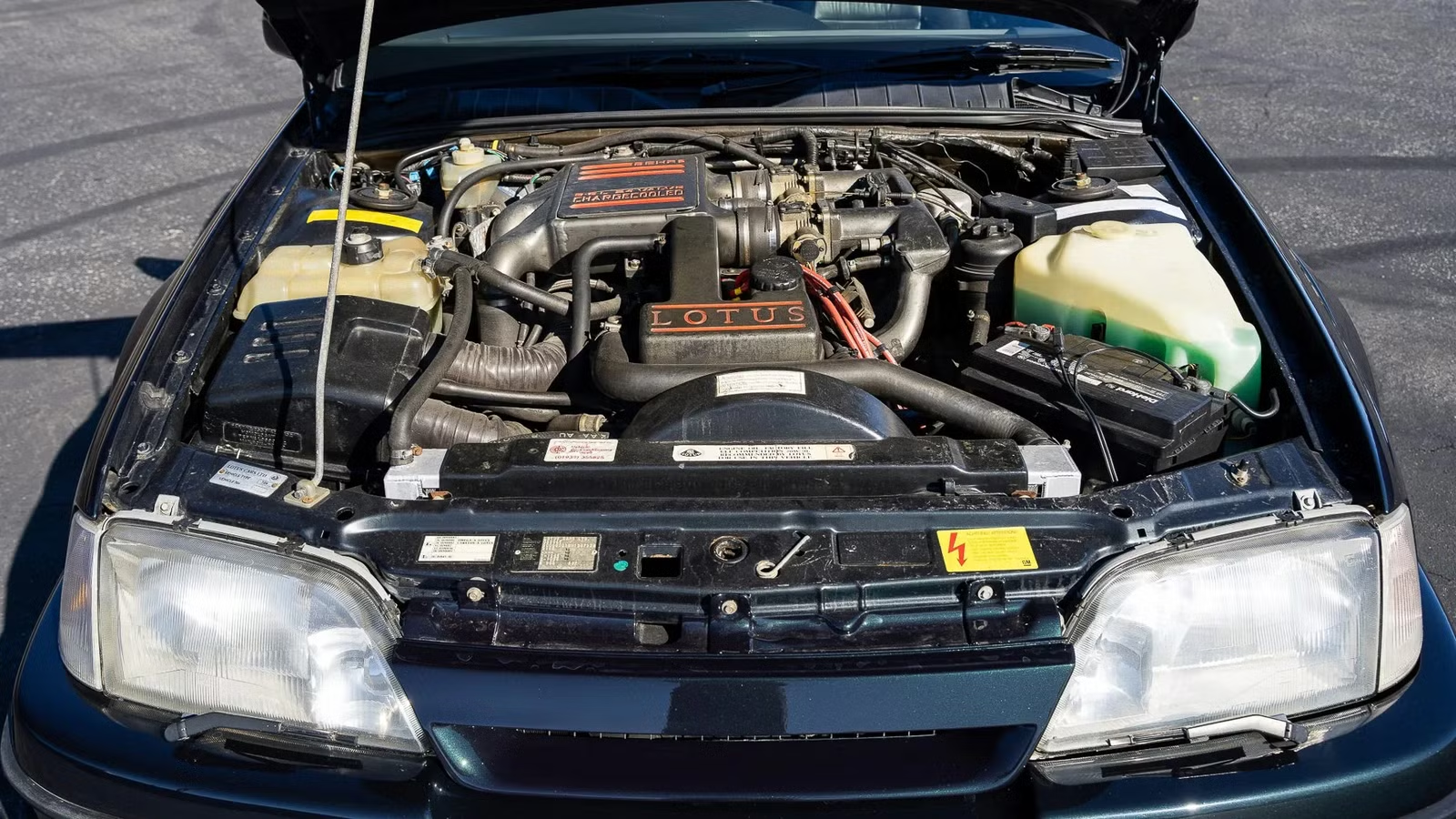
On November 16, 1990, the British House of Commons held a debate about a car. Not about fuel economy. Not about emissions. About a specific four-door family saloon that members argued should be removed from public sale entirely. The car’s advertising had already been condemned on the floor of the chamber. The Association of Chief Police Officers had gone on record calling for it to be banned. The Daily Mail was running it as a national safety crisis. And all of this was happening because Vauxhall, a brand whose vehicles had spent decades ferrying company reps to regional meetings, had done something that nobody in the establishment had prepared for. It had asked Lotus to build a car with no instruction to be sensible, and Lotus had obliged.
When Family Cars Knew Their Place

The early 1990s performance car hierarchy was clearly defined and largely unchallenged. At the top sat the supercar, Italian or German, mid-engined where possible, two seats, no luggage space, and a price that separated its owners from the rest of the world by a visible margin. Below that sat the performance sedan, represented most credibly by the BMW M5, a machine that delivered genuine driver engagement in a four-door body without embarrassing itself against properly fast machinery. Below that was everything else, which included the full range of executive sedans produced by mainstream European manufacturers. Those cars existed to be comfortable, reliable, and quietly prestigious. They were not supposed to be fast.
The assumption was held because it had always held. A family car came with certain expectations baked in: four doors, a trunk, seating for five, and performance tuned for relaxed motorway cruising rather than anything that might make a police officer reach for their radio. Manufacturers who built those cars understood the brief and delivered it faithfully. The BMW M5 was an exception that the market had made room for because BMW had the performance credibility to justify it. No mainstream British brand had any such credibility, and none were attempting to build one. The segment seemed stable.

America’s First Turbocharged AWD Car Nobody Remembers Anymore
Long before the WRX and Evo hit American streets, there was already a turbocharged AWD car — but chances are, you’ve completely forgotten about it.
What Happens When A Sports Car Company Rebuilds A Family Sedan

The idea, when it was first floated internally, would have struck most sensible people as a waste of everyone’s time. Take a family saloon. Not a sports car platform. Not a performance coupe. A proper four-door executive sedan that company representatives drove to regional meetings and middle managers specified on their lease agreements. Hand it to a specialist performance firm. Tell them there is no ceiling on what the finished car should be capable of. Watch what happens.
What happens is that the performance firm takes the brief seriously. Very seriously. The shell stays. Everything else is a question. The engine goes. The transmission goes. The suspension, the brakes, the internals, all of it is reconsidered from the perspective of engineers who normally build racing cars for a living and who have not been given any reason to hold back. When the finished product eventually emerges wearing the same unremarkable body it started with, the performance figures it carries are so far outside what anybody expects from a family sedan that the announcement triggers a response nobody in the marketing department had prepared for.
The Vauxhall Lotus Carlton: Faster Than A Ferrari With Room For The Shops

|
Model |
Engine |
Power |
Torque |
0-60 mph |
Top Speed |
|---|---|---|---|---|---|
|
Vauxhall Lotus Carlton (1990-92) |
3.6-liter twin-turbo straight-6 |
377 hp |
419 lb-ft |
5.1 sec |
176 mph |
|
BMW M5 E34 (1989-92) |
3.5-liter straight-6 |
311 hp |
266 lb-ft |
6.1 sec |
155 mph* |
|
Ferrari Testarossa (1984-91) |
4.9-liter flat-12 |
385 hp |
361 lb-ft |
5.1 sec |
181 mph |
|
Mercedes-Benz 500E (1991-93) |
5.0-liter V8 |
322 hp |
354 lb-ft |
5.9 sec |
155 mph* |
The car was the Vauxhall Lotus Carlton, also sold in continental Europe as the Opel Lotus Omega. It went on sale in 1990 and was produced until December 1992, with just 950 units completed in total: 320 right-hand-drive Carltons and 630 left-hand-drive Omegas. In the United Kingdom, just 286 Carltons were sold. Put that number in context. Ford shifted more Sierras in a slow afternoon. The Lotus Carlton’s specifications were, given the body they came in, entirely unreasonable.
The performance table shows exactly why the controversy was inevitable. The Lotus Carlton outgunned the BMW M5 by 66 horsepower, turned a 0-60 time that matched a Ferrari Testarossa, and hit a top speed that no police pursuit vehicle in Britain could approach. The M5 and the Mercedes 500E were both electronically limited to 155 miles per hour because their manufacturers had quietly agreed that putting unrestricted cars on public roads was a problem they did not need. Vauxhall and Lotus made no such calculation. The Carlton’s 176-mile-per-hour top speed was not a number in a brochure. It was a verified, tested, real-world figure, delivered by a car that could also seat five adults, carry a week’s worth of groceries, and disappear from a standing start before the driver next to it had finished processing what it was.
The Engine And Drivetrain Lotus Built From Scratch

Lotus began with GM’s 3.0-liter 24-valve straight-six from the standard Carlton GSi and rebuilt it into something unrecognizable. Displacement was bored out to 3,615 cc, two Garrett T25 turbochargers were added with water-to-air intercooling, the distributor ignition was replaced with a three-coil wasted spark system, and the internal components were rebuilt entirely to handle the resulting outputs. The finished engine, designated C36GET, produced 377 horsepower at 5,200 rpm and 419 lb-ft of torque at 4,200 rpm. Three hundred and fifty lb-ft of that torque figure was available from 2,000 rpm, which meant the delivery was not something that waited for high revs. It arrived early, it arrived hard, and it kept coming.
The transmission was a ZF six-speed manual, the only unit available that could handle the torque the engine produced. Power went to the rear wheels through a limited-slip differential sourced from the Holden Commodore. Each engine was hand-built by a dedicated Lotus technician at Hethel, with the completed unit stamped with the builder’s identification. The suspension used uprated components throughout, with the front setup revised to handle the additional power and weight, and the rear geometry retuned to manage the torque delivery under hard acceleration. AP Racing four-piston brake calipers gave the car stopping power to match the engine, which, given that it could reach 100 miles per hour from rest in 11.1 seconds, was not a minor consideration.
Why The Government Tried To Ban It And Why That Made It Famous

The parliamentary session of November 16, 1990, was not the first sign that the Lotus Carlton had a public relations problem. The car had been on sale for less than a year when the Association of Chief Police Officers formally called for it to be banned or restricted from UK roads. Their argument was practical: no patrol vehicle could follow it, and at 176 miles per hour, the gap was not a marginal one. Member of Parliament Alex Carlile told the Commons that the car “should not be available for public purchase,” and fellow MP Joan Ruddock added that it was “questionable whether anyone can drive well at 170 mph.” The Daily Mail ran the campaign hard. The car’s own advertising was condemned on the floor of the chamber.
Then the thieves got involved. A Carlton registered “40 RA” was stolen on November 26, 1993, and put to work as the getaway vehicle in a series of UK ram raids, netting the crew approximately £20,000 worth of cigarettes and alcohol across multiple jobs. Police pursuit was not attempted. The Carlton’s top speed was nearly double what any patrol car could manage, and that was not a driver-skill problem. It was a physics problem that nobody in British law enforcement had a solution to. The car was never recovered. It is still out there somewhere. The ban campaign ultimately failed, no legislation was passed, and the Lotus Carlton continued being sold at Vauxhall dealerships to anyone who could write a check. The establishment had aimed squarely at it, and missed. In doing so, they handed the car a reputation that no marketing budget could have bought.
What A Lotus Carlton Costs Today

|
Model |
Fair |
Good |
Excellent |
Concours |
|---|---|---|---|---|
|
Vauxhall Lotus Carlton (1990-92) |
~$36,950 |
~$67,696 |
~$90,000 |
$111,524 |
The auction record for the Lotus Carlton, tracked in USD across all global sales, tells a clear story. The lowest recorded sale sits at $36,950 for a high-mileage driver-quality car, the average across all sales is $67,696, and the high-water mark is $111,524 for a clean 1991 example sold at Historics in November 2023. Values have tracked steadily upward as the pool of clean survivors shrinks. The car passed the 25-year NHTSA import threshold in 2017, making it an attractive US import prospect for buyers prepared to source from the UK market, where the majority of the 286 right-hand-drive Carltons remain.
What drives value is a combination of factors specific to this car. With just 286 UK Carltons ever sold, and four decades of British roads reducing that number further, a documented, numbers-correct example with service history commands a premium that grows as the field narrows. The Opel Lotus Omega is more common at 630 units but carries less of the cultural weight. Right-hand-drive Carltons, particularly those with matching engine numbers and original paint in period colors like Imperial Green Metallic, are the variants serious collectors are tracking. For the U.S. buyers, the added complexity of right-hand-drive import is the trade-off for owning the variant with the stronger provenance.
Why The Lotus Carlton Still Matters

The Lotus Carlton is the purest expression of what a sleeper car can be. It was not designed to look fast. It was not designed to attract attention. It was designed, within the constraints of a standard executive sedan body, to be as fast as Lotus could make it, and the result was a car that matched Ferrari performance figures while carrying the groceries and triggered a parliamentary debate in the same fortnight. Nobody planned that story. It is what happens when an engineering team is handed genuine freedom and treats the question seriously.
The car’s legacy is cleaner in retrospect than it was at the time. In 1990, it was controversial, politically awkward, and commercially unsuccessful enough that production ended early due to recession-era demand weakness. Today, it is understood as the car that proved a mainstream family sedan could deliver supercar performance before the term “super sedan” had been properly invented, before the BMW M5 had reached its current cultural status, and before the performance saloon segment had been normalized by decades of AMG and M division marketing. Vauxhall and Lotus built the Lotus Carlton once, in 950 units, at a moment when nobody thought they could. That is enough.
Sources: Car Throttle, Classic.com, Bring a Trailer, Jay Leno’s Garage on YouTube.

Related posts




Latest Post


No Comments