
Hennessey Blackbird Hypercar: NA V8, Manual, No Screens
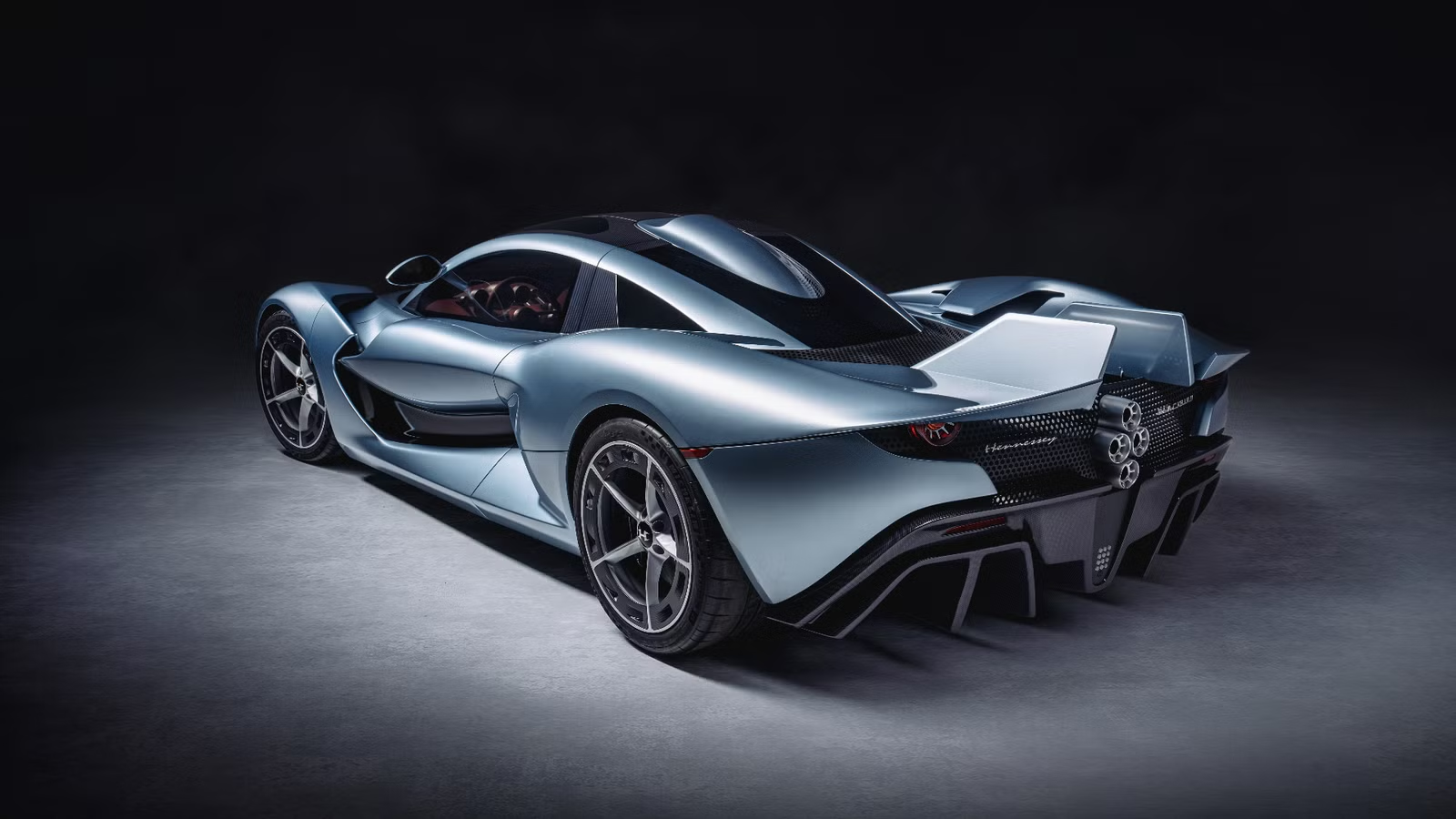
Hennessey just pulled the wraps off the Blackbird, its third hypercar — and nothing about it looks like what you’d expect from the company that built the 2,031-hp Venom F5. Revealed today ahead of a public debut at The Quail during Monterey Car Week on August 14, the Blackbird is naturally aspirated, manual-only, screen-free, and deliberately analog. It’s a philosophical 180 from everything Hennessey built its reputation on.

Limited to 71 examples at $2.5 million each, with more than two-thirds already spoken for, the Blackbird is powered by a 6.2-liter naturally aspirated V8 co-developed with Ilmor Engineering, targeting 800–850 hp and a redline north of 9,000 rpm. It drives only the rear wheels through a genuine six-speed gated manual — no turbos, no hybrid assist, no electric motors. Hennessey calls it a “touring hypercar.” Gearheads should call it exactly what it is: America’s answer to the Carrera GT.
A 9,000-RPM V8 With No Shortcuts
The engine alone makes a statement. The Ilmor-developed 6.2-liter naturally aspirated V8 is an all-new unit — no relation to the Venom F5’s twin-turbo 6.6-liter — and Hennessey is claiming it will be the most powerful and highest-revving naturally aspirated road-car V8 ever built, besting the 670 hp 5.5-liter flat-plane V8 in the Corvette Z06. Final output is confirmed in the 800–850 hp range, with a top speed target of 220 mph and a 0–60 mph run of 2.5 seconds.

A bespoke full-carbon tub and carbon-fiber bodywork keep the target curb weight below 3,000 pounds. Michelin Pilot Sport Cup 2 tires are standard, with adaptive suspension, ABS, and traction control rounding out the chassis package. That’s it for driver aids — no torque vectoring, no launch control algorithms, no electronic nannies beyond the basics. The gated shifter’s exposed linkage is visible from the cabin, a deliberate design choice that puts the mechanical act of rowing gears front and center.
The SR-71 Reference Is More Than A Name

Hennessey trademarked the SR-71 name for automotive use, and the references run far deeper than a badge. The body-side chine line — the crisp crease that runs along the flanks — is lifted directly from the spy plane’s distinctive fuselage junction. The active vertical rear stabilizers deploy automatically at 71 mph and rest at ±71 degrees, both numbers a deliberate nod to the aircraft’s designation. The quad-exit exhaust is arranged in a diamond pattern drawn from the Bell X-1 rocket plane that Chuck Yeager flew to Mach 1 in 1947. Formula 1-inspired side pods, LMP1-influenced winglets, and high-mounted mirrors that echo classic Le Mans racers complete a design language that earns its references.
Inside, the cockpit philosophy is just as considered. There is no infotainment screen, no digital instrument cluster, no steering-wheel buttons. A large central analog tachometer anchors the dash — the correct focal point for a high-revving, naturally aspirated car with a gated shifter. A physical ignition key starts the engine. A dash-mounted whiskey compass — an SR-71 cockpit reference — is standard equipment. Smartphone connectivity exists through a bespoke Hennessey holster, keeping CarPlay and Android Auto available without a screen dominating the cabin.
Why Hennessey Chose Less Power, Not More
Hennessey Director of Design Nathan Malinick was direct about why the obvious follow-up to the F5 — “3,000-plus horsepower and 400 miles an hour” — was rejected early. That path, he explained, “would sort of make the F5 irrelevant and do a disservice to our customers.” Buyers who already own an F5 needed a reason for both cars to make sense in the same garage. The Blackbird provides it by being a fundamentally different machine: a driver’s car built for engagement at any speed, not a record-chaser built for one specific number.
The Blackbird is engineered to cover 800 miles in a day without crushing the driver. Gullwing doors open into a cabin with more space than the Venom F5, four cup holders, adaptive suspension tuned for long-haul comfort, and a frunk sized for two full carry-on bags. Rear-quarter storage pods handle additional luggage. Production is set to begin in 2029–2030, after the Venom F5’s 99-car run wraps up around 2028. With more than two-thirds of 71 allocations already reserved ahead of the Quail debut, the market has already answered the question of whether analog hypercar buyers still exist. They do — and they’re writing $2.5 million checks to prove it.
John Hennessey put it plainly at the reveal: “This is not a numbers car.” For a builder who spent decades chasing 300 mph, that sentence lands like a gear change. The Blackbird won’t be in customer hands until 2029 at the earliest, and plenty could still shift between now and then — but the direction is set. Hennessey is building the car that driver-focused enthusiasts have been asking for, and it’s got the mechanical credentials to back the claim up. Let’s hope it delivers every last one of those 9,000 rpm.

Related posts



Latest Post


No Comments