
The $2.5M Hennessey Blackbird Has No Screens, No Hybrid, No Apologies
Hennessey has revealed the Blackbird, its third hypercar and arguably its most unexpected one. Announced on August 3, 2026, ahead of a public debut at The Quail on August 14, the Blackbird is a naturally aspirated, six-speed manual, screen-free touring machine — a deliberate rejection of the electrification and digital complexity that now defines most of its competitors.

Limited to 71 examples worldwide and priced from $2.5 million before taxes, the Blackbird is already more than two-thirds allocated before most people have seen it in person. Designed and built in Texas, it targets customer production from 2029 to 2030 and represents, in Hennessey’s own framing, not just the next chapter in the company’s story — but the start of a new book entirely.
An Ilmor-Developed V8 Built for Sound and Feel, Not Just Numbers
Power comes from an all-new 6.2-liter naturally aspirated V8 developed in partnership with Ilmor Engineering. Hennessey is targeting 800–850 hp and a redline north of 9,000 rpm — figures the company believes will make it the highest-revving and most powerful naturally aspirated road-car V8 when it reaches production. Performance targets sit at 0–60 mph in 2.5 seconds and a top speed of 220 mph.

But the spec sheet is almost beside the point. There are no turbochargers, no hybrid assist, and no artificial throttle-response layers. The engine is designed to deliver linear, immediate power directly to the rear wheels through a six-speed gated manual — the only drivetrain configuration offered. A bespoke full-carbon tub, carbon-fiber bodywork, and a target weight below 3,000 lbs give the chassis the credibility to match. Michelin Pilot Sport Cup 2 tires are standard.
The SR-71 Blackbird Shaped Everything — Including the Numbers

The Lockheed SR-71 Blackbird is more than a naming reference. It shaped the car’s long stance, crisp body-side chine line, and most distinctively, its active vertical rear stabilizers — which deploy automatically at 71 mph and rest at ±71 degrees, a nod to the aircraft’s designation. The chine line echoes the SR-71’s tightly pinched upper-to-lower surface junction, giving the bodywork tension without excess.
A second aerospace reference runs through the exhaust: the diamond-shaped quad-exit design is drawn directly from the Bell X-1, the aircraft Chuck Yeager flew to Mach 1.06 on October 14, 1947. Formula One-style side pods and LMP1-inspired winglets round out a design language that earns its references rather than borrowing them for marketing purposes. An optional Sky Glass roof panel — asymmetrically tapered, inspired by the SR-71’s canopy — is available for buyers who want more light in the cabin on long runs.
A Cockpit Built Around the Tachometer, Not a Touchscreen

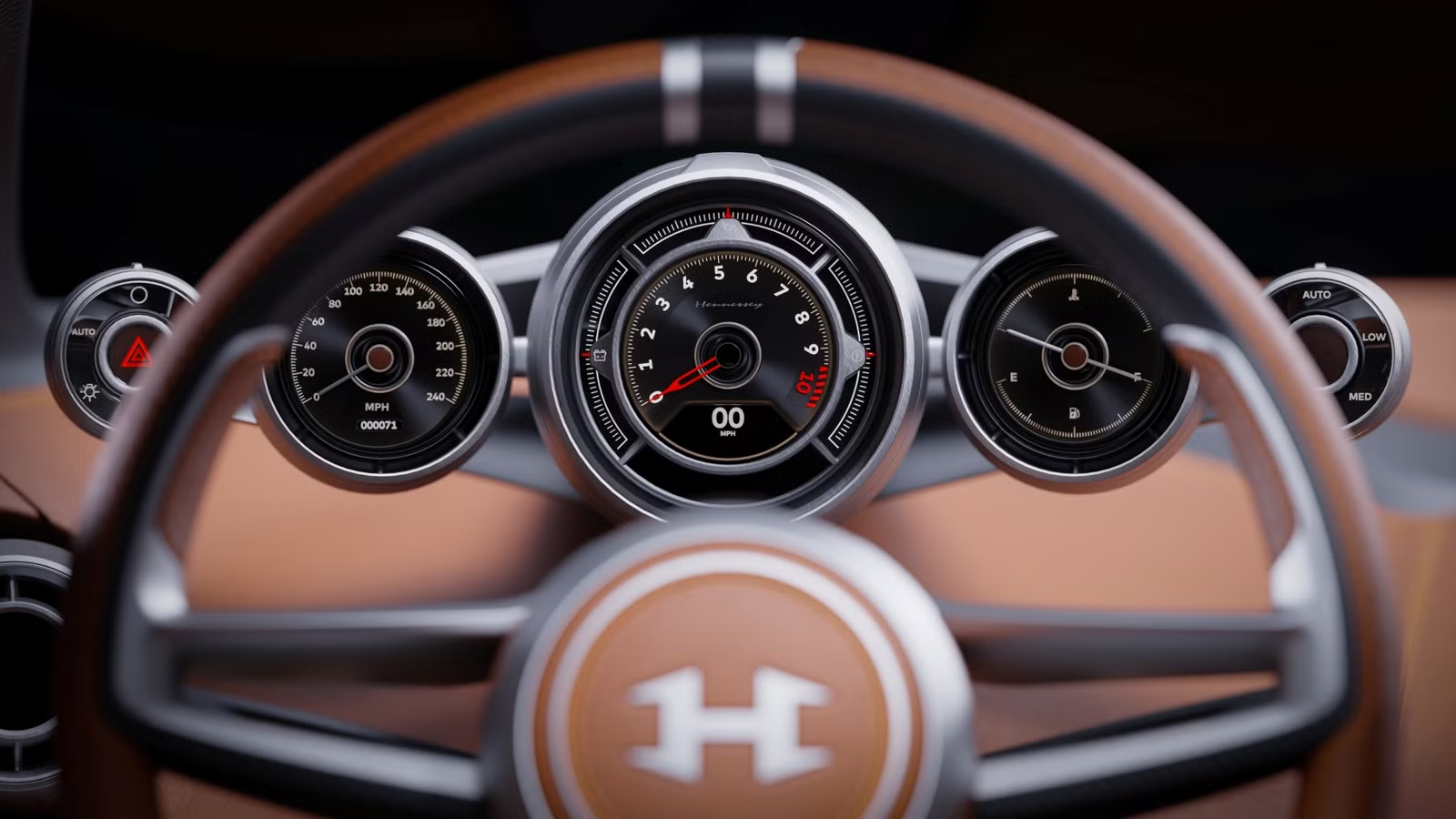
Inside, the Blackbird’s philosophy is immediately legible. There is no infotainment screen, no digital instrument cluster, and no steering-wheel buttons. A large central analog tachometer anchors the dashboard — the right focal point for a high-revving, naturally aspirated car with a gated shifter. A physical ignition key starts the engine. A dash-mounted whiskey compass is standard equipment.
Connectivity is handled through what Hennessey calls a hidden-technology strategy: Apple CarPlay and Android Auto run through the driver’s own device, held in a bespoke Hennessey holster, while premium speakers handle audio. Navigation and communication remain available without a screen dominating the cabin. The goal, as the company frames it, is a car that feels timeless in fifty years — not one that ages with its software.
Built to Cover 800 Miles, Not Just Set Lap Records
The Blackbird is engineered as a touring hypercar first. Gullwing doors open into a cabin with more space than the Venom F5, adaptive suspension tuned for long days on varied roads, low NVH targets, and four cup holders. Storage runs to two full-size carry-on bags in the front trunk, rear-quarter luggage pods, and additional in-cabin stowage — practical details that most hypercars treat as afterthoughts.
John Hennessey, company founder and CEO, put the mission plainly: “This is not a numbers car. We set out to create an unparalleled emotional experience, from the first time you see it to the moment you take the wheel and feel the connection between driver and machine.” With Venom F5 production expected to wind down around 2028, the Blackbird becomes Hennessey’s flagship driver’s car — carrying forward the manual philosophy of the F5-M into something built for the road rather than the record books.

Related posts


Latest Post


No Comments